


Welcome to the Free edition of How They Make Money.
Over 300,000 subscribers turn to us for business and investment insights
In case you missed it:
⚽️ The biggest World Cup ever is here!
Hosted by Canada, Mexico, and the US, the competition kicked off Thursday. It’s the first one expanded to 48 teams. FIFA president Gianni Infantino calls it "104 Super Bowls in a month" (it's actually 39 days, but who's counting).
This year's teams will share a record $871 million in prize money, while some fans pay as much as $33,000 for a single seat.
Across this World Cup cycle, FIFA expects to take in roughly $13 billion. As a non-profit, most of that money is supposed to flow back into football: staging tournaments, funding member federations, and running the global game.
Today at a glance:
💰 The Four-Year Heartbeat
🌍 Where The Money Goes
🎟️ Pricing the People's Game

💰 The Four-Year Heartbeat
Because FIFA’s business revolves around the World Cup, held once every four years, the organization uses a four-year budget cycle.
The visual below shows the latest budget for the 2023-2026 cycle.
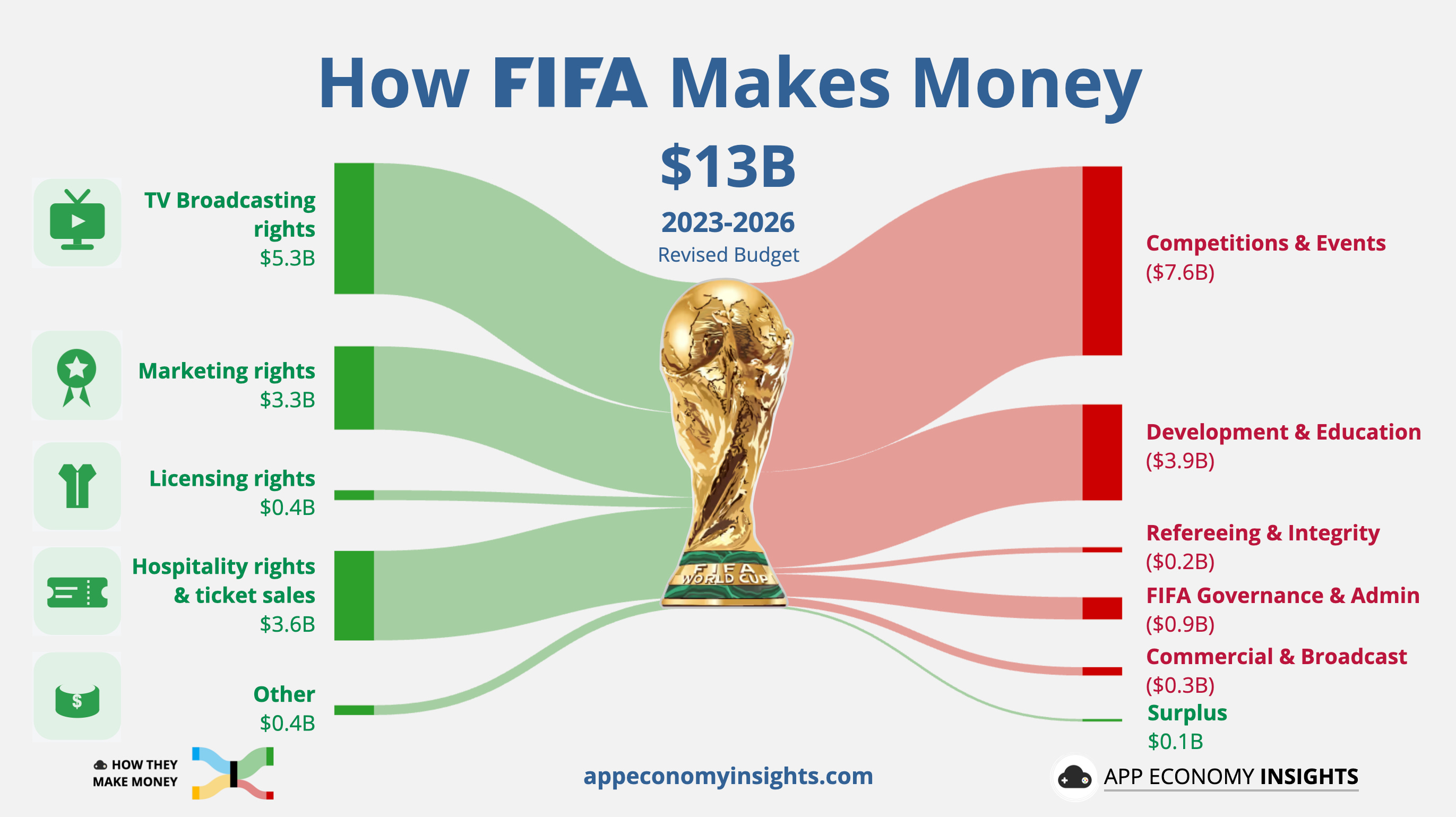
FIFA expects to earn $13 billion in this cycle, up 72% from $7.6 billion for the 2019-2022 Qatar cycle. That’s a big upside from the $11 billion it had previously budgeted.
The jump came from three places:
The field expanded to 48 teams (more inventory to sell).
The tournament landed in the US (the richest media market on earth).
FIFA bolted on a second large event in the US, the revamped Club World Cup.
Here’s where the revenue comes from:
📺 TV Broadcasting ($5.3 billion, ~40%): FIFA’s largest stream by far. It sells the right to air the matches to networks region by region, and the bidding runs hot because few events deliver a global audience watching live, all at the same time.
🎟️ Hospitality & Ticketing ($3.6 billion, ~28%): Match tickets plus premium corporate packages, run through a FIFA-owned subsidiary so every dollar flows straight back to headquarters. 2026 is the first World Cup with dynamic, demand-based pricing, which sent the top end soaring (more on this in a minute).
🤝 Marketing & Sponsorship ($3.3 billion, ~25%): The deals brands like Coca-Cola, Visa, and Adidas pay to attach their name to the tournament, sold in tiers from global partners down to regional supporters. Sponsors spend several times more on advertising, though that money goes to agencies and broadcasters, not FIFA.
🏷️ Licensing ($0.4 billion, ~3%): FIFA-branded merchandise, video games, and royalties on the FIFA name. Tiny next to the rest, and almost a rounding error.
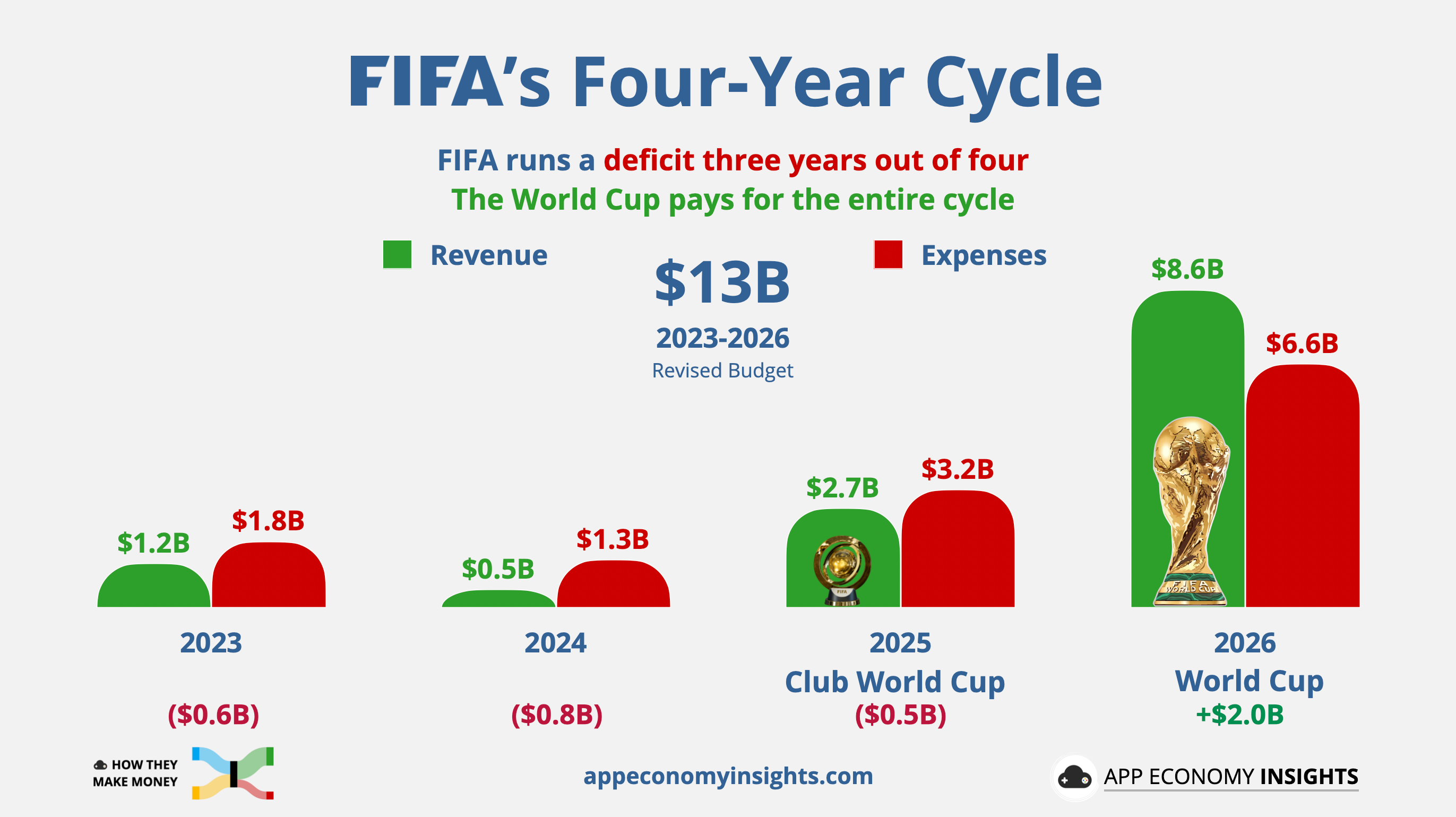
FIFA runs a deficit three years running, then the World Cup arrives and pays for everything — nearly $9 billion in a single year. The Club World Cup debut in 2025 also created a revenue boost. The lumpiness is the design, with a budget built with that timeframe in mind.
Takeaway: For a non-profit, near-breakeven is the whole point. The cycle is engineered to look like FIFA reinvests almost everything. Which raises the real question: where does the money actually go?
2. 🌍 Where the Money Goes
Almost none of that $13 billion stays with FIFA, and that is the entire point.
The 2026 World Cup is unusually asset-light for FIFA. Every match will be played in an existing stadium, many of them NFL venues. Unlike Qatar’s reported $200 billion buildout, the tournament does not require a countrywide stadium construction boom. More of the revenue can flow back into football.
Here’s where it goes:
🏟️ Competitions & Events ($7.6 billion, ~58%): The largest line by far. This is the cost of staging the tournaments themselves: running the World Cup and FIFA’s other events, including the prize money paid to teams.
🌱 Development & Education ($3.9 billion, ~30%): The money FIFA puts back into the game. Through its FIFA Forward programme ($2.25 billion of it), FIFA funds all 211 member federations: pitches, youth programs, and grants in places the commercial market overlooks.
🏛️ Governance & Admin ($0.9 billion, ~7%): FIFA’s own running costs. Salaries, governance bodies, and the day-to-day expenses of operating the organization itself. That includes the compensation package of roughly $6 million annually for FIFA President Gianni Infantino.
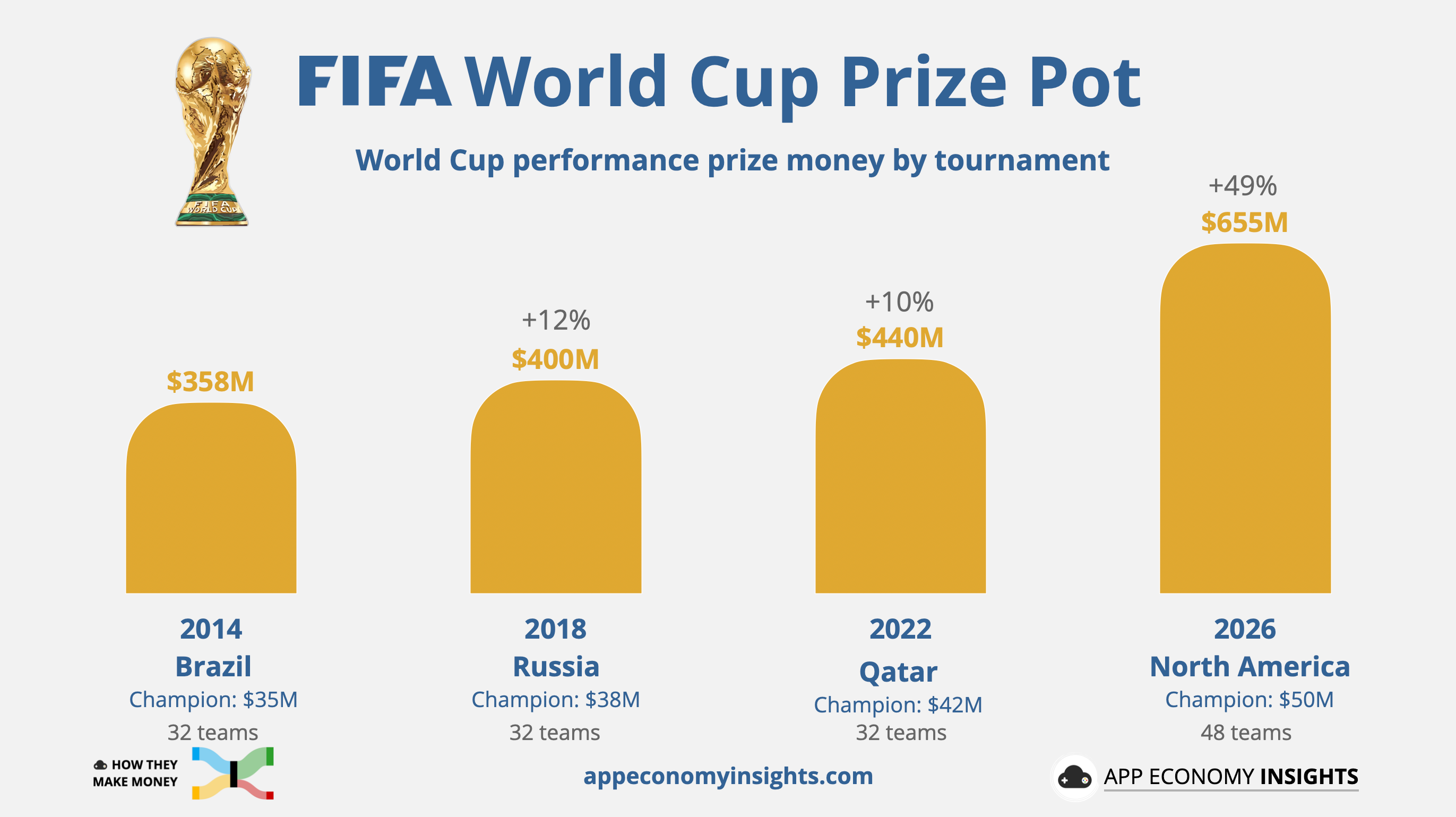
The World Cup Prize money pool is $871 million for 2026, including $655 million allocated to performance, a 49% increase over Qatar, with the champion taking home $50 million and even the first team eliminated leaving with over $10 million. The expansion of the competition from 32 to 48 teams was the main reason behind the increase.
Every member federation that receives a check also has a vote for the FIFA president. Infantino won in 2016 partly by promising to more than double those grants. He runs for a fourth term in 2027. Critics see a patronage machine. FIFA calls it growing the game.
In 2015, US prosecutors charged dozens of officials and sports-marketing executives over more than $200 million in bribes, almost all of it paid for the media and marketing rights to FIFA's tournaments. That history matters because media and marketing rights are still FIFA’s two largest revenue engines. The same machine that funds football also asks the world to take its redistribution on trust.
The books are built to break even on paper. But when revenue routinely beats budget, the surplus compounds into a reserve now approaching $2.7 billion.
Takeaway: FIFA runs a redistribution machine mixing sports and politics. The same dollars that grow the game secure the votes that keep the machine and its president in place. No rival governing body has built a flywheel this durable.
3. 🎟️ Pricing the People's Game
A real-time auction for seats
For the first time, the tournament uses dynamic pricing, ticket prices that float with demand, like airline fares. The contrast with the last US-hosted World Cup is brutal.
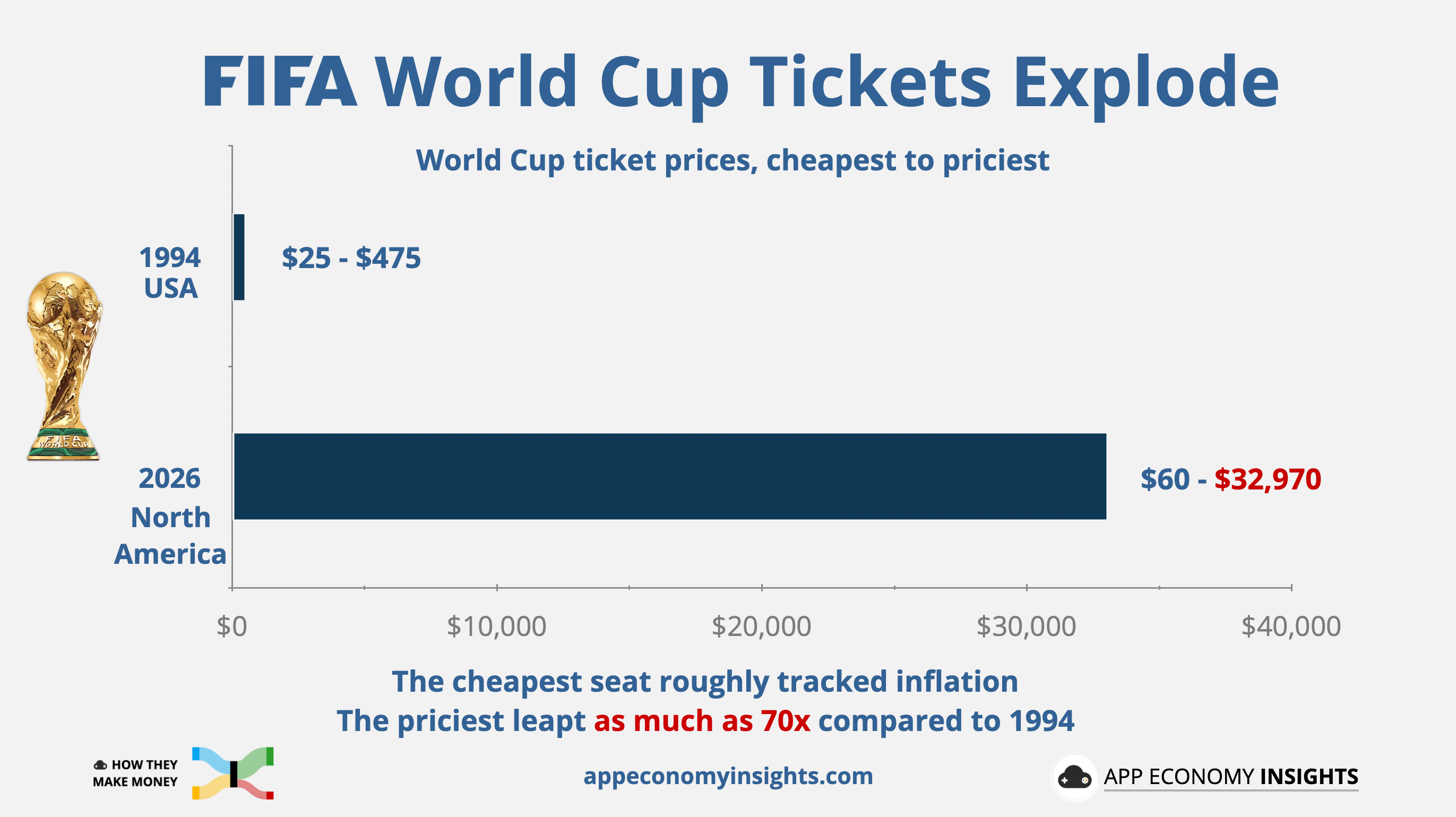
In 1994, a World Cup ticket ran $25 to $475. In 2026, the floor is $60, roughly in line with inflation. But the ceiling has detonated: $6,730 for the final at list, with premium seats that opened there climbing past $32,000 by May.
The cheap seats held. The expensive ones went up as much as 70×.
Some estimates put the average 2026 World Cup ticket around $1,300. That implies an increase of about 1,000% after inflation compred to 1994. Real median household income over the same span rose just 32%.
Football is the most popular sport on earth, played and followed by people of every income level. The World Cup carries public and national meaning, and pushing prices out of reach can erode its cultural value. The asset that makes the rights so valuable is football’s universality — and pricing out ordinary fans threatens exactly that.
FIFA pushes this hard for a reason. This is likely the last men’s World Cup on US soil for decades. FIFA’s own budget projects that hospitality and ticketing will decline by $938 million in the 2027-2030 cycle, even as total revenue climbs. The 2026 gate is a peak FIFA doesn’t expect to see again.
The backlash arrived on cue. New York and New Jersey attorneys general have subpoenaed FIFA over its ticket practices. Meanwhile, host cities like Boston and Kansas City are covering tens of millions in security and transport while FIFA keeps the upside at the gate.
Cities take the bet for a reason. Each US host is promised between $160 million and $620 million in local spending from visiting fans, plus local jobs and a month in the global spotlight. A summer of full hotels and busy restaurants is real money.
But the payoff may not arrive as advertised. Victor Matheson, a sports economist at Holy Cross, calls FIFA’s projections closer to a press release than serious analysis. Much of the spending that does show up may have simply shifted from somewhere else. For an economy of America’s size, the whole tournament barely registers, well under 0.1% of GDP.
The controversy goes beyond prices and public costs. Human-rights groups have also warned about risks around immigration enforcement, policing, freedom of expression, and the treatment of local communities during the tournament. FIFA markets the World Cup as a global celebration, but the 2026 edition arrives with a heavier political backdrop than usual.
Beyond the men’s World Cup
A major growth driver for FIFA has been the 2025 Club World Cup. FIFA expanded it to 32 teams and staged it in the US, creating a second marquee event to smooth the four-year sawtooth.
The $1 billion Women’s World Cup revenue target in Brazil in 2027 points in the same direction: more global events, more premium pricing, and more predictable revenue between men’s World Cups.
Takeaway: The 2023-2026 cycle is where FIFA became less dependent on a single event and more like a portfolio of scarce global sports rights. But maximizing revenue comes with controversy. Teams collect record checks. Fans are asked to pay more. FIFA may keep finding new ways to monetize football, but its own brand could be the one paying the price.
That’s it for today!
Happy investing!
Want to sponsor this newsletter? Get in touch here.
Thanks to Fiscal.ai for being our official data partner. Create your own charts and pull key metrics from 50,000+ companies directly on Fiscal.ai. Save 15% with this link.
Disclosure: I do not own any stock discussed in this article in App Economy Portfolio. I share my ratings (BUY, SELL, or HOLD) with App Economy Portfolio members.
Author's Note (Bertrand here 👋🏼): The views and opinions expressed in this newsletter are solely my own and should not be considered financial advice or any other organization's views.
The really interesting part of FIFA’s proposed deal, to me, is the financial question underneath the governance controversy.
FIFA wasn’t a distressed organization raising emergency capital. It was proposing to sell a permanent stake in one of the most valuable sports assets in the world—after projecting more than $15 billion in revenue for the current cycle—in exchange for roughly $4.2 billion today.
That raises a pretty basic question: was FIFA actually getting a fair price for the future cash flows it was giving up?
For a deeper breakdown, subscribe to @Matador Finance & read: https://matadorfinance.substack.com/p/the-price-of-the-world-cup?utm_source=chatgpt.com
Don’t forget Wiccan support
https://siroctavianmercatus.substack.com/p/the-beautiful-game?r=89otq9&utm_campaign=post&utm_medium=web&showWelcomeOnShare=true