


Welcome to the Premium edition of How They Make Money.
Over 300,000 subscribers turn to us for business and investment insights.
In case you missed it:
It’s 13F season again!
Every quarter, funds managing over $100 million must disclose their portfolios, offering a rare glimpse into the minds of elite investors.
The latest 13F filings capture trades from January 1 to March 31.
In Q1, the AI trade moved down the stack.
Big Tech kept raising the stakes with massive AI infrastructure commitments, but investors started questioning the payoff timeline. That tension reshaped the market: semis, power, and physical infrastructure became cleaner expressions of the buildout.
Software told a different story. The category faced one of its sharpest sentiment resets in years as investors questioned how AI agents could pressure traditional SaaS models.
At the same time, hopes for rate cuts faded and oil prices jumped, prompting funds to rethink crowded positions.
Against that backdrop, super investors had to make some calls: chase the AI buildout, buy the software reset, rotate into durable compounders, or trim crowded winners.
Let’s see where the smart money leaned.
Today at a glance:
Hedge funds’ strategies
Top buys and top holdings in Q1
Fund picks that were not on your bingo card
Implications for individual investors

Before we dive into 13Fs, a quick reminder: blindly copying hedge fund trades is a terrible strategy.
Investing is like shooting 3-pointers. Even Steph Curry, the greatest shooter ever, misses more than half the time. There are no guaranteed outcomes, even for the pros.
Your behavior matters more than your portfolio. As Peter Lynch said, “Know what you own and why you own it.”
Conviction is what helps you hold through volatility. And conviction comes from doing your own work, not borrowing someone else’s.
As Ian Cassel puts it:
“You can borrow someone else’s stock ideas but you can’t borrow their conviction. […] Do the work so you know when to sell. Do the work so you can hold. Do the work so you can stand alone.”
Some limitations of 13F filings:
Omit short positions and cash reserves.
Offer a partial view, leaving out smaller funds.
Exclude non-US equities, bonds, and commodities.
Can be dated, given their submission 45 days after the quarter.
With all this said, let’s see what top funds were buying and holding in Q1.
1. Hedge funds’ strategies
Hedge funds are financial powerhouses known for flexible, aggressive strategies designed to beat the market.
Here’s what typically shapes their moves:
Market conditions: Long in bull markets, defensive in bear markets.
Sector trends: Shifts in regulation or consumer behavior steer capital.
Fundamentals: Strong earnings, free cash flow, and leadership matter.
Macro factors: Rates, inflation, and geopolitics influence positioning.
Quant models: Some lean on proprietary algorithms to find an edge.
Risk management: Diversification, hedging, and position sizing.
Investor sentiment: Fear and greed create mispriced opportunities.
Still, it doesn’t always work out.
The Global X Guru ETF (GURU), designed to track top hedge fund holdings, has underperformed the S&P 500 since its inception in 2012. And that comparison still leaves out the classic hedge fund fee drag.

And those fees matter. The classic “2 and 20” model (2% of assets + 20% of gains) can significantly reduce returns. It's no wonder that many individual investors are opting for simpler, lower-cost strategies.
2. Top holdings and top buys in Q1
Our partners at Fiscal.ai gather the data on Super Investors and visualize their portfolio for you. Pick your favorite investors and see how their holdings have evolved.

In early 2020, just before the COVID market turmoil, I curated a list of 20 top-performing hedge funds using TipRanks data. The selection focused on alpha relative to the S&P 500, and I also included a few funds frequently featured in my social feeds and podcast rotation. It’s not perfect, but it remains a solid directional filter.
Top 5 holdings end of March 2026:
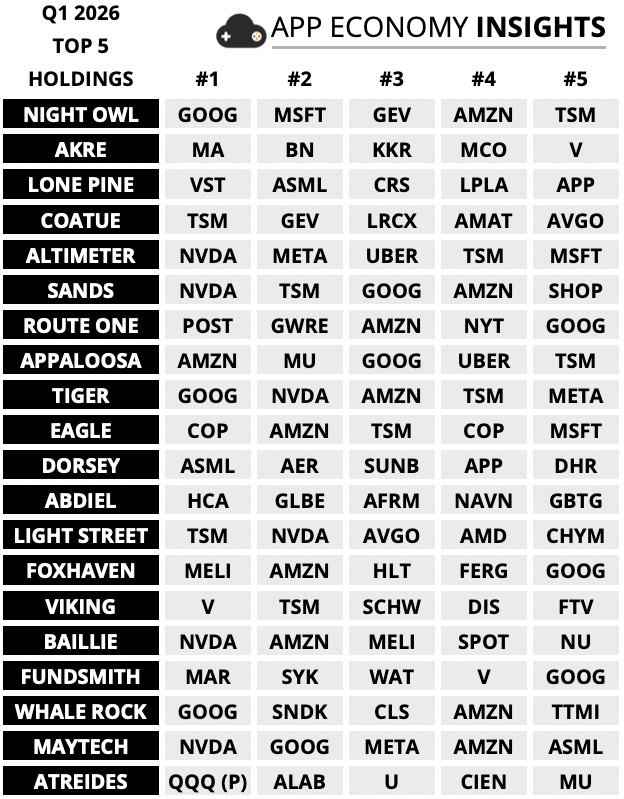
The 12 stocks below represent over half of the top holdings listed:
🤖 AI infrastructure: TSM, NVDA, AVGO, ASML, MU, GEV.
☁️ Hyperscalers: AMZN, MSFT, GOOG, META.
📦 Global commerce: MELI, V.
Amazon remains the most widely held stock, making the top 5 holdings of half of these funds, followed closely by Taiwan Semiconductor and Alphabet.
Also, note that Apple is entirely absent despite being the third-largest company by market cap globally. You also won’t find Tesla here, despite its popularity with individual investors.
This list of holdings doesn’t change much from one quarter to the next, so let’s turn to the more actionable insights with the new movements in Q1.