


Welcome to the Free edition of How They Make Money.
Over 300,000 subscribers turn to us for business and investment insights.
In case you missed it:

“Ah shit, here we go again.”
Google shares plunged 13% after earnings, and you might be feeling déjà vu. Investors are worried about the future of Search. Again.
But this time, the concern is more tangible. Queries are growing at their fastest pace in five years, yet revenue growth is slowing, with AI Mode monetizing at lower rates.
Meanwhile, Cloud revenue doubled and margins expanded.
AI is simultaneously Alphabet’s biggest growth engine and a threat to its core ad business.
Can the booming AI business outgrow the disruption it’s creating elsewhere?
Here’s what stood out this quarter.
Today at a glance:
Alphabet Q3 FY26.
From models to monetization.
Key insights from the earnings call.
What to watch moving forward.

1. Alphabet Q3 FY26
Income statement:
Alphabet recorded an $8.7 billion loss on equity investments, largely reflecting the decline in SpaceX’s stock price during the quarter. That’s a sharp reversal from the $99 billion paper gain in Q2, demonstrating how Alphabet’s growing investment portfolio can distort its reported earnings.
Revenue grew 25% Y/Y to $127.6 billion ($0.3 billion miss), while GAAP EPS fell 26% to $2.12 ($0.89 miss). The EPS shortfall was largely driven by the investment losses.
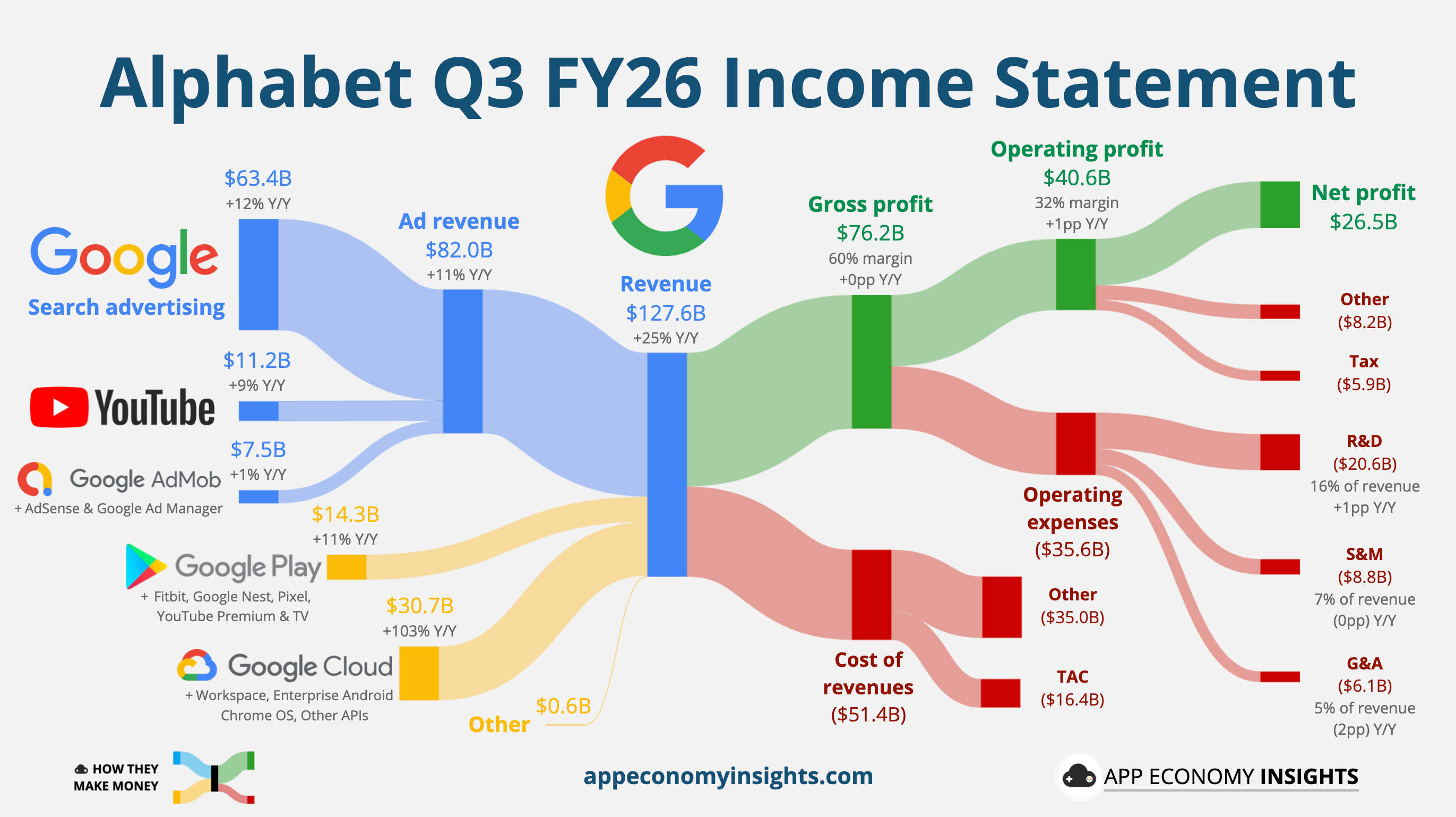
🔎 Advertising: $82.0 billion (+11%).
Search: $63.4 billion (+12%).
YouTube ads: $11.2 billion (+9%).
Network: $7.5 billion (+1%).
📱 Subscriptions, platforms, and devices: $14.3 billion (+11%).
☁️ Cloud: $30.7 billion (+103%).
Margin trends:
Gross margin: 60% (flat Y/Y).
Operating margin: 32% (+1pp Y/Y).
Services (Advertising & Other): 41% (+2pp Y/Y).
Cloud: 36% (+13pp Y/Y).
Cash flow:
Operating cash flow declined 13% Y/Y to $42.3 billion, weighed down by a one-time $5.2 billion European Commission fine and inventory buildup ahead of TPU system sales.
Free cash flow deteriorated to a $9.1 billion outflow, compared to $24.6 billion generated a year ago and a $5.9 billion outflow in Q2.

CapEx reached a record $51.4 billion, up from $44.9 billion in Q2. Management maintained its FY26 outlook of ~$200 billion and reiterated that spending will increase significantly in 2027.

Balance sheet:
Cash, cash equivalents, and marketable securities: $265 billion.
Long-term debt: $125 billion.
So, what to make of all this?
🔎 Search growth slows despite record engagement: Search revenue grew 12% Y/Y, down from 17% in Q2 and 19% in Q1, missing expectations despite the fastest query growth in five years. FX was the biggest driver of the slowdown, but lower AI Mode monetization also contributed.
☁️ Cloud doubles: Cloud revenue accelerated to 103% growth, from 82% in Q2, while operating income more than tripled to $11.1 billion. The operating margin held at a record 36%. TPU system sales were a meaningful contributor, though management said underlying Cloud growth remained exceptionally strong without them.
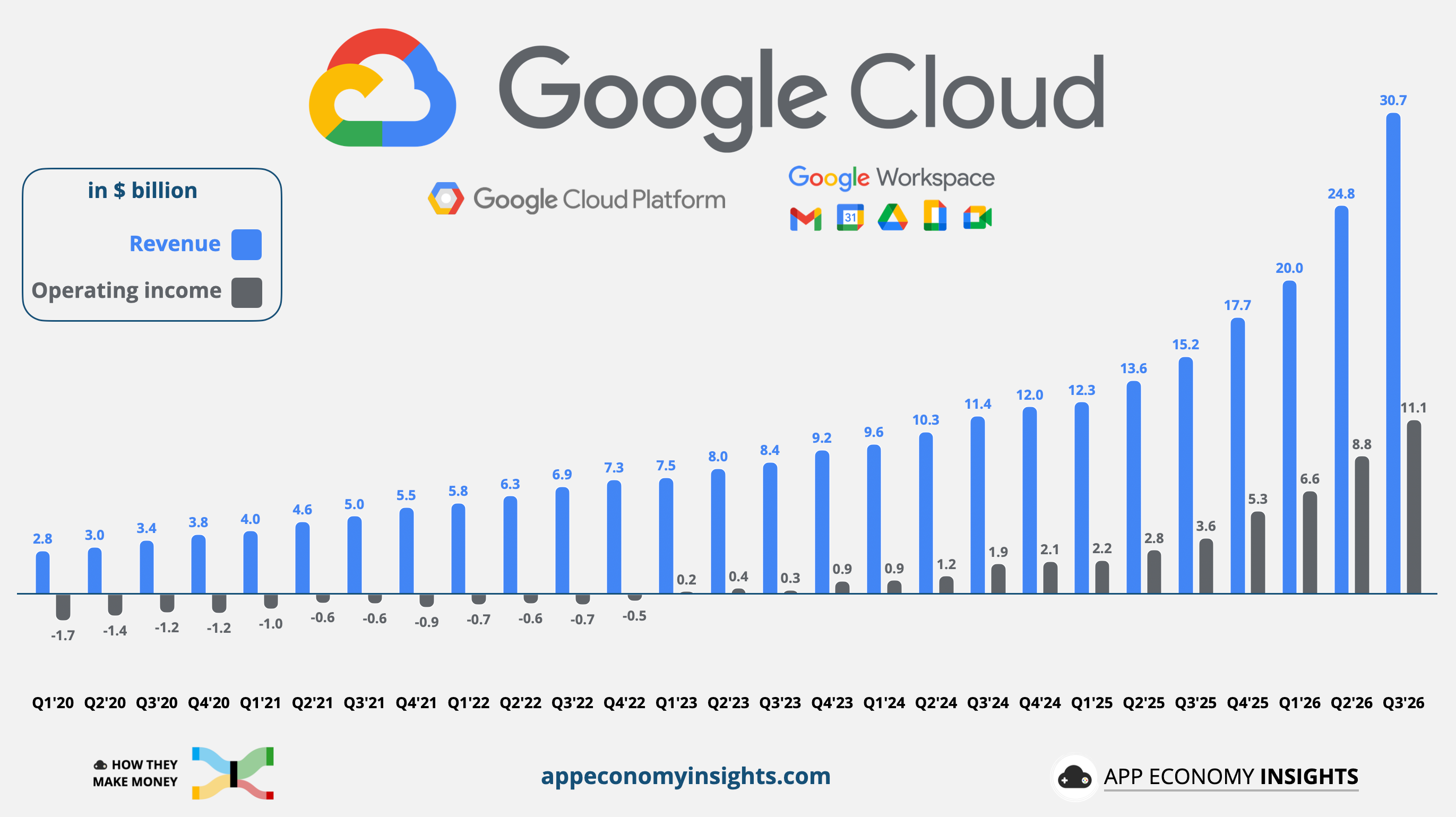
📦 The backlog keeps climbing: Cloud backlog rose to $561 billion, up 9% sequentially. More than 55% is expected to convert into revenue within 24 months, up from just over 50% last quarter. The backlog offers extraordinary revenue visibility, though the returns on fulfilling those commitments remain uncertain.
📈 Cloud’s margin pressure is delayed: Management had warned that third-party computing capacity would weigh on Q3 profitability. But the rented capacity only came online near quarter-end, leaving margins largely unaffected. Usage will ramp in Q4, bringing the expected pressure. That makes the next quarter a more meaningful test of Cloud’s underlying economics.
🤖 Gemini reaches one billion users: The Gemini app crossed one billion users, while the first-party APIs processed nearly 32 billion tokens per minute, up from 22 billion in Q2. Enterprise adoption is also expanding, with more than 100 million AI knowledge-work seats sold. Consumption continues to grow rapidly, though the economics of serving that demand are difficult to assess.
🎬 YouTube’s World Cup boost fades: YouTube advertising growth slowed to 9%, from 13% in Q2, as the exceptional World Cup comparisons normalized. Meanwhile, YouTube Music and Premium surpassed 150 million subscribers globally, including trials. Subscriptions continue growing faster than advertising, providing a more recurring revenue stream.
🚕 Other Bets losses widen: Revenue reached $0.4 billion, while operating losses expanded to $2.0 billion, from $1.4 billion a year ago. Alphabet continues funding Waymo’s expansion, but the business remains a significant drag on consolidated profitability.
💡 Takeaway: Cloud’s acceleration validates AI infrastructure demand, but Alphabet’s financial profile is changing. More growth now comes from capital-intensive infrastructure and hardware sales, while AI is reshaping the economics of Search. The challenge is sustaining those strong margins as infrastructure spending and TPU system sales continue scaling.
2. From models to monetization
🤖 Gemini 4 enters the fight
Gemini 4 Argon rolled out broadly on October 13, targeting coding, cybersecurity, and complex professional workflows. Two weeks later, Alphabet unveiled Gemini 4 Carbon, which now leads the updated Artificial Analysis Intelligence Index with a score of 59. Access remains limited to selected cybersecurity partners, with broader availability pending.
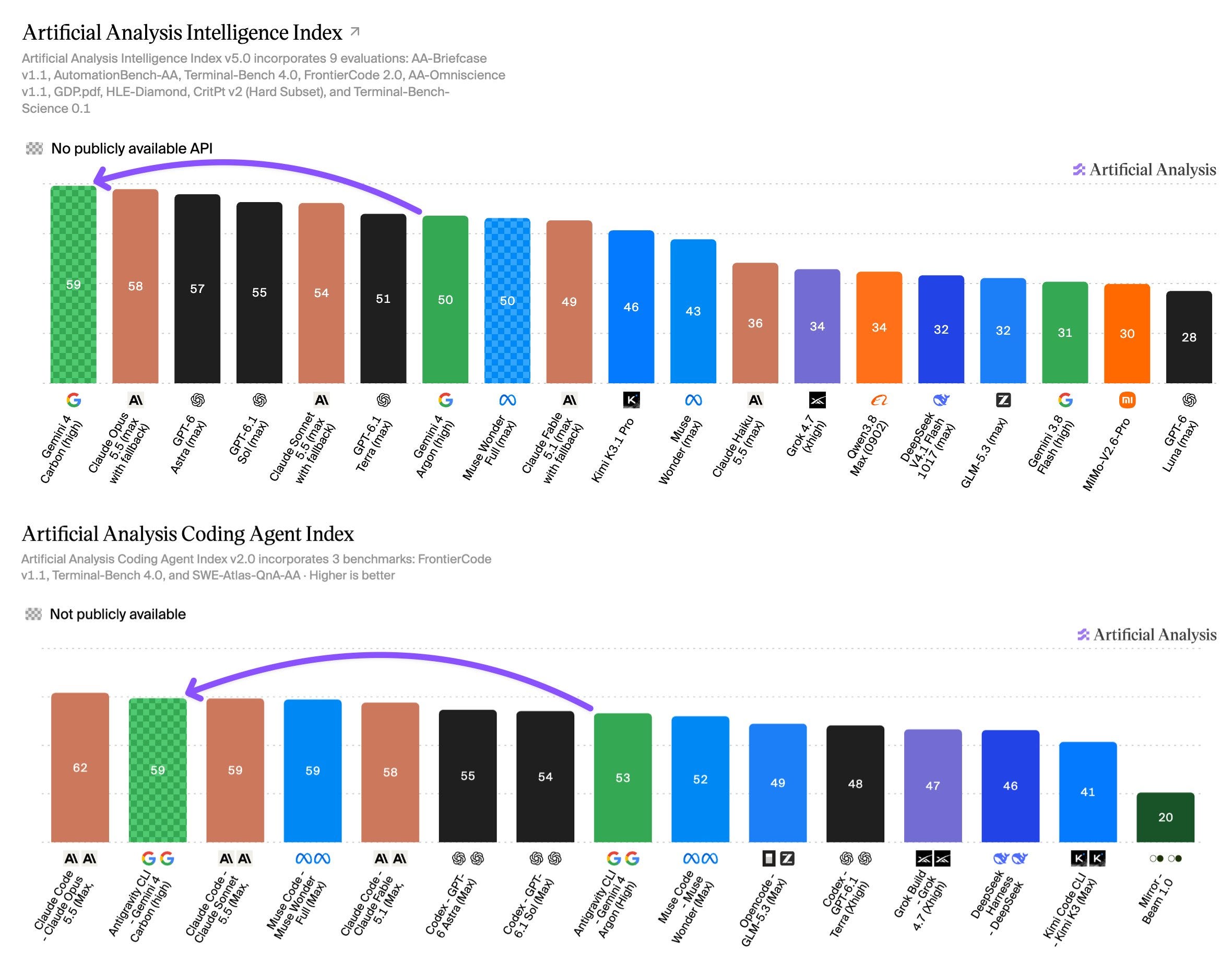
Last quarter, Sundar Pichai acknowledged that the company needed to improve in agentic coding. Now management says Argon has helped internal engineering teams ship 35% more code with 30% fewer errors. The improvement is encouraging, although internal productivity gains don’t necessarily translate into commercial success.
Alphabet also introduced a universal Gemini work agent that automates research, coding, and workflows across enterprise applications and can access third-party models.
The company is competing on two fronts: building frontier models and owning the interface businesses use to access them. The second may prove more defensible if models become increasingly interchangeable.
☁️ TPUs become a business
Alphabet's custom AI chips are becoming a commercial business, with management expecting TPU system sales to ramp significantly in 2027.
Distribution is expanding. Oracle will become the first competing hyperscaler to offer TPUs in 2027, while Blackstone-backed Crux AI provides another channel for customers seeking dedicated computing capacity.
Anthropic’s newly released S-1 disclosed $114.5 billion in compute commitments to Alphabet through 2033, alongside $161.2 billion in TPU equipment leases with Broadcom.
But there’s a trade-off. Hardware sales require inventory investment before delivery and may carry different margins than recurring cloud services. TPUs are becoming a major business, but their economics remain largely opaque.
🛒 Search becomes a shopping cart
Universal Cart launched in the US on October 15, allowing consumers to save products across Search and Gemini, track prices, find promotions, and check out through Google Pay or participating merchants.
The broader development is the Universal Commerce Protocol (UCP), which now enables direct checkout for hundreds of thousands of brands. Meanwhile, advertising is expanding within AI Mode, including new multi-turn formats in the US.
The implications extend beyond shopping convenience. AI assistants increasingly promise to compare products, recommend purchases, and complete transactions on behalf of consumers. That could disrupt the traditional model of monetizing commercial searches through advertising clicks.
Universal Cart keeps Alphabet involved beyond the initial search, potentially preserving valuable purchasing intent even as consumers move toward agent-driven shopping.
The next challenge is monetizing actions as effectively as clicks.
3. Key insights from the earnings call
Check out the earnings call transcript on Fiscal.ai here.
The Q3 call shifted from the model war to the economics of AI. Analysts pressed management on Search monetization, the working-capital demands of TPU sales, and the opportunity to supply infrastructure to competitors.
Chief Business Officer Philipp Schindler
On why Search growth slowed despite record query growth:
“First, there was FX. It was the single largest driver of Search deceleration relative to Q2. […] Also to the next part of your question, it’s worth noting that the strong growth in AI Mode queries had an impact because of the lower monetization we were seeing in AI Mode.”
Schindler separates temporary factors behind the slowdown from a longer-term monetization challenge. The expansion of AI Mode advertising into international markets and multi-turn formats will test whether growing engagement can eventually translate into comparable revenue.
CFO Anat Ashkenazi
On the cash flow implications of selling TPU systems:
“When we sign an agreement with a customer to sell TPU systems, once we sign that agreement you’ll first see that showing up in our backlog. Then we start building inventory. […] As we start delivering and billing customers for these TPU systems, then you see cash coming in. It’s not the traditional kind of CapEx […], but rather a different cycle of cash flow generation.”
This distinction matters for interpreting Alphabet’s negative free cash flow. TPU system sales consume working capital before delivery, while owned data centers require long-lived CapEx. Both require upfront cash, but their payback profiles differ significantly.
CEO Sundar Pichai
On selling AI infrastructure to competitors:
“We have long viewed what we build as categories of things which we build as products, and then there are categories of things which we build as platforms. You need to have a clear view on which is which. […] Similarly, we view our TPU systems as an important platform we are building.”
Treating TPUs as a platform turns rivals into potential customers. Broader adoption could improve unit economics through scale, giving Alphabet another way to participate in the AI boom. The company can profit from the AI model race even when someone else’s model wins.
4. What to watch moving forward
🤖 Gemini’s traffic plateau
Gemini’s share of global GenAI website traffic nearly doubled over the past year, reaching 25% in September, according to Similarweb. But its share peaked around 27% in April and has since slipped, while ChatGPT recovered modestly.
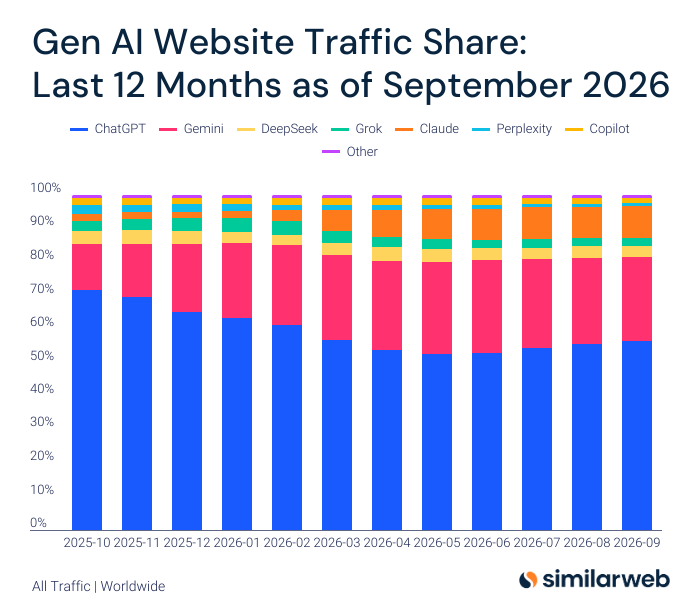
Website traffic captures only part of AI adoption and excludes mobile apps and APIs. Still, the plateau raises an interesting question. Can Gemini 4’s improved capabilities reignite share gains, or has distribution already delivered most of the easy wins?
🔎 Search’s AI economics
Alphabet is expanding advertising within AI Mode, but it remains uncertain whether those queries can eventually monetize as effectively as traditional Search.
More queries create additional opportunities for advertisers, but AI-generated responses also require more computing power. The critical test is whether incremental advertising revenue can offset any erosion in Search’s existing economics.
Meta faced a similar challenge when Reels began cannibalizing higher-monetizing Feed and Stories. In 2022, the shift created a $500 million quarterly revenue headwind. A year later, Reels was no longer a drag on advertising revenue, even though monetization per minute remained lower.
💎 The AI valuation paradox
OpenAI is seeking a $1.25 trillion valuation, while Anthropic’s IPO could value it over $1.5 trillion. Investors are assigning extraordinary value to frontier AI platforms, despite their enormous infrastructure commitments.
Yet Alphabet competes with both at the model frontier, while owning proprietary TPUs, a booming Cloud business, and distribution to billions of users. And it’s trading at roughly 16x EBITDA.
Of course, the infrastructure bill is enormous. Alphabet disclosed up to $924 billion in future purchase commitments, alongside another $152 billion in pre-commencement leases and other obligations. But its AI rivals face similarly staggering commitments, without Alphabet’s established cash-generating businesses.
Why does Wall Street celebrate frontier AI at trillion-dollar valuations, yet assign a conventional multiple when those capabilities sit inside Alphabet?

That’s it for today!
Happy investing!
Want to sponsor this newsletter? Get in touch here.
Disclosure: I am long AAPL, AMD, AMZN, GOOG, META, MSFT, NFLX, NVDA, and TSLA in App Economy Portfolio. I share my ratings (BUY, SELL, or HOLD) with App Economy Portfolio members.
Author’s Note (Bertrand here 👋🏼): The views and opinions expressed in this newsletter are solely my own and should not be considered financial advice or any other organization’s views.