


Welcome to the Premium edition of How They Make Money.
Over 300,000 subscribers turn to us for business and investment insights.
In case you missed it:

SpaceX just delivered its first profitable quarter as a public company.
Revenue surged 161% to $14.6 billion, and net income reached $4.4 billion. The rebranded Super Intelligence (SI) segment now generates more revenue than Starlink, transforming the rocket manufacturer into an AI powerhouse. But that growth came with nearly $20 billion in quarterly CapEx.
An even bigger move may be coming soon.
During the earnings call, Musk confirmed that SpaceX and Tesla have formed special committees to explore a merger. A combination could create a company worth more than $3 trillion, bringing Musk's AI, robotics, and space ambitions under one roof.
But would a merger unlock greater value for shareholders, or simply combine two enormous investment programs with very different economics?
Today at a glance:
SpaceX Q3 FY26.
Starlink opens new fronts.
Key insights from the call.
SpaceX + Tesla: One Musk empire?
1. SpaceX Q3 FY26
Income statement:
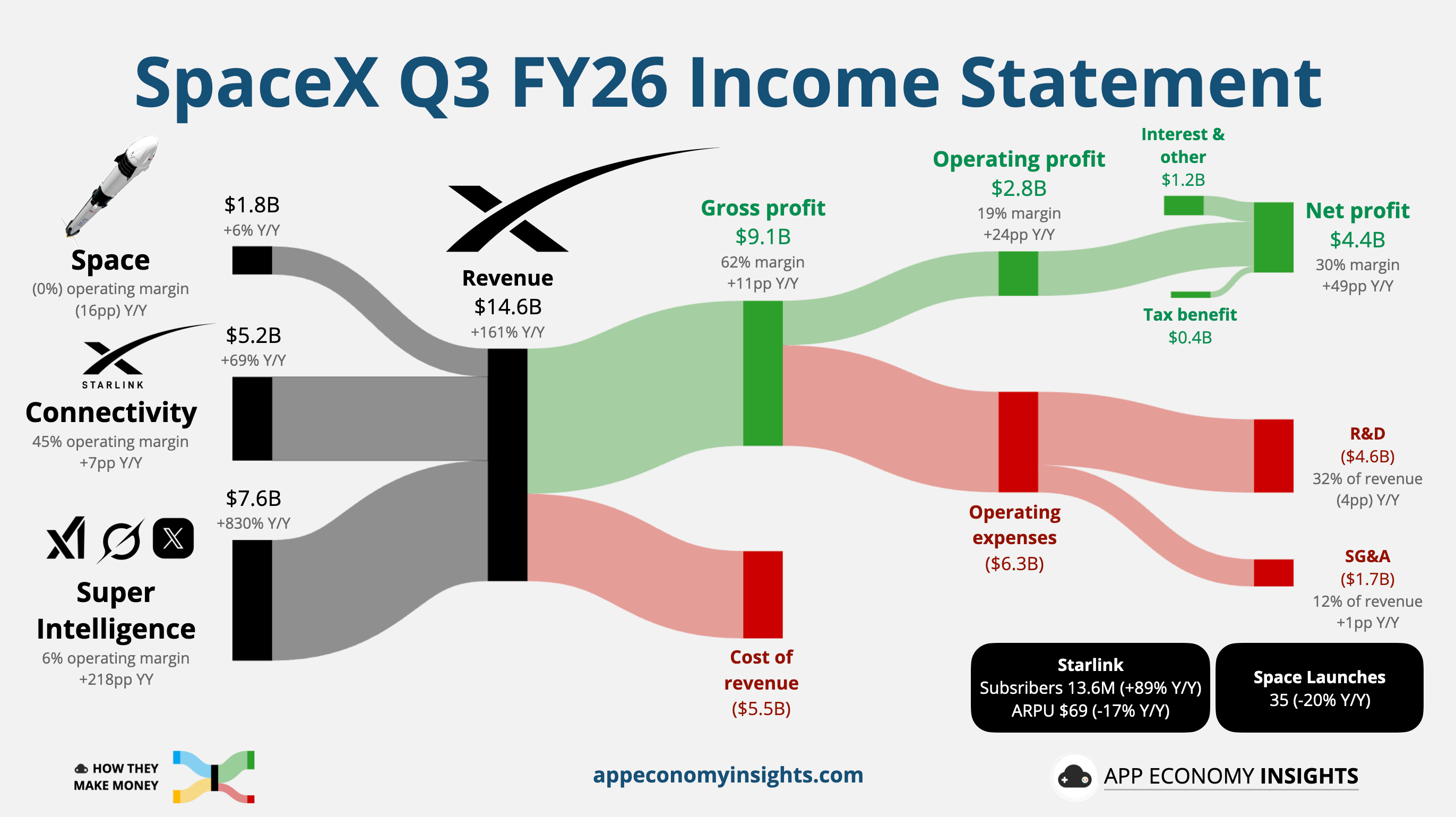
SpaceX beat Wall Street expectations in Q3, with revenue $1.6 billion ahead and GAAP EPS of $0.35 ($0.19 beat). Adjusted EBITDA quadrupled Y/Y to $8.8 billion, driven by growth across Connectivity and SI.
The three businesses are moving at very different speeds:
🚀 Space revenue grew 6% Y/Y to $1.8 billion (+84% Q/Q) as SpaceX completed 12 customer launches. The segment roughly broke even despite continued investment in Starship, which generated revenue for the first time. Its successful deployment of next-generation Starlink satellites marks an important step toward commercial operations.
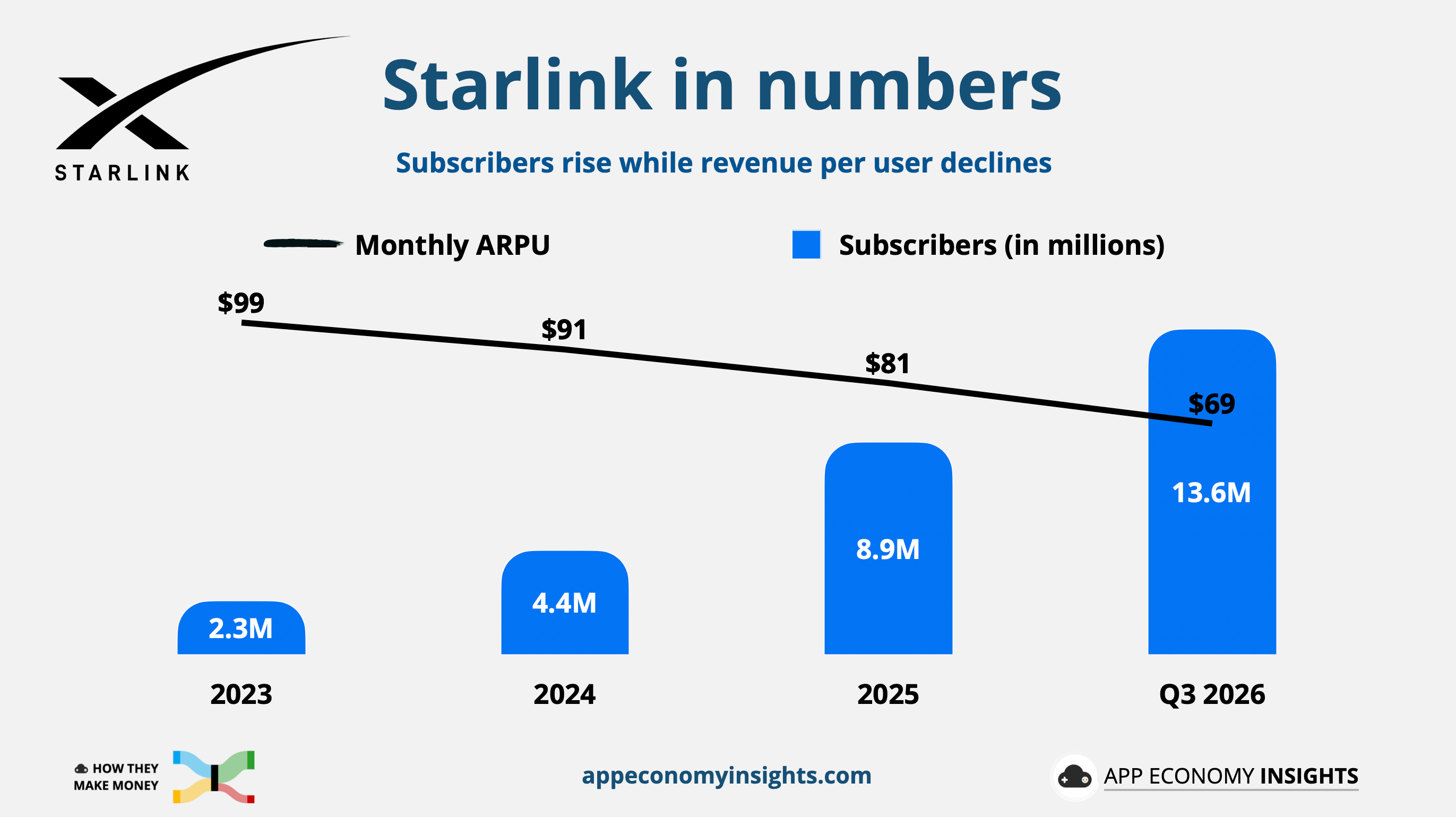
🛰️ Connectivity revenue jumped 69% Y/Y to $5.2 billion (+22% Q/Q), supported by consumer growth (+57%) and enterprise and government demand (+91%). Starlink subscribers reached 13.6 million (+89% Y/Y), but average revenue per user fell 17% (+5% Q/Q) to $69 as the service expanded internationally. Operating margin improved 7 percentage points to 45%.
🤖 Super Intelligence revenue soared 830% Y/Y to $7.6 billion (+195% Q/Q), becoming SpaceX's largest segment with 52% of total revenue. Growth reflected new cloud computing agreements, increased Grok adoption, and the acquisition of AI coding platform Cursor, which contributed $608 million in revenue from its August 14 acquisition through September 30. The segment swung from a $1.7 billion operating loss a year ago to $431 million in operating profit, although its 6% margin remains far below Starlink's 45%.
Cash flow:
Operating cash flow reached $9.6 billion in Q3 (+156% Y/Y).
CapEx reached $19.6 billion, up from $18.4 billion in Q2. And management expects a much bigger jump in Q4.
Free cash flow was negative ~$10.0 billion, compared with negative ~$16.0 billion in Q2.
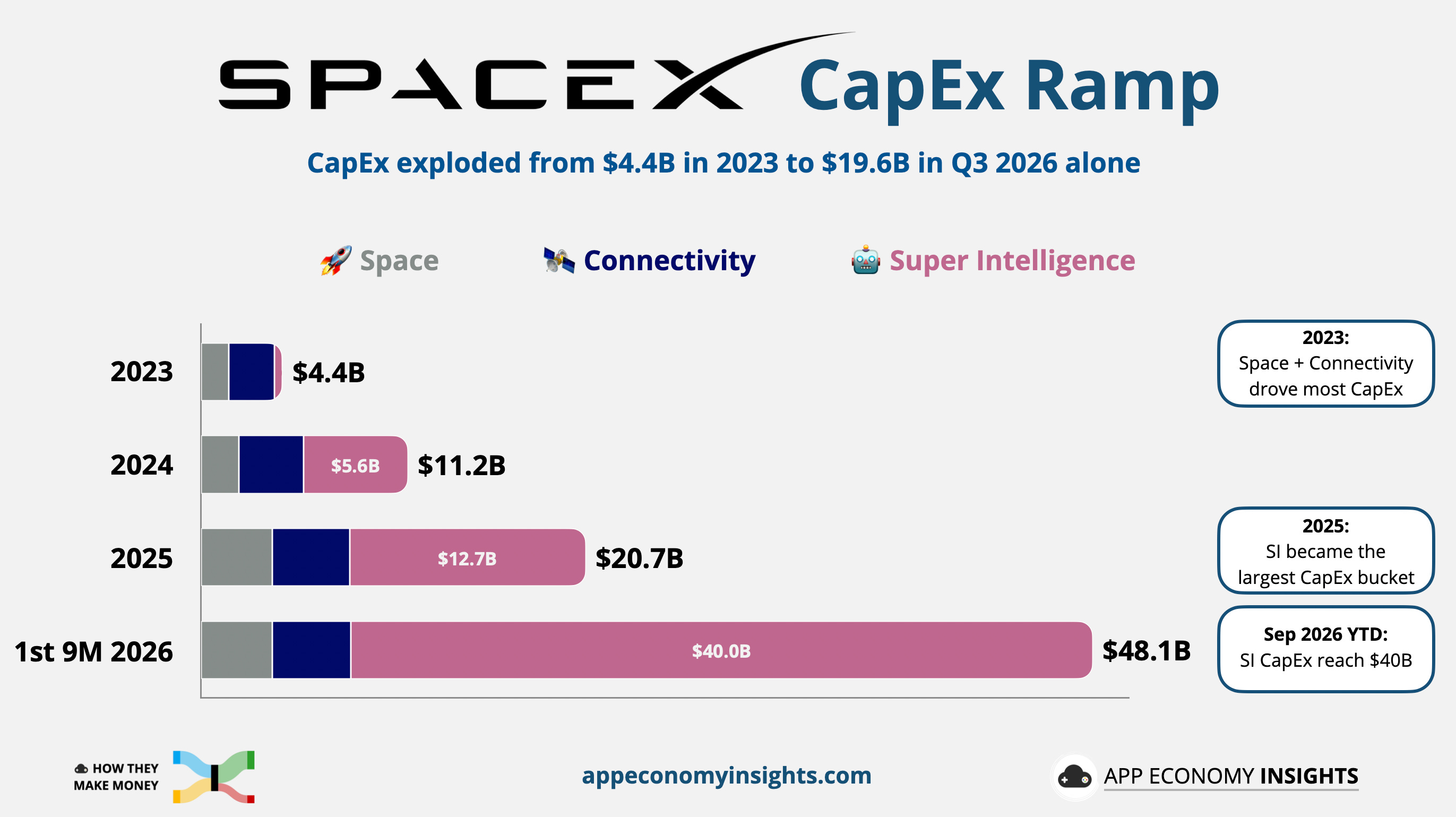
Super Intelligence accounted for $16.4 billion, or 84% of total CapEx in Q3, compared with $1.6 billion for Space and $1.5 billion for Connectivity. AI compute capacity increased from 1.4 GW to 1.7 GW during the quarter.
The operating cash flow improvement is encouraging, but SpaceX still invests roughly twice as much as it generates from operations.
Balance sheet:
Cash, cash equivalents, and marketable securities: $89.9 billion, down from approximately $100 billion at the end of Q2.
Debt and finance leases: $38.8 billion, including $36.1 billion of long-term obligations.
Net cash: approximately $51.0 billion, before other financing obligations or restricted-cash adjustments.