


Welcome to the Free edition of How They Make Money.
Over 300,000 subscribers turn to us for business and investment insights.
In case you missed it:
💸 AI’s debt problem
Financing is the latest obstacle in the AI infrastructure boom.
CoreWeave shares plunged more than 15% on Wednesday, while yields on some of its bonds have climbed above 16%, a level associated with distressed debt. The NVIDIA-backed cloud provider has taken on tens of billions of dollars in debt to build the data centers powering the AI boom.
The pressure extends beyond CoreWeave. Oracle and other AI infrastructure companies have also faced selling pressure as investors reassess their borrowing costs and capital requirements. Higher interest rates make an already expensive buildout even more costly.
For highly leveraged AI infrastructure providers, the concern is shifting from demand for computing power to the cost of supplying it. Companies are committing enormous amounts of capital today against revenue they expect to collect over many years.
NVIDIA CEO Jensen Huang pushed back on Thursday, insisting that CoreWeave’s financial position is improving. But NVIDIA owns roughly 10% of CoreWeave and is also one of its biggest suppliers. Huang has every incentive to defend its expansion, even as bond investors demand higher returns to finance it.

Today at a glance:
⚡ TSMC is not slowing down
🤖 The model race heats up
🏠 Apple moves into the living room

💯 TSMC is already a 100-bagger
Its US-listed shares have returned more than 100x since 1997.
I put together a free 35-page report on what to look for in quality stocks before they become obvious.

⚡ TSMC is not slowing down
Taiwan Semiconductor (TSMC) is investing at a scale few companies can match. Its CapEx budget has climbed from $41 billion in 2025 to $60–$64 billion in 2026, with cumulative spending over 2026–2028 expected to substantially exceed the previous three years.
CEO C.C. Wei has little interest in leaving opportunities to competitors:
“We have no intention to leave food on the table for others, and we want to capture every piece of business possible.”
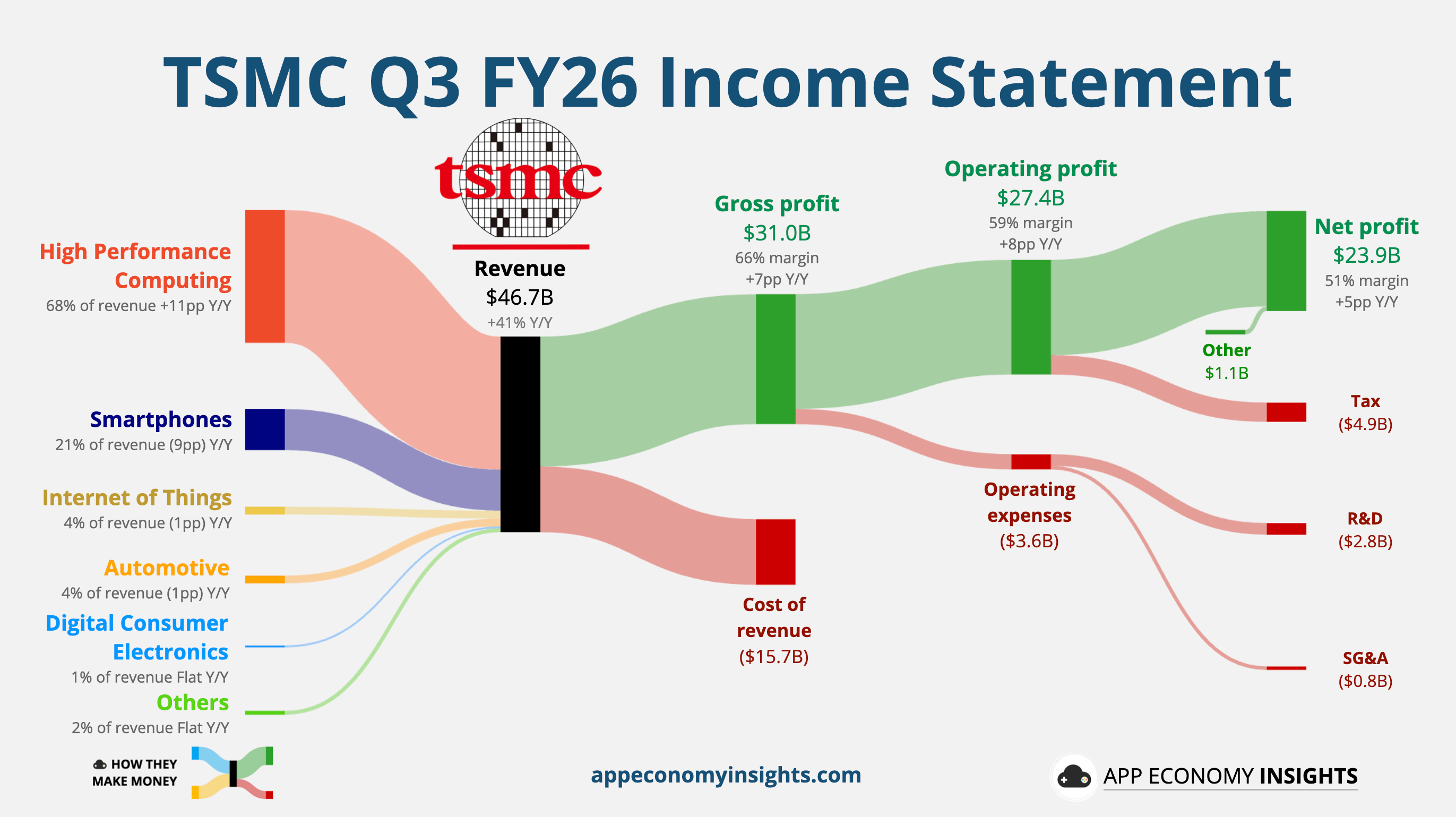
Another record quarter backs his conviction. Q3 Revenue grew 41% Y/Y to $46.7 billion, and operating margin reached nearly 59%. TSMC is becoming more profitable even as it undertakes the largest manufacturing expansion in its history.
Q3 in numbers
Income statement:
Revenue +41% Y/Y to $46.7 billion ($0.9 billion above the high end of guidance).
Gross margin 66% (-1pp Q/Q).
Operating margin 59% (+8pp Y/Y).
EPS per ADR $4.60 (+69% Y/Y in local currency).
Cash flow:
Free cash flow margin: 32% (+18pp Y/Y).
Balance sheet:
Cash and marketable securities: ~$126 billion.
Interest-bearing debt: ~$32 billion.
Guidance:
Management raised its FY26 revenue growth outlook to approximately 44% in USD, up from slightly above 40%. Q4 guidance of $52.3–$54.3 billion implies 58% Y/Y growth at the midpoint, a sharp acceleration.
So what to make of all this?
🤖 AI demand keeps surprising management. TSMC previously forecast mid-to-high-50% annual growth in AI accelerator revenue through 2029. C.C. Wei now suggests even that ambitious forecast could prove conservative:
“The demand is extremely robust. We did not see any sign of slowdown. Whether it is a high 50 CAGR, it does not matter. It probably will be higher.”
The forecast excludes conventional CPUs and networking chips, which are also benefiting from the rise of AI agents. TSMC’s opportunity extends well beyond GPUs, as its changing revenue mix shows. HPC (High Performance Computing) now accounts for 68% of revenue, up from 42% just three years ago.

🏗️ TSMC wants every available order. Yet the company isn’t simply taking its customers’ forecasts at face value. It checks their financial strength, visits data center construction sites, and verifies electricity availability before committing additional capacity. These checks help explain why management remains confident enough to invest tens of billions in factories that take years to build. They also connect directly to the financing concerns facing some AI infrastructure providers.
⚙️ Manufacturing leadership comes at a cost. The new 2nm process already accounts for 8% of wafer revenue, with capacity expected to more than double by 2027. Alongside advanced packaging and 3nm expansion, this reinforces TSMC’s position as the preferred manufacturer for the most demanding chips. However, the initial 2nm ramp contributed to the sequential decline in gross margin. Overseas expansion will add further pressure, with international factories expected to dilute consolidated gross margin by 3–4 percentage points over the next few years.
💰 How profitable can TSMC become? Despite rising investment and manufacturing costs, operating margin has climbed to nearly 59%. When asked about the longer-term potential, Wei replied:
“There is no ceiling for TSMC’s profitability. But a dramatic increase will not happen overnight either.”
TSMC’s technological lead and scarce capacity give it considerable pricing power. But management is also warning that rising component costs and macroeconomic uncertainty are hurting price-sensitive consumer markets. The company enters 2027 with exceptional AI demand, but not every part of the semiconductor industry is seeing the same conditions.
🤖 The model race heats up
Google and Meta made major moves in the AI model race this week, challenging OpenAI and Anthropic's perceived lead.
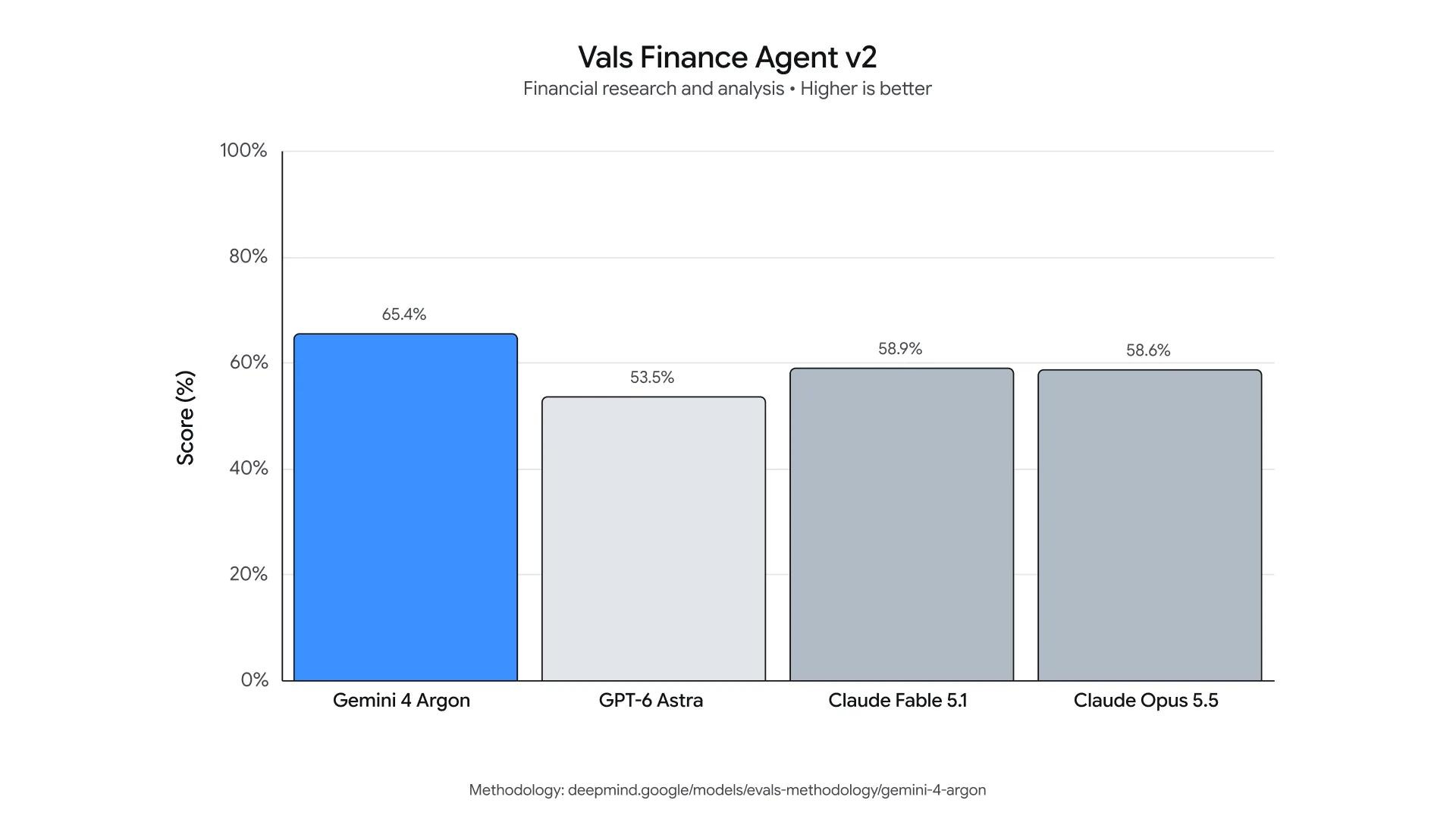
Google launched Gemini 4 Argon, its latest frontier model, claiming leadership across several benchmarks involving coding, finance, law, and cybersecurity. Its performance on professional tasks (Vals Index) is particularly noteworthy as AI agents move beyond answering questions to performing actual work.
Argon is available through Google’s API, Gemini app, Search, and coding tools. Google can distribute increasingly capable AI to billions of existing users, an advantage over independent AI labs that must build their own distribution.
Meanwhile, Meta introduced Muse Wonder and Muse Wonder Full, its most capable models to date. After struggling to keep pace at the frontier, Meta claims competitive performance with OpenAI and Anthropic. The models emphasize memory and the ability to carry out complex, multi-step tasks. Meta plans to bring these capabilities to its Muse personal AI agent.
More competition could pressure model pricing, while more capable agents could increase computing demand. Unlike chatbots that answer individual questions, agents can work through lengthy tasks involving dozens or hundreds of steps, consuming far more tokens along the way.
Better models and lower pricing don’t necessarily mean less infrastructure spending. They could make AI useful enough to justify even more investment.
🏠 Apple moves into the living room
Apple unveiled HomeView, a $299 smart-home display arriving November 13. It’s built around an upgraded Siri, alongside new HomePod and Apple TV devices. The seven-inch display recognizes household members and draws on personal information from their iPhones to answer questions and handle everyday tasks.

Apple also introduced cameras, thermostats, and smart locks developed with LG and Schneider Electric. These accessories work directly through Apple Home, without separate apps or accounts. The new Apple TV adds far-field microphones for hands-free Siri commands.
Apple is betting that its hardware ecosystem and access to personal data can make Siri the default interface for the connected home. But there’s a catch: HomeView still relies on a nearby, recently unlocked iPhone for personalized features, and many of its use cases already work on the phone itself.
The real test is whether Apple’s integration can compensate for Siri’s limitations. Amazon and Google already have established smart-home ecosystems, while AI agents are becoming increasingly capable of handling tasks without traditional apps.
That's it for today.
Happy investing!
Want to sponsor this newsletter? Get in touch here.
Disclosure: I own AAPL, AMZN, GOOG, META, and TSM in App Economy Portfolio. I share my ratings (BUY, SELL, or HOLD) with App Economy Portfolio members.
Author's Note (Bertrand here 👋🏼): The views and opinions expressed in this newsletter are solely my own and should not be considered financial advice or any other organization's views.
The part about TSMC checking customer balance sheets and power availability before adding capacity stands out, because it puts a buyer with roughly $126 billion in cash ahead of the credit stress. If CoreWeave bonds yielding over 16% mean the weakest buyers drop out of the queue, TSMC's order book could keep looking strong while the neocloud tier shrinks. The headline numbers might hide that shift for several quarters.