


Welcome to the Free edition of How They Make Money.
Over 300,000 subscribers turn to us for business and investment insights.
In case you missed it:
AI has created a massive capacity gap.
There is more demand for compute than the biggest cloud companies can supply.
That gap has fueled the rise of neoclouds, specialized providers built around AI infrastructure. They focus on securing raw power, specialized data-center capacity, and accelerator clusters rather than replicating the broad software ecosystems of AWS, Azure, or Google Cloud.
Three distinct neocloud models reported this week, offering a clear view into how different strategies tackle this compute bottleneck:
CoreWeave: Pure-play NVIDIA GPU fleet rental scaling on long-term enterprise commitments.
Nebius: An AI-focused cloud platform built from scratch on international data-center infrastructure.
Cerebras: A proprietary chipmaker pivoting into cloud-hosted fast inference.
The economics across all three are counterintuitive. Capacity must be funded and built months before it can generate revenue, driving negative free cash flow. Debt, leases, depreciation, and customer concentration matter almost as much as growth.
Let’s review what we learned.

🧱 CoreWeave is Sold Out
CoreWeave is the purest version of the neocloud model. It buys NVIDIA GPUs, installs them in data centers, and rents the compute to customers such as OpenAI, Microsoft, and Meta.
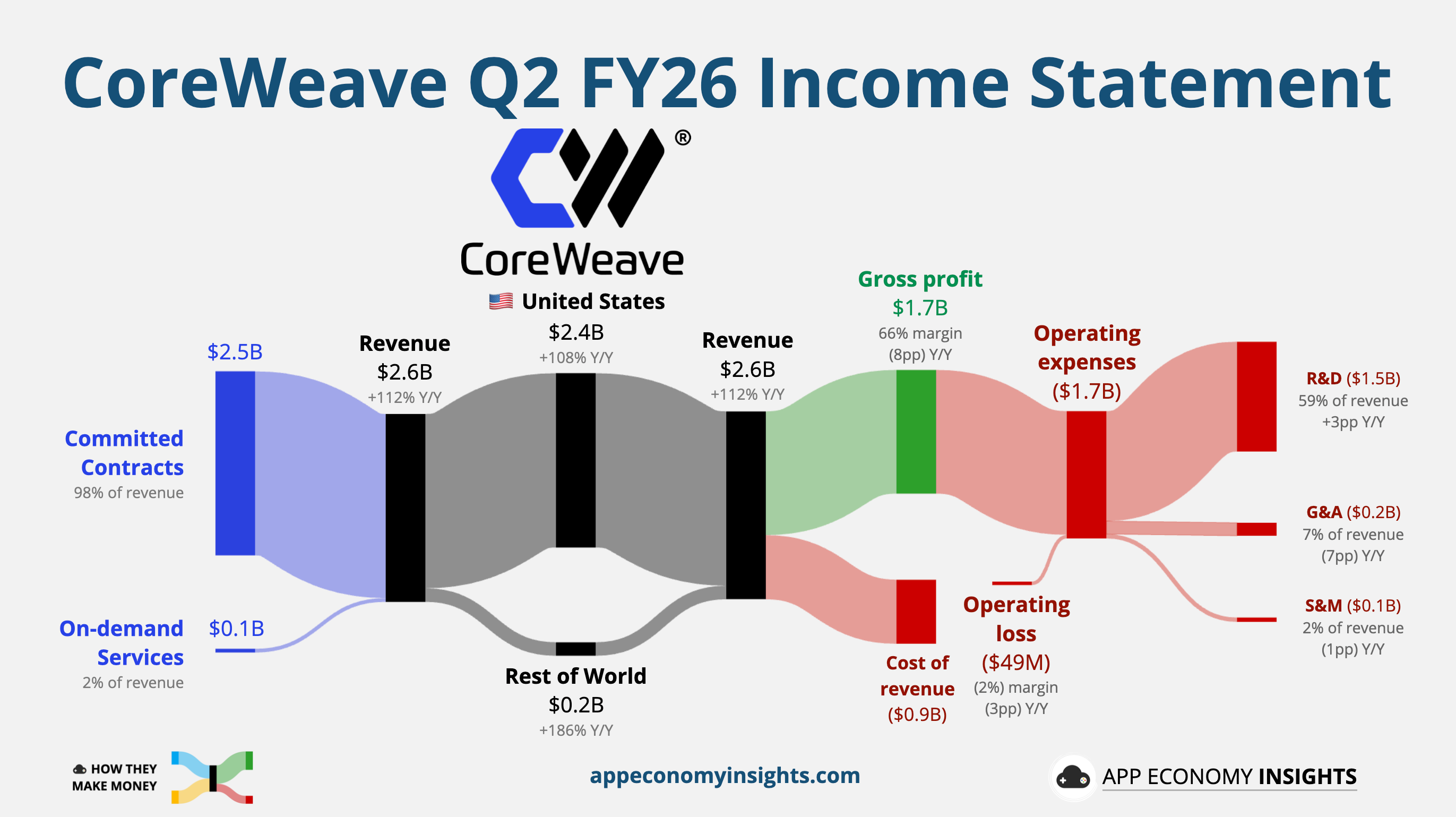
Most of the business is already spoken for. Committed contracts generated 98% of Q2 revenue, while on-demand usage contributed just 2%.
Revenue jumped 112% Y/Y to $2.6 billion, but gross margin contracted by 8 points to 66% as data-center rent, power, and other ramp costs grew even faster.
CoreWeave posted a $49 million operating loss and a $626 million net loss, heavily weighed down by $640 million in interest expense tied directly to its GPU-collateralized debt facilities.
And the income statement captures only part of the spending. Q2 CapEx reached $9.4 billion, more than three times quarterly revenue.
What to make of all this?
📚 Demand keeps outrunning capacity: Backlog reached $104 billion, up 246% Y/Y, before another $25 billion of customer commitments signed in early Q3. Near-term capacity is effectively sold out.
💰 Margins are expected to turn: Gross margin contracted as CoreWeave raced to bring new capacity online, but adjusted operating margin improved sequentially from 1% to 5%. New Q2 contracts are expected to carry contribution margins 5 to 10 points above recent deals, even before July’s roughly 25% price increase.
🧠 The mix is getting better: Storage, CPU, networking, and software now exceed $400 million of ARR. Managed inference jumped from $1 million to more than $100 million of booked ARR in a single quarter.
🏗️ Growth remains extremely expensive: CoreWeave raised its 2026 CapEx outlook to $35 billion to $39 billion as it races toward more than 1.85 GW of active power by year-end.
Bottom line: CoreWeave’s $104 billion backlog sounds almost absurd next to a targeted 2026 exit revenue run rate of $19 billion. But conversion is constrained by physical capacity. The investment case comes down to how quickly it can turn power and GPUs into revenue without letting financing costs overwhelm the margin gains.
☁️ Nebius Finds Pricing Power
Nebius did not start as a typical AI infrastructure startup.
🇷🇺 Yandex roots: Nebius emerged from the 2024 breakup of Russian tech giant Yandex. Its Nasdaq-listed Dutch holding company sold the Russian operations for $5.4 billion and kept a smaller group of international businesses that became Nebius.
♻️ Public-company reset: The remaining company kept its Nasdaq listing, rebranded as Nebius Group, and put Yandex co-founder Arkady Volozh back in charge.
☁️ AI infrastructure pivot: Rather than rebuild the old internet conglomerate, Nebius used its engineering talent, cloud expertise, and capital base to build a purpose-built AI cloud.
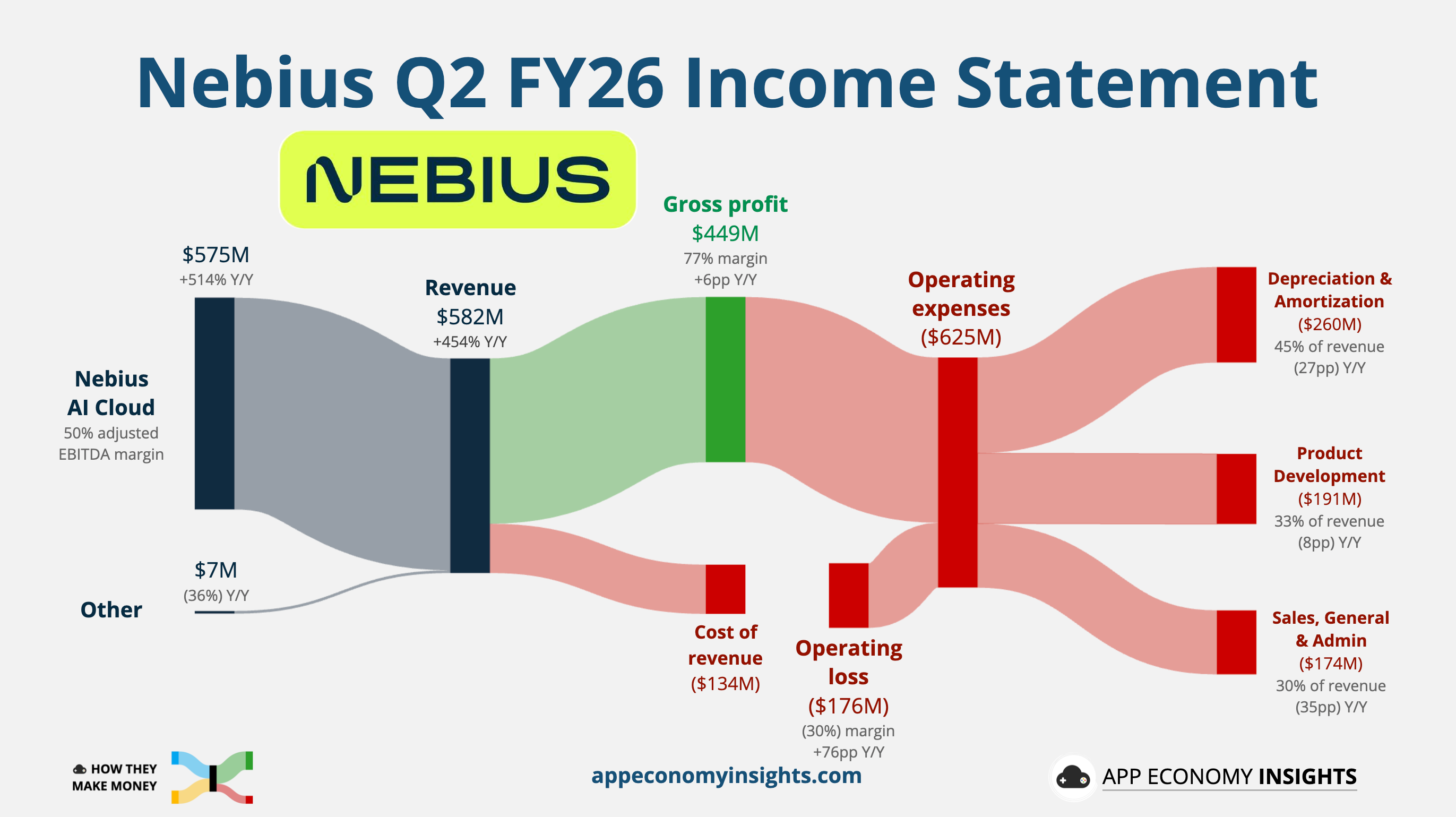
AI Cloud generated $575 million, or 98% of Q2 revenue, by renting GPU capacity through its own cloud platform.
Revenue surged 454% Y/Y to $582 million, while gross margin expanded 6 points to 77%. The business also generated $236 million of adjusted EBITDA at a 41% margin.
Nebius posted a $176 million operating loss, but depreciation and amortization alone reached $260 million as billions of dollars of new infrastructure started hitting the income statement.
What to make of all this?
💰 Pricing is moving higher: Four new AI cloud deals averaged more than $1 billion of contract value and $20 million to $25 million per megawatt. Shorter-term capacity is now fetching as much as $40 million to $50 million per MW.
⏱️ Payback is getting faster: Management estimates the Q2 contracts will repay their associated CapEx and operating costs in about 22 months, down from the previous two-to-three-year range.
🏗️ The buildout is enormous: Q2 CapEx reached $5.7 billion, almost 10 times quarterly revenue. Nebius still expects $20 billion to $25 billion for the year.
🤝 Customers are helping finance it: Nebius expects more than $9 billion of customer prepayments in 2026, covering roughly 50% to 60% of the associated CapEx.
Bottom line: Nebius is spending at extraordinary scale, but rising prices, faster paybacks, and customer prepayments are making each new megawatt more attractive. That capital efficiency may ultimately matter more than its 454% revenue growth.
🧠 Cerebras Moves to the Cloud
Cerebras is the odd one out among neoclouds. Instead of buying NVIDIA GPUs, it designs its own wafer-scale processor and monetizes it either by selling systems or renting the compute through Cerebras Cloud.
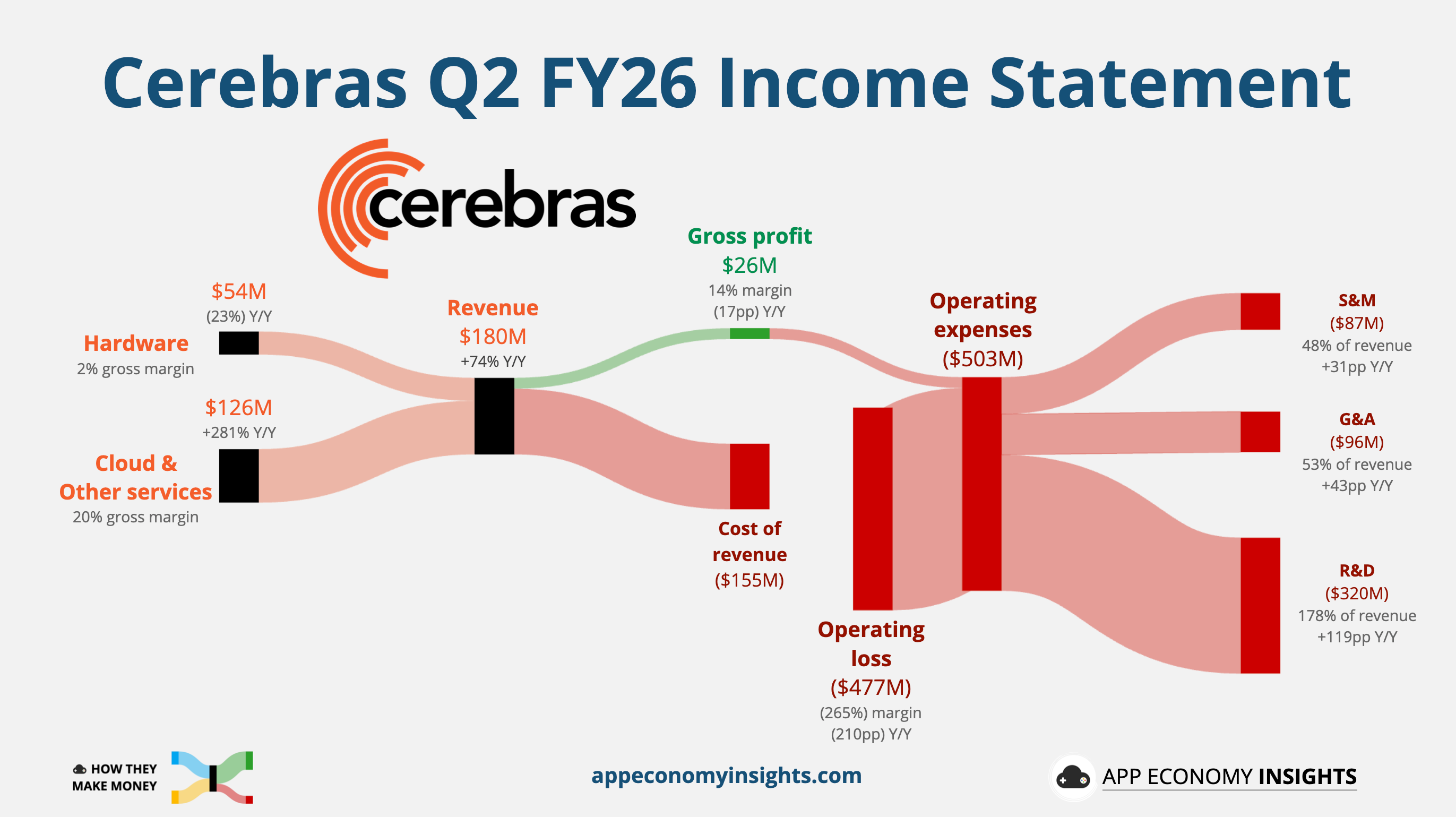
The revenue mix is shifting quickly. Q2 revenue rose 74% Y/Y to $180 million, with Cloud & Other Services surging 281% to $126 million while hardware fell 23% to $54 million.
The company had a brutal $477 million operating loss, but the headline needs context. Cerebras went public in May, triggering substantial stock-based compensation. Its core operating loss was just $34 million, compared with $477 million under GAAP.
Core results exclude stock comp, customer-warrant charges, and certain pass-through items. This stock-based compensation overhang should normalize over upcoming quarters as initial post-IPO equity grants settle.
Reported gross margin was just 14%, but on a core basis it was 41%, up about 9 points Y/Y. That was down from 46.5% in Q1, partly because Cerebras is temporarily paying to rent back systems it previously sold so it can meet cloud demand.
What to make of all this?
☁️ Cloud has become the growth engine. Core cloud revenue nearly quadrupled to $128 million and surpassed hardware for the first time.
📈 The outlook improved. Cerebras raised FY26 core revenue guidance to $880 million to $890 million, alongside higher gross-margin and operating-margin expectations.
🏗️ Capacity is still the bottleneck. More than 600 MW of data-center capacity is now live or contracted through 2027. Core gross margin is expected to bottom in Q3 before new capacity comes online and reduces the need for expensive rented capacity.
📚 Demand is far ahead of revenue. Remaining performance obligations reached $25.4 billion. OpenAI remains a major customer, but converting that backlog requires substantially more infrastructure.
Bottom line: Cerebras is evolving from a chip seller into a fast-inference cloud. Stock comp and other accounting adjustments obscure that progress, but the real test is converting its enormous backlog into revenue while rebuilding margins as new capacity comes online.
What to Watch
Across all three neoclouds, the same tension keeps showing up. Demand is outpacing available compute, but serving it requires enormous amounts of capital before revenue arrives.
That same compute shortage is pushing tech giants to build their own capacity. Meta is scaling custom silicon and gigawatts of GPUs, while SpaceX has already started selling access to its Colossus cluster. The longer-term question is whether neoclouds remain essential infrastructure partners or temporary relief valves once mega-cap AI capacity fully comes online.

The next phase comes down to capacity, margins, and funding. Neoclouds need to turn contracted demand into energized infrastructure, improve returns as utilization rises, and fund the next wave of expansion without letting debt or dilution overwhelm the economics.
The demand is locked in. Capital efficiency will separate the winners.
Next up: Saturday’s PRO edition will include the other big earnings of the week, like Berkshire, Tencent, Cisco, Sea Limited, Nu, Adyen, and more.
That’s it for today!
Stay healthy and invest on!
Want to sponsor this newsletter? Get in touch here.
Thanks to Fiscal.ai for being our official data partner. Create your own charts and pull key metrics from 50,000+ companies directly on Fiscal.ai. Start an account for free and save 15% on paid plans with this link.
Disclosure: I am long AMZN, MSFT, GOOG, NVDA, AMD, TSM, and ASML in App Economy Portfolio. I share my ratings (BUY, SELL, or HOLD) with members.
Author's Note (Bertrand here 👋🏼): The views and opinions expressed in this newsletter are solely my own and should not be considered financial advice or any other organization's views.
Would love to see you add a moat (or moatlesss?) analysis for these 3. Are they really just temporary, momentum plays, or is there a resilience aspect worth considering?
CoreWeave has $104 billion in backlog, but the cash timing is rough. The company has to fund the power and chips before customers can use the capacity. Financing matters as much as demand here.