


Welcome to the Premium edition of How They Make Money.
Over 300,000 subscribers turn to us for business and investment insights.
In case you missed it:
Jensen Huang used his first-ever X post last week to enter Washington’s fight over open-weight AI. He shared an open letter initially signed by 25 companies, including Microsoft, Meta, and Palantir. The coalition urged policymakers to preserve the development and deployment of open-weight models.
Satya Nadella quickly amplified the message, arguing that openness is essential to a healthy AI ecosystem.


To understand why the industry is clashing over this policy, it helps to distinguish how AI software is delivered:
Closed models (proprietary): The model’s internal weights remain locked behind an API. Companies such as OpenAI and Anthropic control the security guardrails, computing infrastructure, and pricing.
Open-weight models: The pre-trained weights can be downloaded and inspected. Businesses can customize and host the software on their own infrastructure without paying every query fee to a single vendor.
The immediate catalyst is model distillation, where developers use outputs from leading closed models to train cheaper alternatives. It is the same concern behind US accusations that Chinese lab Moonshot AI used a leading American model to improve Kimi. Closed-model providers argue that unrestricted distillation amounts to intellectual-property theft. Supporters of open weights see it as part of the competitive process that lowers costs and broadens access.
OpenAI, Anthropic, and Google were initially absent from the letter. OpenAI later joined after Sam Altman said he wanted the US to lead in both open and closed models, while Google’s Sundar Pichai endorsed the effort on the company’s behalf. Anthropic remained the clearest holdout, arguing that it does not want to ban open models but supports stricter chip controls, action against industrial-scale distillation, and mandatory safety testing for all capable systems.
NVIDIA reinforced the campaign this week by launching the Open Secure AI Alliance, a coalition of nearly 40 companies building tools to defend against AI-powered cyberattacks. Microsoft, SpaceX, and IBM are founding members. Anthropic, OpenAI, and Meta are notably absent.
The policy fight matters because Microsoft is hedging both outcomes. It maintains a multibillion-dollar closed-model alliance with OpenAI while positioning Azure as the indispensable platform for open-weight deployment. Microsoft does not need to predict which model architecture wins. It wants to provide the compute, governance, and security layer underneath all of them.
In this Q4 breakdown (June quarter), we analyze how that strategy is playing out.
Today at a glance:
Microsoft’s Q4 FY26.
The sovereignty play.
Earnings call takeaways.
What moves the needle?

1. Microsoft’s Q4 FY26
Income Statement:
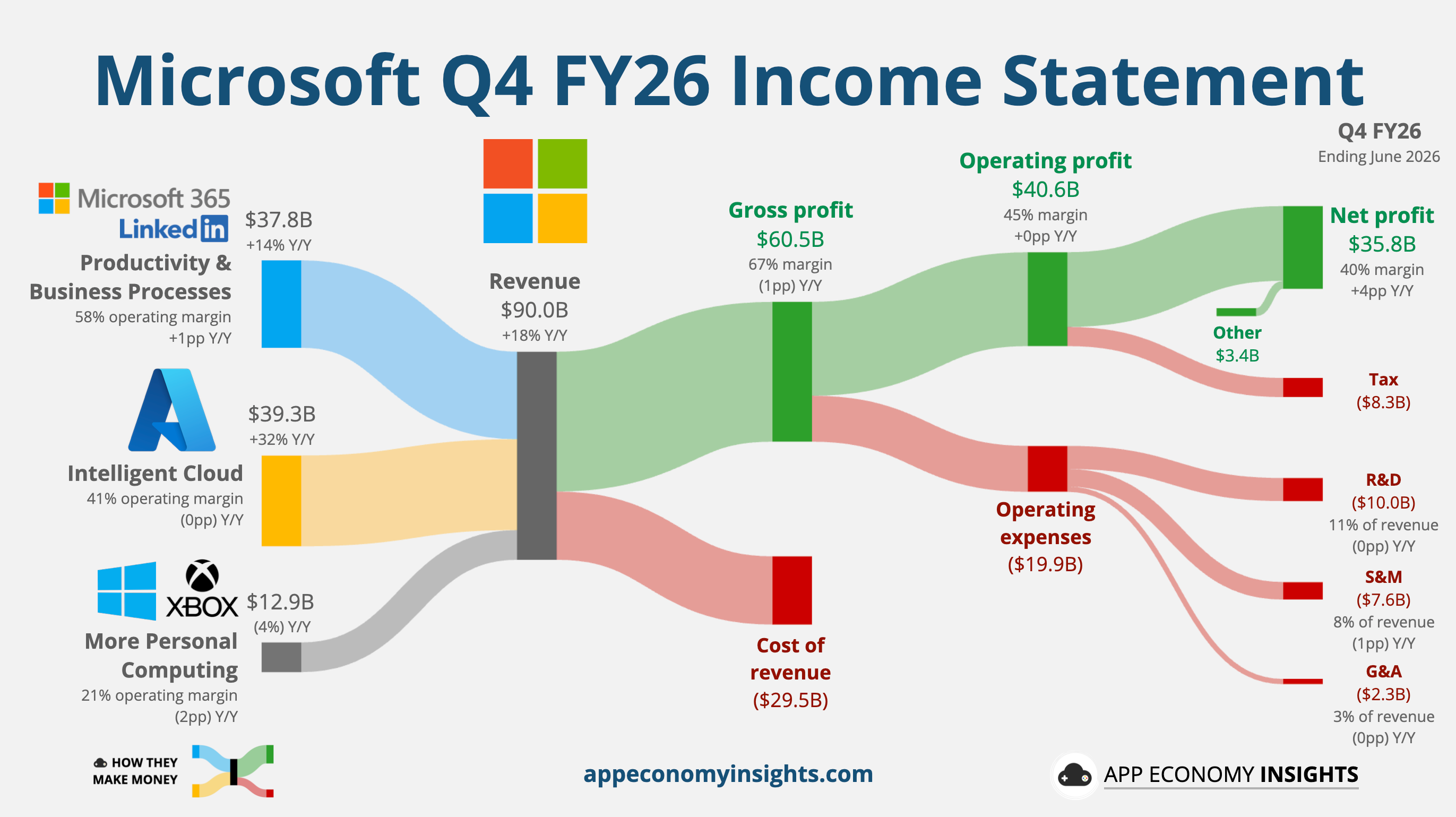
Revenue +18% Y/Y to $90.0 billion ($2.4 billion beat).
Gross margin 67% (-1pp Y/Y).
Operating margin 45% (flat Y/Y).
Non-GAAP EPS $4.74 ($0.50 beat).
Core business segments:
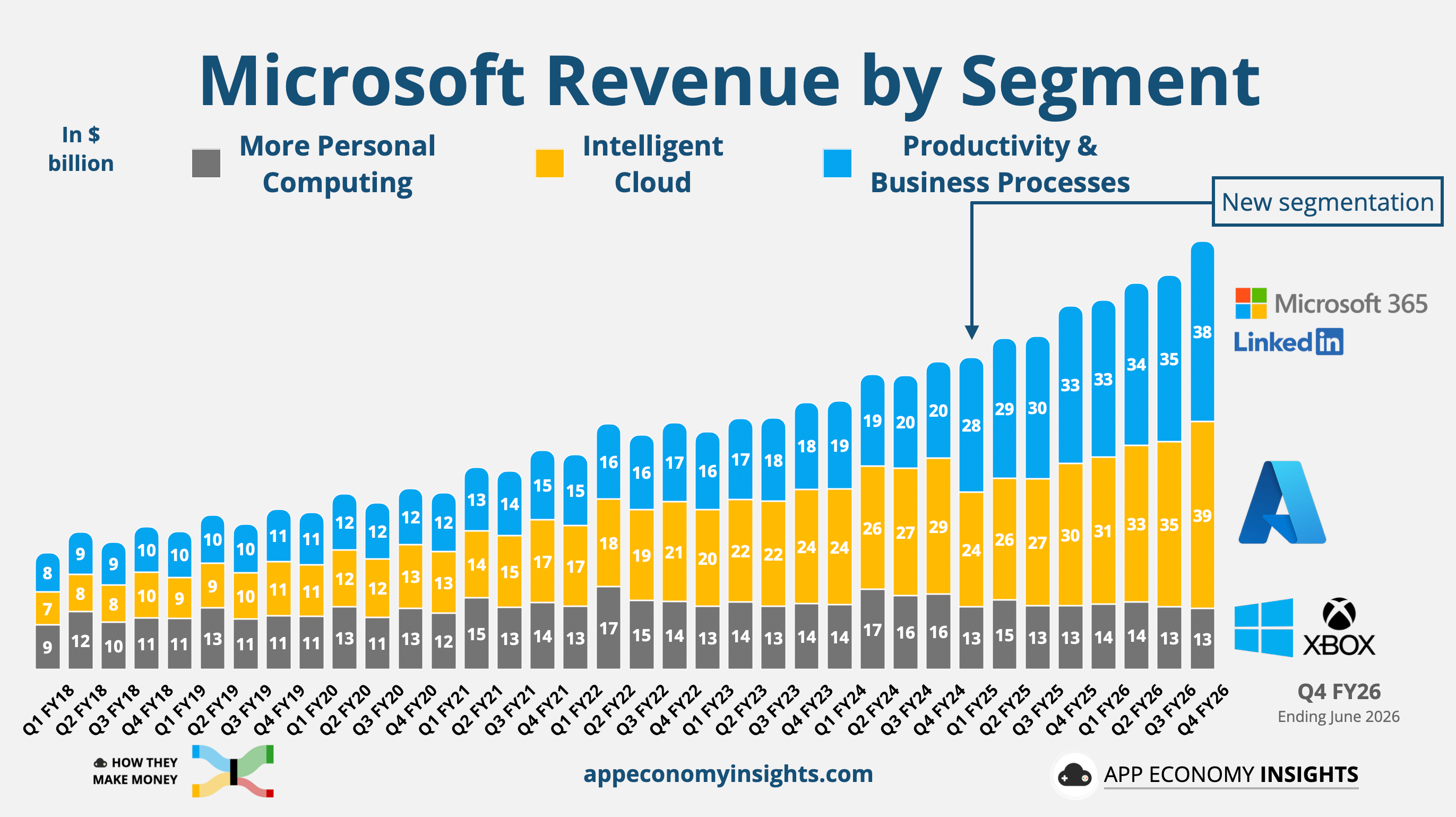
📊 Productivity and Business Processes grew 14% Y/Y to $37.8 billion, supported by M365 Copilot, E5, and early E7 momentum, alongside stronger M365 commercial products revenue.
☁️ Intelligent Cloud grew 32% Y/Y to $39.3 billion, driven by 43% Azure growth as Microsoft improved fleet efficiency and brought new capacity online faster.
🎮 More Personal Computing declined by 4% Y/Y to $12.9 billion, as weaker Windows OEM and Xbox revenue outweighed 10% growth in Search advertising.
Key Trends:
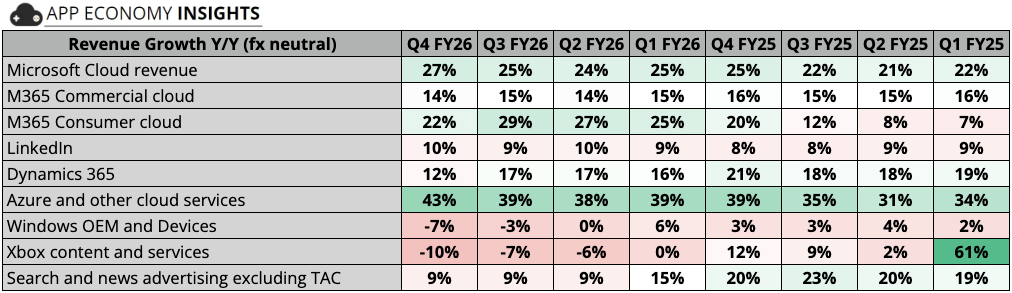
The table below compares growth year-over-year in constant currency. Some of the products and services overlap.
Cash flow:
Operating cash flow grew 30% Y/Y to $55.4 billion.
Free cash flow declined by 23% Y/Y to $19.6 billion.
Balance sheet:
Cash, cash equivalents, and investments: $76.8 billion.
Long-term debt: $31.1 billion.