


Welcome to the Free edition of How They Make Money.
Over 300,000 subscribers turn to us for business and investment insights.
In case you missed it:

Amazon plans to spend $220 billion in CapEx this year, up another $20 billion.
And it still won’t be enough. CEO Andy Jassy explained:
“Even at that amount, we will still not have enough capacity to meet all the demand we have in 2026. […] I believe this dynamic will also be true in 2027, too.”
AWS growth accelerated for the fifth consecutive quarter, backlog reached $496 billion, and margins expanded despite the unprecedented buildout.
Amazon has been building the stack for agentic AI. Now, the bet is moving from architecture to economics. Demand is arriving faster than capacity, and Jassy is increasingly confident the returns will justify the spend.
Now let’s see what stood out this quarter.
Today at a glance:
Amazon Q2 FY26.
The economics of the AI stack.
Key quotes from the call.
What to watch moving forward.

1. Amazon Q2 FY26
Income statement:
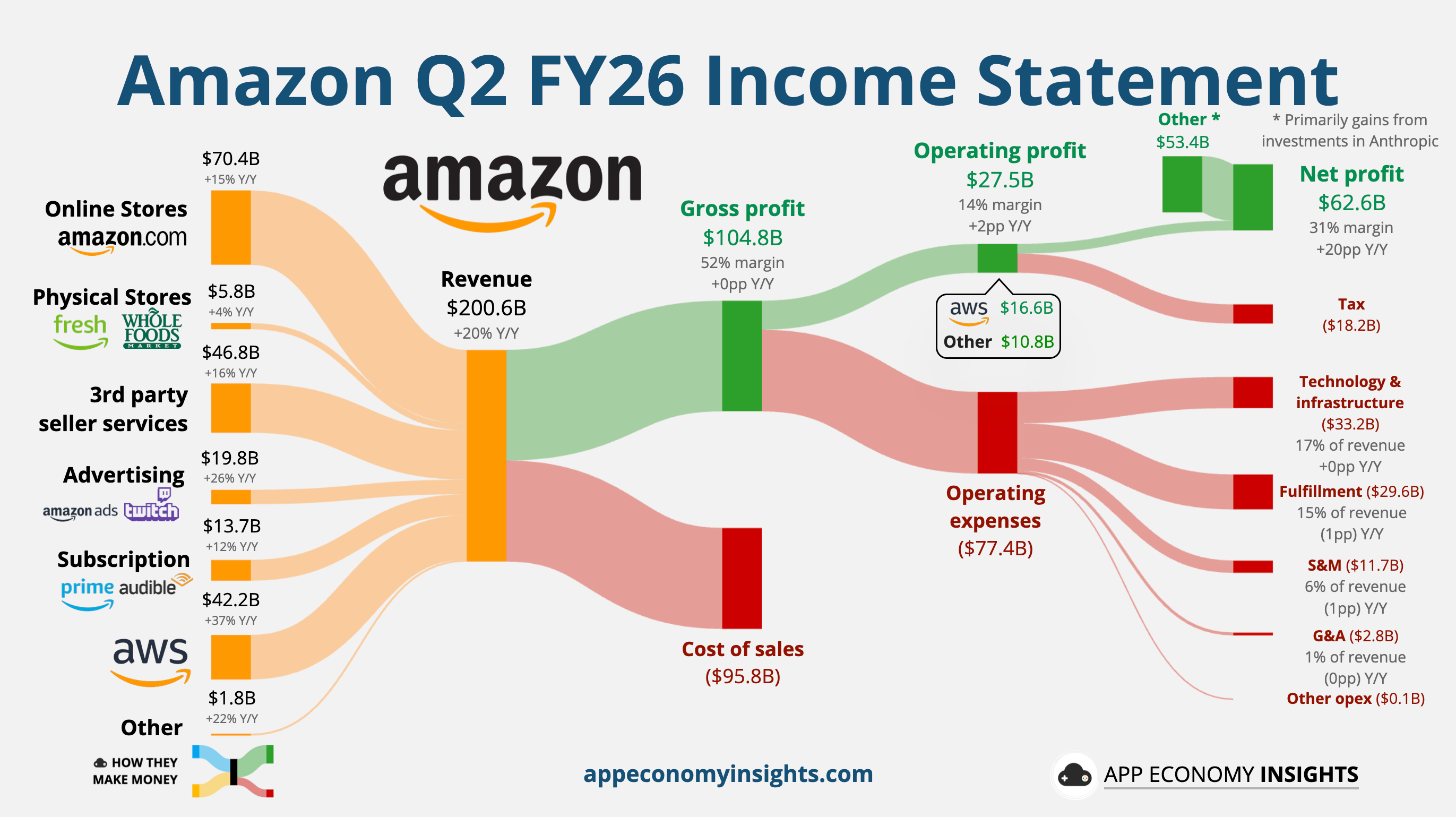
Revenue rose +20% Y/Y to $200.6 billion ($4.2 billion beat).
Gross margin was 52% (+0pp Y/Y).
Operating margin was 14% (+2pp Y/Y).
AWS: 39% margin (+6pp Y/Y).
North America: 8% margin (+0pp Y/Y).
International: 4% margin (+0pp Y/Y).
Net profit included a $53.4 billion non-operating gain, primarily from the valuation markup of Anthropic. The markup followed Anthropic’s $65 billion Series H round in May at a $965 billion valuation, up from $380 billion in February.
Cash flow:
Operating cash flow TTM was $161.4 billion (+33% Y/Y).
Free cash flow TTM fell to negative $7.6 billion as a 64% rise in CapEx to $169.0 billion more than offset the growth in operating cash flow.
Balance sheet:
Cash, cash equivalents, and marketable securities: $123 billion.
Long-term debt: $129 billion.
Q3 FY26 Guidance:
Revenue +9% to 12% Y/Y.
Operating income of ~$24.5 billion, or +40% Y/Y at the midpoint.
So, what to make of all this?
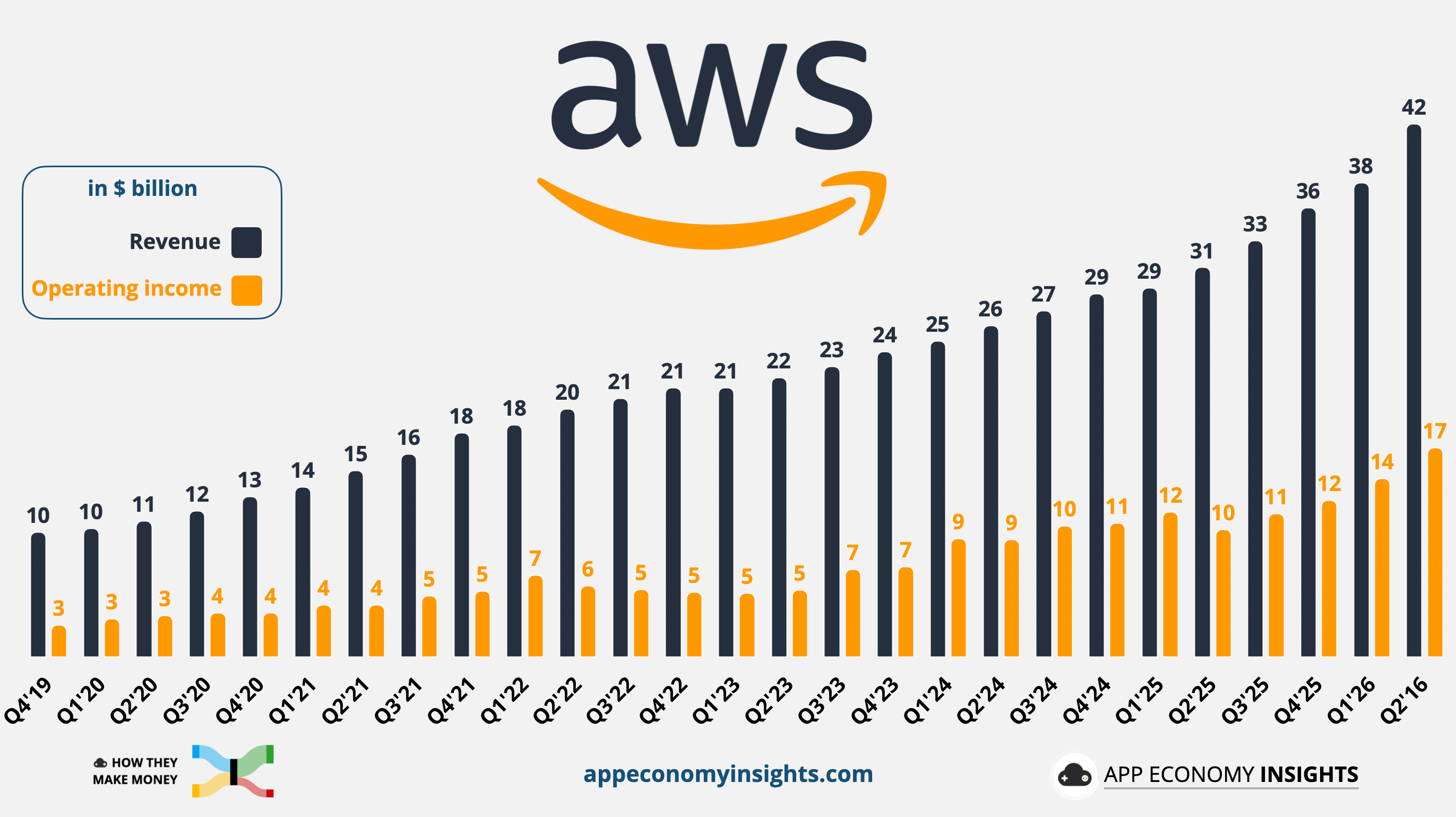
☁️ AWS breaks out: AWS revenue accelerated 37% Y/Y to $42.2 billion, its fastest growth in 18 quarters. AWS operating margin reached 39%. Excluding a $600 million energy-contract accounting gain, it still expanded 520 basis points Y/Y. Meanwhile, Amazon’s AI and custom-chip businesses each surpassed $25 billion annual revenue run rates, both growing triple digits. The chips business was above $20 billion just three months ago. At this scale, accelerating growth and expanding margins at the same time is the quarter’s defining result.
💵 The AI bill is getting larger: Free cash flow swung to a $7.6 billion outflow as CapEx reached $169 billion over the past year. Amazon also raised its 2026 CapEx forecast from $200 billion to $220 billion, primarily because of higher memory costs. Capital spending now exceeds the cash Amazon generates from operations.
📦 Retail volume remains strong: North America revenue grew 16%, International grew 15%, and worldwide paid units increased 17%. North America margin was flat even with a $600 million tariff refund, as higher fuel and transportation costs offset continued fulfillment efficiencies.
📢 Advertising keeps climbing: Revenue grew 26% Y/Y to $19.8 billion, putting the business near an $80 billion annual run rate. Sponsored Products remains the core engine, while Prime Video and live sports are opening new inventory.
🔮 Guidance looks softer than the underlying business: Q3 revenue growth is expected to slow to 9%–12%, but the shift of Prime Day into Q2 reduces the reported growth rate by nearly four percentage points, while foreign exchange creates another 80-basis-point headwind. Operating income is still expected to grow roughly 40% at the midpoint, suggesting Amazon’s margin expansion remains intact.
2. The economics of the AI stack
🏗️ The return profile
Jassy finally laid out the math behind Amazon’s massive CapEx ramp.
The spending falls into two different buckets:
Servers and networking equipment: Purchased only a few months before deployment, when Amazon already has visibility into demand. They typically break even in less than three years, while most AI capacity is contracted for at least five.
Data centers: Built roughly two years before monetization, but designed to operate for more than 30 years and support five or six generations of servers.
Most of AWS’s 2027 capacity is already reserved, with meaningful commitments extending into 2028.
The near-term free cash flow pressure is unavoidable, but Amazon is not building on speculation. Much of the equipment is backed by long-term contracts, while the data centers can generate revenue long after the first generation of servers is retired.
👔 Moving up the stack
AWS is also expanding beyond infrastructure into the software agents running on top of it. Bedrock customers spent more in Q2 than in all previous quarters combined.
Bedrock AgentCore added payments, web search, deterministic controls, and a development harness.
Amazon Quick can now run autonomous workflows across email, calendars, files, and third-party applications.
Kiro, Amazon’s coding agent, tripled usage sequentially.
Continuum uses agents to identify, validate, and remediate software vulnerabilities.
AI is also pulling the core cloud business with it, since post-training and agent tool use rely heavily on CPUs. Trainium and Graviton lower the cost underneath, Bedrock sits at the model and agent layer, and applications such as Quick, Kiro, and Continuum move AWS closer to the end user.
3. Key quotes from the earnings call
Check out the earnings call transcript on Fiscal.ai here.
Andy Jassy on AI economics:
“We see the margins and returns in AI tracking what we saw with Core at the same point of evolution, actually a little ahead.”
This directly challenges the assumption that AI workloads will structurally dilute cloud margins. Amazon believes AI economics are developing faster than AWS did in its early years.
On the real inference opportunity:
“In the middle of the barbell is all of the current enterprise production workloads, some of which are using inference in a pervasive way, but most of which aren't. That is going to change very significantly over time. In my opinion, that will be the largest absolute segment […].”
AI demand is currently barbelled between frontier labs and breakout applications on one side, and narrow enterprise use cases on the other. Jassy believes the middle will eventually become the largest segment: AI embedded across existing production workloads.
On Amazon’s frontier model:
“My view of it is that within the next few years, you're going to have at least a half dozen models that are comparably good to each other. [...] They'll all be in Bedrock, one of them will be ours.”
Amazon does not need its model to dominate. Bedrock wins through choice, while an in-house frontier model gives Amazon more control over cost, speed, and product priorities.
4. What to watch moving forward
☁️ AWS market share
Total cloud infrastructure spending surged 43% Y/Y to $143 billion in Q2, the 11th consecutive quarter of accelerating growth and the fastest pace in eight years. The market has doubled over that period, with GenAI-specific cloud services growing 165% Y/Y, according to Synergy Research Group.
AWS maintained its leading 28% market share, compared to 20% for Microsoft Azure and 15% for Google Cloud. The three platforms now control 63% of the overall cloud infrastructure market, and 67% of public IaaS and PaaS spending.
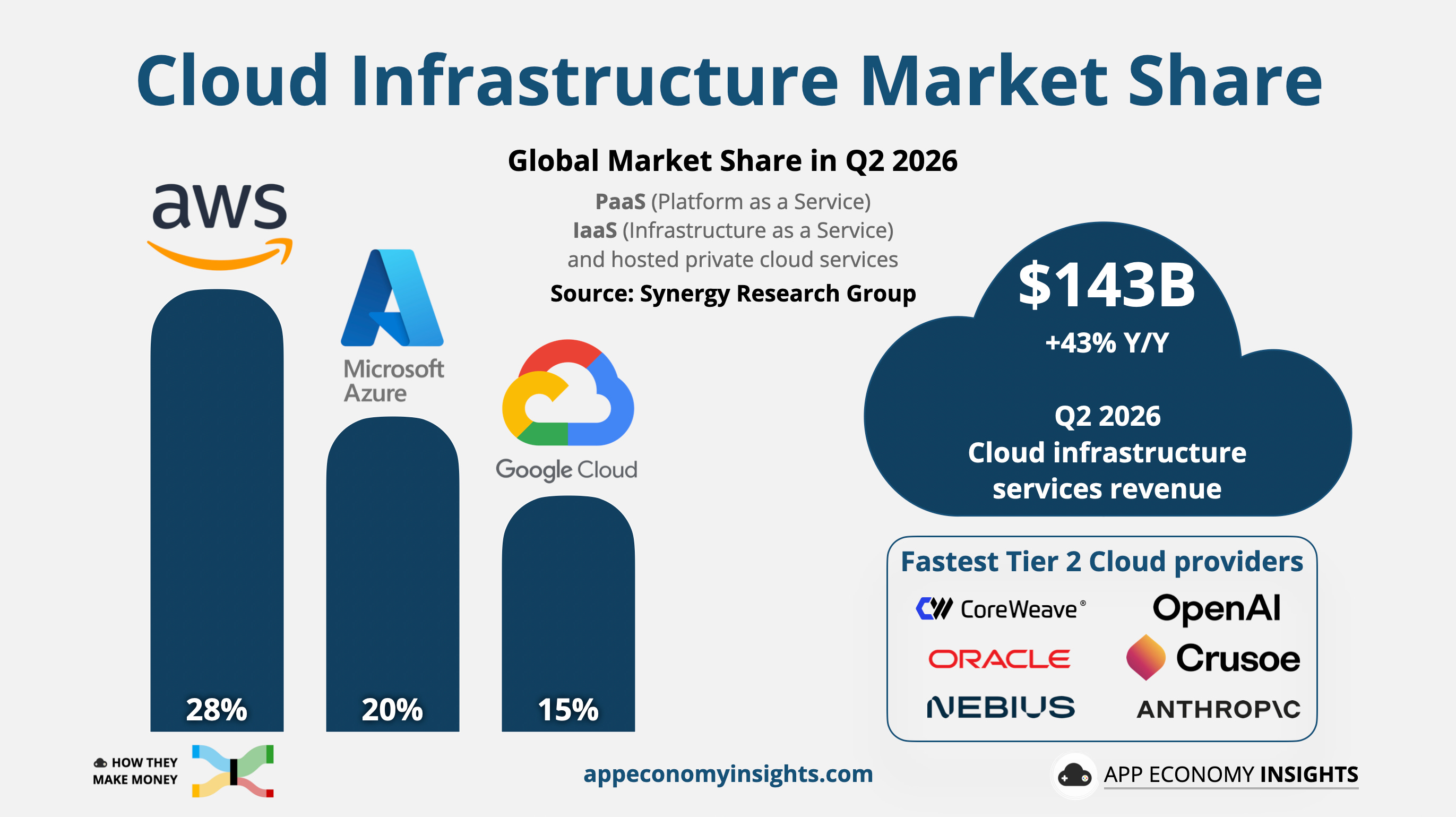
All hyperscalers remain supply-constrained, so small quarter-to-quarter market-share movements should not be overanalyzed. The bigger story is a broad AI-driven reacceleration. Microsoft and Google are still growing faster, but AWS has held its 28% share while accelerating from a much larger revenue base.

🧠 Trainium beyond AWS
Amazon is exploring selling Trainium chips separately to customers operating their own data centers. That could turn Trainium from an AWS-exclusive advantage into a merchant-chip business, expanding Amazon’s addressable market beyond the cloud.
The trade-off is whether selling Trainium more broadly weakens one of AWS’s clearest cost and performance advantages.
🛒 Grocery changes the shopping habit
Amazon now offers same-day perishables in 2,300 US cities. Monthly active perishables customers have increased 50% since the start of the year, while orders containing perishables average three times as many units.
The opportunity extends beyond grocery revenue. Grocery can increase purchase frequency, basket size, delivery density, and advertising inventory at the same time.
🏗️ Big Tech’s cash engine
In Q2 2026, the leading hyperscalers grew their trailing-12-month operating cash flow by 34% to $660 billion.

That cash engine allowed Big Tech to begin the AI buildout without relying heavily on outside capital. But the scale of investment has now caught up: free cash flow has turned negative at Amazon and Google and fallen close to zero at Meta. The next phase is already pulling more debt into the equation. Amazon issued debt this year and says it will continue evaluating its funding options (in Alphabet’s case, that includes equity issuance).
Amazon argues this is a timing mismatch rather than a deterioration in economics. It is spending years ahead of demand, while the resulting infrastructure could generate revenue for decades. If Jassy is right, today’s free-cash-flow collapse is the price of locking in tomorrow’s capacity. If demand, pricing, or utilization disappoints, that operating leverage works in reverse.
Next up: Saturday’s massive PRO edition, with more than 30 companies visualized.
That’s it for today!
Stay healthy and invest on!
Want to sponsor this newsletter? Get in touch here.
Thanks to Fiscal.ai for being our official data partner. Create your own charts and pull key metrics from 50,000+ companies directly on Fiscal.ai. Start an account for free and save 15% on paid plans with this link.
Disclosure: I am long AMZN, GOOG, META, and MSFT in App Economy Portfolio. I share my ratings (BUY, SELL, or HOLD) with members.
Author's Note (Bertrand here 👋🏼): The views and opinions expressed in this newsletter are solely my own and should not be considered financial advice or any other organization's views.
Amazon lays out some of this cash about two years before it can make money from the capacity. That is the part I keep coming back to. AWS is growing fast now, but demand can change a lot in two years.
The market just voted on the capex question, +15% on the print. What I'm watching now is whether $AMZN holds the gap while $QQQ sits under its 50-day with 8 distribution days on the count. If the spend keeps flowing, memory is the follow-on trade. $MU just put in its first higher low in the broken group.