


Welcome to the Free edition of How They Make Money.
Over 300,000 subscribers turn to us for business and investment insights.
In case you missed it:
🤖 Anthropic cracks open
Anthropic’s IPO prospectus hasn’t officially landed yet, but Reuters obtained a leaked draft this week, giving us the first real look inside one of AI's most extraordinary growth stories.
A few numbers already stand out:
Revenue reportedly reached ~$4.6 billion in 2025, up 12x Y/Y.
Compute and infrastructure spending topped $7 billion.
Nearly half of revenue came through AWS and GCP, showing how Amazon and Google are simultaneously investors, infrastructure providers, distributors, and competitors.
Much more is hidden beneath those numbers, including customer concentration and cash burn. Anthropic has also agreed to spend at least $518 billion on future compute and infrastructure over the next decade, with roughly 80% of those commitments reportedly non-cancellable. I’m waiting for the public S-1 before doing the full teardown. Stay tuned for Anthropic visualized! 📊
Today at a glance:
🏢 Meta’s enterprise push
☁️ Micron raises the floor

🔎 The companies investors haven’t discovered yet
Most of the businesses I cover are already firmly on investors’ radar.
But there’s another part of the market I don’t cover nearly enough.
I’ve been working on something new that fills that gap.
Access will be limited when it opens. Join the priority list to hear it first.

🏢 Meta’s enterprise push
Meta spent the past few weeks showing what AI could mean for consumers.
This week, it turned to businesses.

On Monday, Meta unveiled Meta Enterprise Platform, which Zuck called the company’s “next major pillar.” The new division will bring several pieces of Meta’s AI stack under one roof for businesses and developers, including:
Muse, its personal AI agent
Meta Business Agent
Muse API
Muse Code
Meta’s underlying models and infrastructure
Meta also hired MongoDB CEO CJ Desai to lead the effort. Desai previously ran product and engineering at Cloudflare and spent nearly eight years at ServiceNow. He brings Meta deep enterprise software experience at the top, something it has historically lacked.
The announcement was ambitious enough to rattle the software sector. Salesforce, ServiceNow, Oracle, Adobe and other enterprise names sold off as investors contemplated another hyperscaler moving up the software stack.
That reaction may prove premature.
Building the technology is only part of enterprise software. Large customers also require long sales cycles, procurement, security reviews, integrations and implementation support. Meta has spent decades building consumer products and advertising tools, not selling mission-critical software to CIOs.
That’s why Tuesday’s announcement may be more interesting.
Small business first
Meta introduced Muse for Small Business, allowing companies to connect the agent to tools they already use, including Shopify, QuickBooks, Stripe, Canva, Slack, Notion, Figma, and Zoom, alongside their Facebook and Instagram business accounts.

The opportunity is not necessarily to replace those applications. It’s to sit above them.
A small business owner could ask Muse to understand why sales slowed, identify customers worth targeting, prepare new creative, and coordinate the work across several apps. Meta says actions involving publishing, sending, or spending still require approval.
That’s a much more natural fit for Meta. The company already works with more than 200 million businesses, primarily because they want access to customers on Facebook and Instagram. Many are small enough that the owner is simultaneously the marketer, operator, salesperson, and finance department (like yours truly).
An AI agent that can help across all four functions could be genuinely useful.
It also extends the same thesis we discussed last week without requiring Meta to win an entirely new market.
For consumers, Muse wants to become the interface to the internet
For businesses, it wants to become the interface to the software stack
The applications underneath may remain the same. What changes is who controls the layer where users express intent.
A new way to pay for AI
Meta is also pushing this aggressively for financial reasons.
The company is spending more than $100 billion on AI infrastructure this year. In previous earnings calls, almost every path to monetization eventually came back to advertising, leaving investors skeptical about how broadly Meta could monetize that spending. Enterprise software gives Meta another way to earn a return on the same models, agents, and compute.
Its AI monetization stack is quickly expanding:
Advertising monetizes attention
Subscriptions monetize heavy users
Commerce could monetize transactions
Business software could monetize the AI stack itself
💡 Takeaway: None of this means Meta suddenly becomes Salesforce or ServiceNow. But it is starting to turn its massive AI investment into businesses that extend beyond advertising. Enterprise is the boldest ambition, while small business looks like the lowest-hanging fruit given Meta’s existing customer relationships and distribution.
☁️ Micron raises the floor
Micron closed fiscal 2026 with another extraordinary quarter.
Revenue surged 379% Y/Y and 31% Q/Q to $54.2 billion ($2.7 billion beat).
Adjusted EPS: $33.42, up from $3.03 a year ago ($1.60 beat).
Gross margin: 87%, up from 85% in Q3.
Operating cash flow: $44.0 billion, while free cash flow reached $33.2 billion.
Q1 FY27 guidance: Revenue of ~$61.5 billion (+351% Y/Y; ~$3.6 billion beat) and adjusted EPS of ~$38.15 (~$2.23 beat).
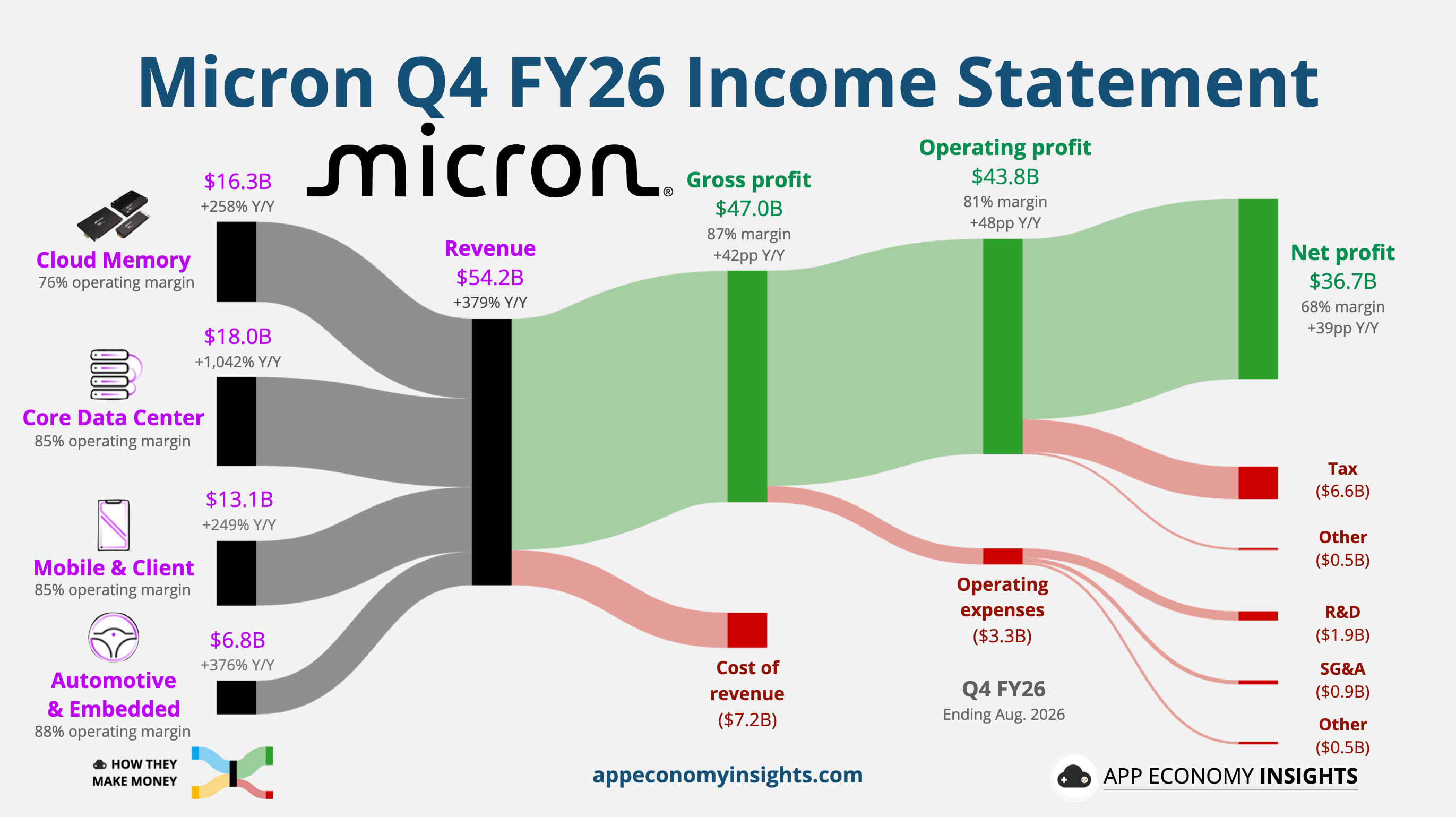
The scale is becoming difficult to process. Micron generated $133 billion of revenue in FY26, up from $37 billion a year earlier, while adjusted gross margin jumped to 81%. It ended the year with nearly $74 billion of cash and investments after producing more than $62 billion of adjusted free cash flow.
The growth is broadening beyond HBM. Core Data Center revenue reached $18.0 billion in Q4, up 56% sequentially, while Cloud Memory climbed to $16.3 billion. Even Mobile and Client posted a remarkable 90% gross margin, showing how far the memory shortage has spread beyond AI accelerators.

The shortage gets tighter
The key update was management’s view that the memory shortage is worsening.
Micron now expects supply-demand conditions in fiscal 2027 and 2028 to be tighter than they were in 2026, with no clear line of sight to when the market returns to balance. That matters because the biggest risk after this kind of earnings explosion is usually obvious: supply catches up, pricing rolls over, and the memory cycle turns.
Micron is also making more progress on the multi-year contracts we discussed last quarter. It now has 26 Strategic Customer Agreements, up from 16, with roughly $32 billion of customer commitments. These agreements cover more than 35% of revenue through 2030, and about three-quarters of that revenue includes defined pricing frameworks. The goal is to make the next downcycle less violent than the last one.
At the same time, Micron is spending aggressively to add capacity. CapEx reached $27 billion in FY26 and is expected to rise further, including roughly $25 billion in the first half of FY27 alone. But much of that new clean-room capacity will not arrive until 2028 and beyond, which helps explain why management still sees such a tight market.

The market is still assuming peak earnings
Despite the extraordinary numbers, Micron still trades at a single-digit forward earnings multiple. The market is effectively saying these margins and earnings cannot last.
That skepticism is understandable. Memory has always been cyclical, and an 87% gross margin looks like the kind of number investors normally associate with a peak.
But Micron is trying to change the evidence investors use to make that judgment:
Long-term customer agreements are replacing annual handshakes.
Customers are putting down billions in deposits and guarantees.
Supply remains constrained well into 2027 and 2028.
AI is increasing memory intensity across data centers, PCs, phones, and eventually physical AI.
The key question is no longer whether Micron is having an extraordinary cycle. It clearly is. The question is whether this cycle has become structurally different enough to deserve a different multiple.
💡 Takeaway: Micron just delivered the kind of quarter that would normally scream peak cycle. Yet supply is getting tighter, customer commitments are getting longer, and FY27 guidance is still moving higher. The market is still pricing Micron like memory eventually reverts to the old playbook. The question is whether AI has changed that playbook enough to justify a different multiple. Just remember the four most dangerous words in investing: “this time is different.”
That's it for today.
Happy investing!
P.S. I’m working on something new for investors looking beyond Big Tech.
Want to sponsor this newsletter? Get in touch here.
Disclosure: I own AMZN, GOOG, and META in App Economy Portfolio. I share my ratings (BUY, SELL, or HOLD) with App Economy Portfolio members.
Author's Note (Bertrand here 👋🏼): The views and opinions expressed in this newsletter are solely my own and should not be considered financial advice or any other organization's views.