Welcome to the Premium edition of How They Make Money.
Over 300,000 subscribers turn to us for business and investment insights.
In case you missed it:

☁️ Nscale is going public
Nscale was spun out barely two and a half years ago.
It has already signed contracts worth up to $103 billion in future revenue.
Now it wants to build a full-stack AI hyperscaler from power to token.
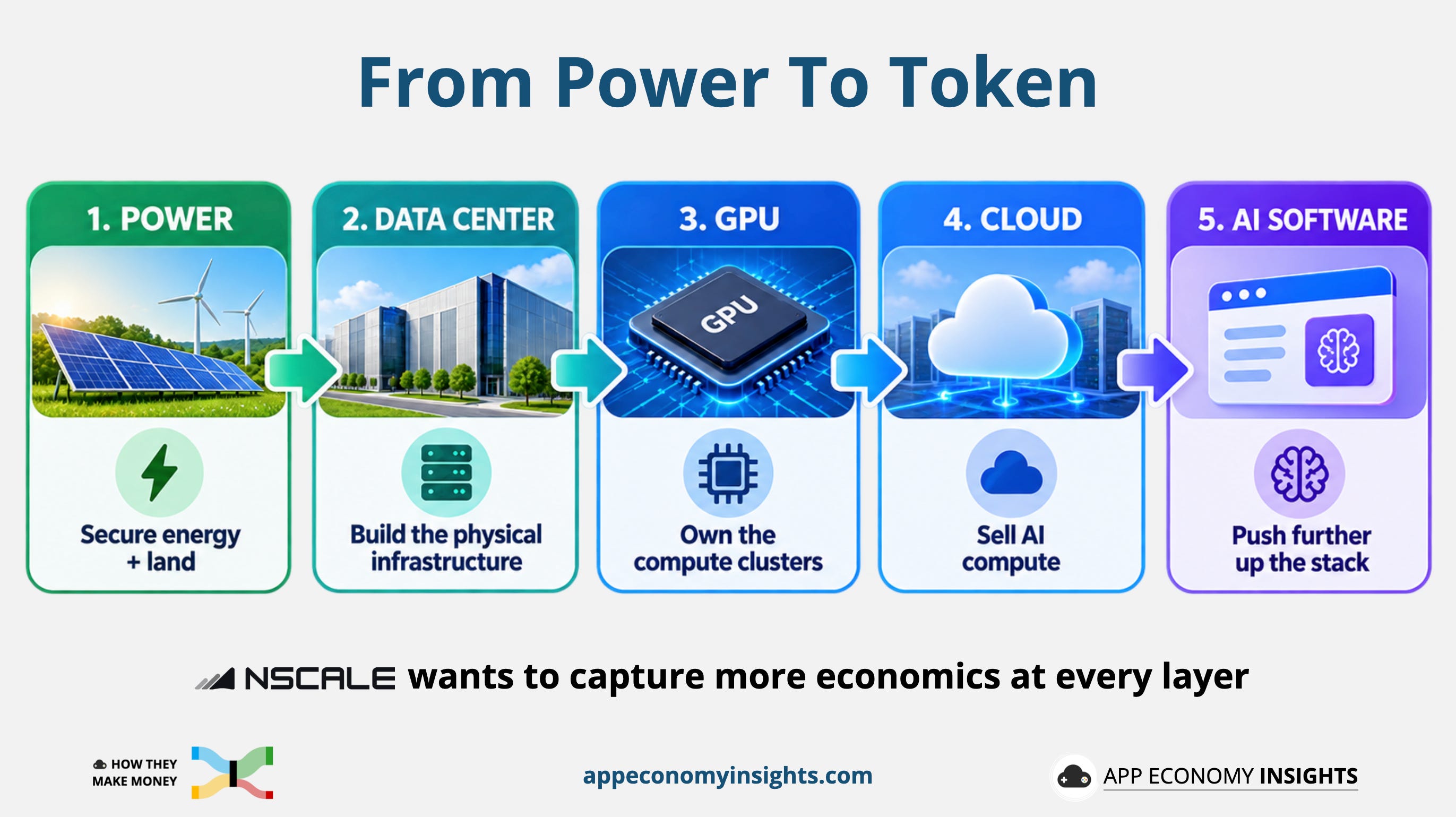
The company secures power and land, builds data centers, buys the GPUs, sells the compute, and is now pushing further into AI software. And it’s scaling at an almost absurd pace.
Yet today, only 25,000 GPUs are active, compared with 461,000 active and contracted GPUs. Revenue reached just $141 million in the first half of 2026, even after growing 1,252% Y/Y.
The gap between what Nscale operates today and what it has already contracted is the main IPO story.
Can it turn extraordinary demand into a vertically integrated AI infrastructure platform before the capital requirements overwhelm the economics?
And then there is NVIDIA, which somehow shows up on almost every side of the transaction.
I condensed the S-1 into a clean breakdown, supported by our signature visuals. By the end, you’ll have a clear view of the Nscale investment case.
Today at a glance:
Overview
Business model
Financial highlights
Risks & challenges
Management
Use of proceeds
Future outlook
Personal take

1. Overview
Nscale was born out of a bitcoin miner.
Before the company was spun out in May 2024, its team was part of Arkon Energy, which had spent years assembling powered sites in markets where electricity was cheap and abundant.
The opportunity changed when AI demand exploded. The logic was simple. If models kept getting larger and more compute-intensive, power would become the bottleneck.
Power first
GPUs get most of the attention, but they are useless without enormous amounts of electricity behind them.
Nscale started by securing land and power in markets including Norway, Iceland, Portugal, and the US, then building compute capacity on top. Management now calls access to large blocks of reliable power the primary constraint on AI infrastructure.
As of August, Nscale had:
5 active and 12 contracted data-center sites
1.37 GW of active and contracted capacity
Line of sight to roughly 10 GW of potential power capacity
The biggest example is Monarch, a 2,250-acre campus in West Virginia acquired in March. Nscale says the site could eventually support more than 8 GW of power, including over 6.5 GW of IT load. The first 1.37 GW is expected to be online in the first half of 2028.
Moving up the stack
Nscale does not want to stop at power and data centers.
It also owns and operates the GPUs inside them, then sells the compute through its cloud platform.
The planned acquisition of Anyscale, which builds software to run and orchestrate AI workloads, pushes Nscale another step higher into the software layer.
That is how Nscale gets to its pitch of becoming a full-stack AI hyperscaler.
But the current business still looks very different from that end state. Most of Nscale’s active capacity today sits in colocation or leased facilities, which lets the company get GPUs online while its own campuses are being built. By contrast, most of its contracted capacity is expected to sit in facilities Nscale owns.
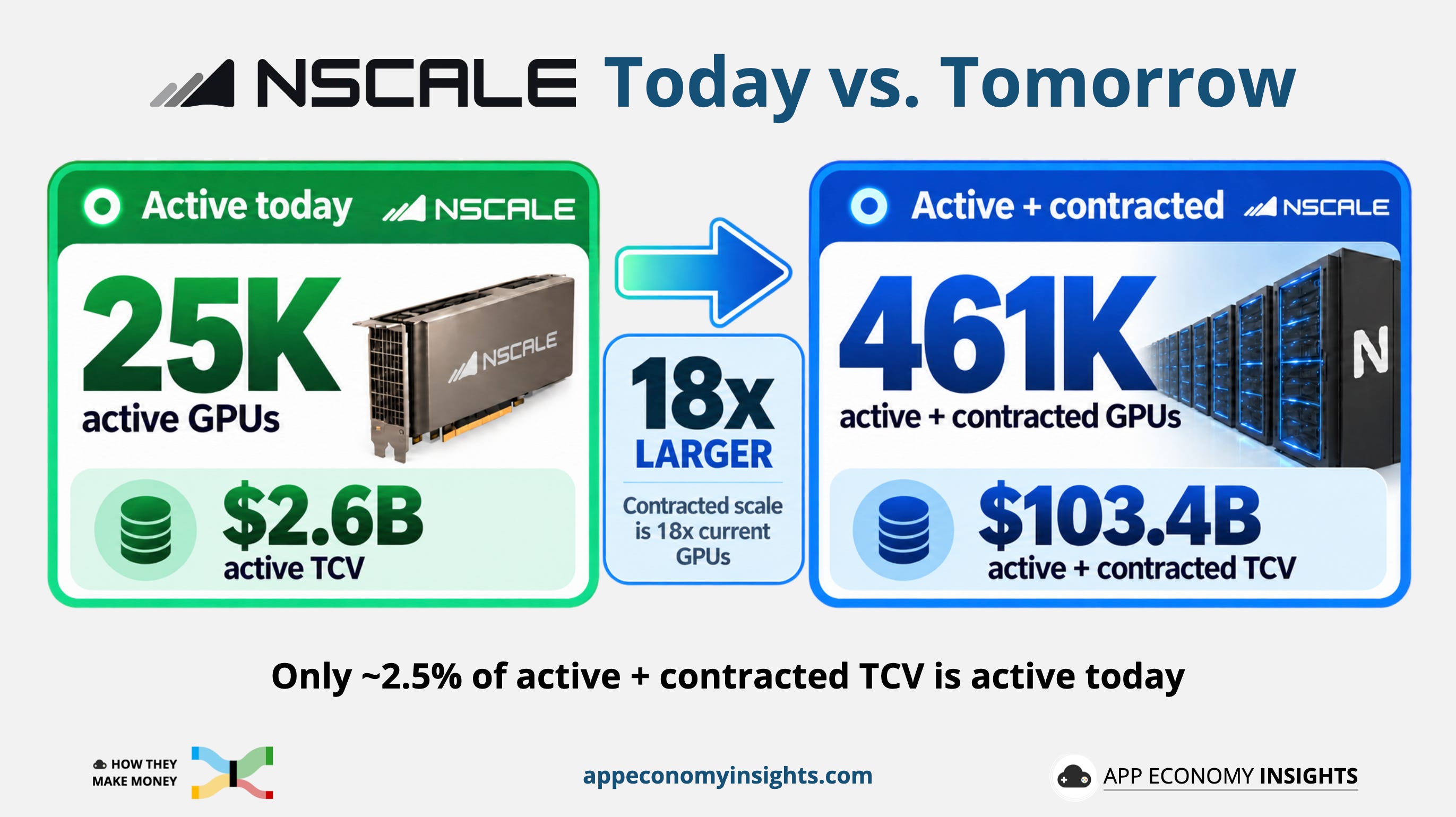
Nscale is already selling the future version of the company while much of the physical infrastructure behind it still needs to be built.
Takeaway: Nscale’s original advantage was access to power. Now it’s trying to use that foothold to own more of the economics around AI compute, from the data center to the GPU to the software layer. The opportunity is enormous, but the vertically integrated company investors are being asked to value is still mostly under construction.
2. Business model
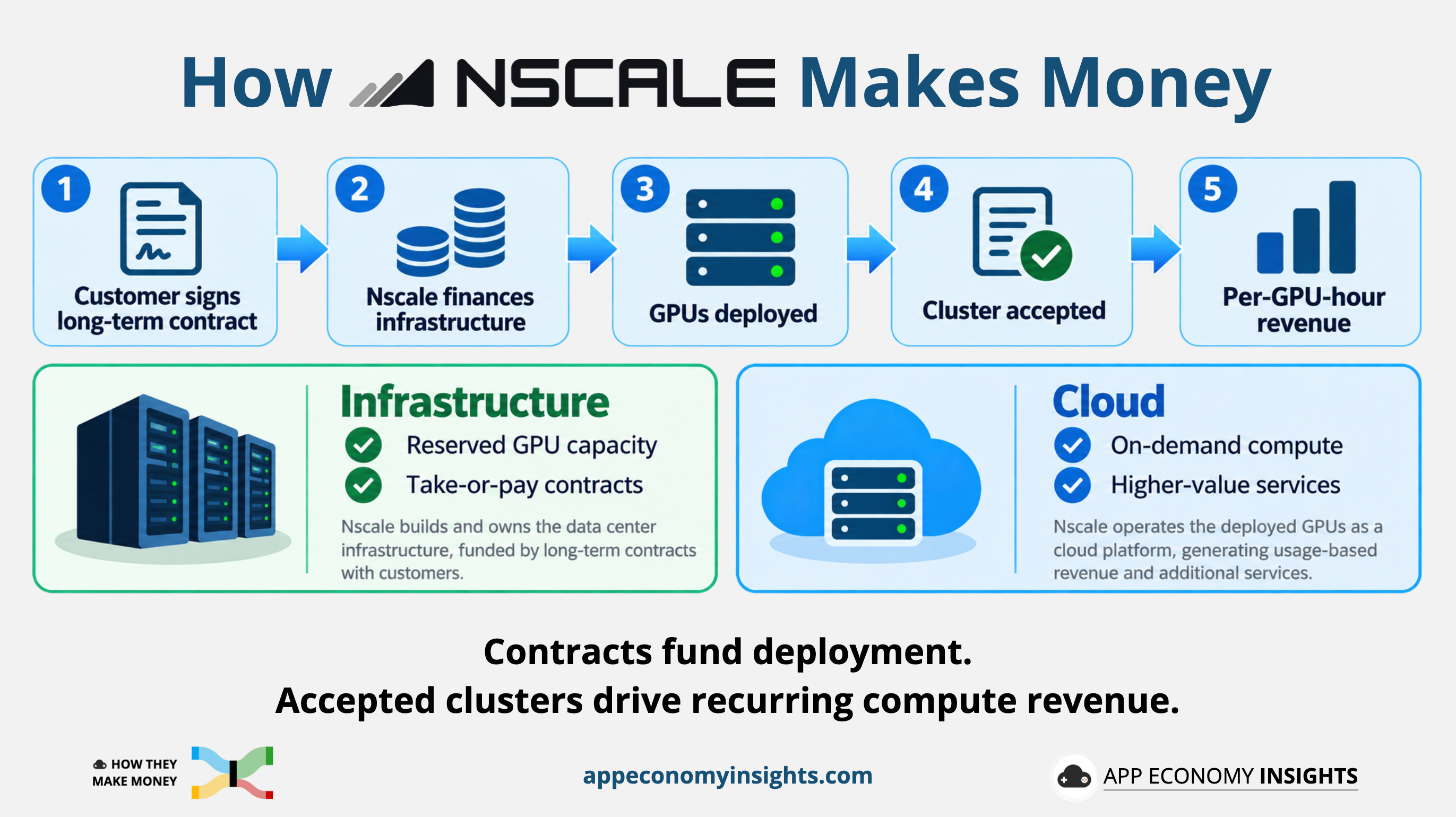
Nscale monetizes its infrastructure through two businesses:
🖥️ Nscale Infrastructure: Reserved AI compute sold under long-term contracts to hyperscalers, frontier labs, and large technology companies.
☁️ Nscale Cloud: On-demand compute and higher-value platform services aimed at AI-native companies, enterprises, and sovereign customers.
Today, the first business drives almost all of the economics.