


Welcome to the Premium edition of How They Make Money.
Over 300,000 subscribers turn to us for business and investment insights.
In case you missed it:
AI is changing business models in real time
OpenAI is building an advertising machine, Meta is pushing deeper into subscriptions, and Salesforce is rethinking how software gets monetized in an agentic world.
How do you make money when AI changes the interface?
AI is no longer just changing products. It’s reshaping the economics underneath them, determining who pays, what they pay for, and which parts of the stack capture the value.
This week, we look at what each company is building, why these shifts are happening now, and what they could mean for some of tech’s most durable business models.
Today at a glance:
🤖 OpenAI’s advertising machine
♾️ Meta’s second business model
☁️ Salesforce is going headless

🤖 OpenAI’s advertising machine
OpenAI spent years insisting advertising was not central to its business model. It took less than 200 days to build a $1 billion advertising business.
ChatGPT Ads reached that annualized run rate in August, with tens of thousands of advertisers already using the platform. Against more than 1 billion weekly ChatGPT users, that still works out to only about $1 per user.
For a rough sense of scale, Meta generated about $57 per daily active person across its Family of Apps last year. Of course, the metrics aren’t directly comparable. Meta uses a much more engaged daily-user denominator across multiple apps, while many ChatGPT users don’t see ads at all. But the gap shows how early OpenAI’s monetization still is.
The more interesting question is how much deeper into the purchase decision ChatGPT can move.
Google became an advertising giant because search captures intent. Someone searching for accounting software is already close to a purchase. ChatGPT can potentially see much more of the decision — the budget, existing tools, requirements, preferences, and tradeoffs discussed throughout a conversation. That could make the commercial intent unusually valuable.
Amazon is already validating that thesis. The company recently opened ChatGPT Ads to brands using Amazon Ads, despite historically restricting AI chatbots from accessing much of its storefront. Amazon manages the campaigns, while OpenAI determines where the ads appear based on the ChatGPT conversation.
The arrangement is clever for both sides. Amazon preserves its advertising economics and remains the destination for the purchase. OpenAI gets paid for the intent generated inside ChatGPT.
In effect, Amazon can sell advertisers the opportunity to become the Amazon link inside a ChatGPT recommendation.
The agent becomes the ad
OpenAI is now pushing further with Sponsored Agents.
Instead of clicking an ad and navigating an advertiser’s website, users can start a clearly labeled conversation with an AI representative of the brand. The agent can answer questions, explain differences, and help the user decide before eventually sending them to the advertiser when they are ready to act. Sponsored Agents are currently being tested with select US advertisers.
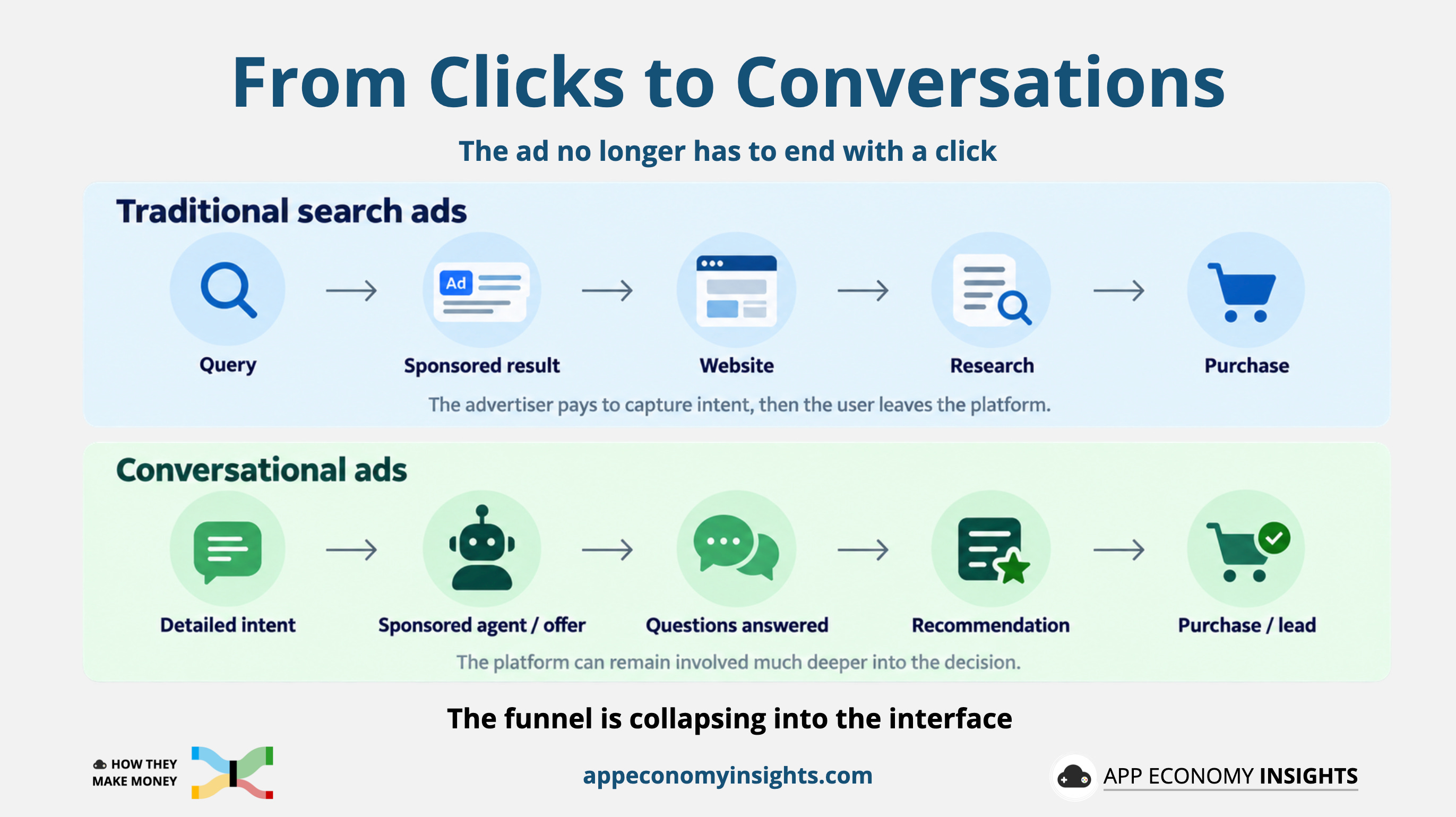
Conversational ads change what the ad itself can do. Instead of merely earning the click, it can help qualify the customer before the click happens.
Here’s one way to think about the evolution of digital ads. We went from monetizing the query (blue links) to attention (the endless scroll) to monetizing more of the decision itself (AI agents).
The decision matters most in categories where purchases require personalized research, such as software, travel, financial services, education, home improvement, or expensive consumer products. The conversation can absorb more of the work that currently happens across search results, comparison sites, product pages, and sales calls.
OpenAI is also making it easier for advertisers to plug into the system. New integrations with Shopify and HubSpot span everything from product catalogs and campaign creation to lead capture and measurement.
The tension is obvious. ChatGPT works because users trust that its recommendations are based on usefulness, not on who paid for placement. OpenAI therefore needs to monetize commercial intent without blurring that distinction.
