


Welcome to the Saturday PRO edition of How They Make Money.
Over 300,000 subscribers turn to us for business and investment insights.
In case you missed it:
Premium members get:
📊 Monthly reports: 200+ companies visualized.
📩 Tuesday articles: Exclusive deep dives and insights.
📚 Access to our archive: Hundreds of business breakdowns.
PRO members get everything PLUS:
📩 Saturday PRO reports: Timely insights on the latest earnings.
Today at a glance:
🕶️ Meta: AI Bet Takes Shape
🚖 Tesla: $5 Billion CapEx Reversal
🧴 P&G: Volume Returns
🧠 Lam Research: AI's Storage Problem
☁️ SAP: Backlog Redemption
⚙️ Texas Instruments: Industrial Breaks Out
🌐 IBM: Mainframe Comeback
💳 Amex: Premium Trade-Off
🧬 Abbott: A Leaner Future
📞 AT&T: Cost of Convergence
🦾 Intuitive Surgical: Cost of Expansion
🛰️ Lockheed Martin: $292 Billion Backlog
🎧 Spotify: Agentic Advantage
💼 Moody’s: AI Financing Boom
🚗 GM: Cash Over Growth
🛩️ United: Pricing Power Meets Its Limits
🛩️ Southwest: Fuel Squeeze
🦅 American Airlines: Fuel Trap
🏡 Appfolio: AI Goes to Work

1. 🕶️ Meta: AI Bet Takes Shape
Meta’s Q3 revenue rose 26% Y/Y to a record $64.6 billion ($1.2 billion beat), while adjusted EPS reached $7.40 ($0.60 beat). GAAP EPS of $3.83 included a $10 billion legal charge tied to its settlement of youth-safety lawsuits.
Shares fell 7% as investors looked past strong advertising growth and encouraging early traction for Muse, and focused instead on mounting AI spending and deteriorating free cash flow.
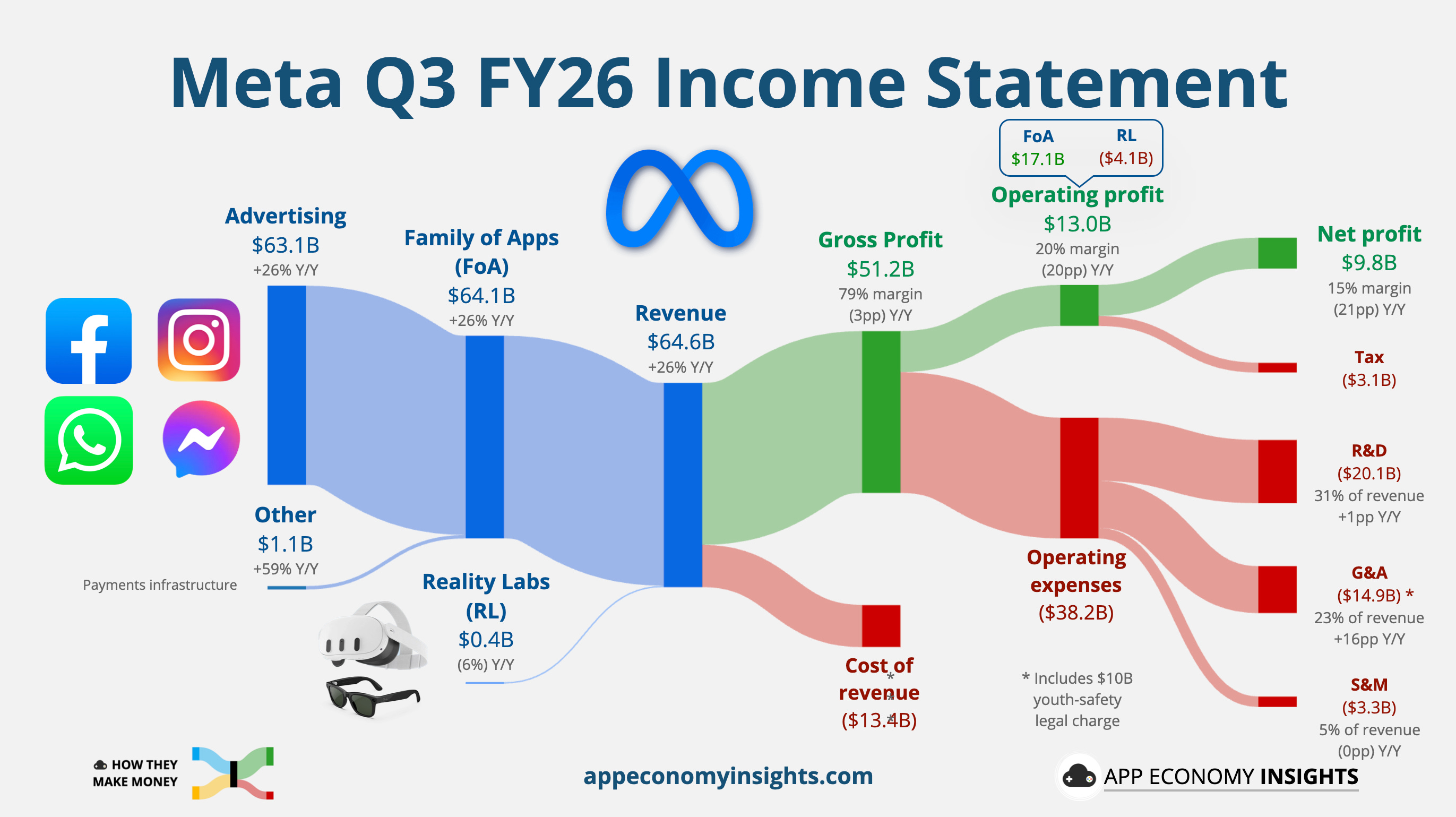
Ad revenue grew 26% Y/Y to $63.1 billion, with impressions up 10% and average price per ad rising 14%. That’s a shift from Q2, when impression growth (14%) outpaced pricing growth (12%). Meta is increasingly monetizing its existing audience more effectively rather than simply showing more ads. Family daily active people reached 3.64 billion (+3% Y/Y), while AI-powered recommendations and targeting continued to support engagement and conversion rates.
But the bigger story is Muse becoming a tangible business opportunity just six weeks after launch:
More than 10 million users have tried Muse in the US and Canada, with approximately 25% returning on a given day. That’s promising early engagement, although retention and monetization remain unproven at scale.
Shopping is the leading use case, with more than 25% of users engaging in commerce activities. Meta sees opportunities in subscriptions, transaction fees, and eventually advertising, extending its reach from influencing purchases to facilitating them.
Muse Wonder, Meta’s first family of frontier models, is already powering new capabilities. Management expects to improve Muse’s compute efficiency by more than 10x over the next year, an important step toward making the agent economically viable.
Zuck believes Muse could eventually serve billions of people and generate more revenue per user than Meta’s existing social platforms. The ambition is enormous, but so are the obstacles. Amazon and other websites have blocked Muse from shopping on their platforms, illustrating why Meta is developing a Personal Agent Protocol to enable structured interactions between agents and businesses. Winning the interface doesn’t automatically guarantee access to the transaction.
Meanwhile, the AI bill keeps growing:
Free cash flow turned negative for the first time, at -$2.1 billion, compared with $784 million in Q2 and $10.6 billion a year ago. Capital expenditures reached $34.9 billion, up from $31.1 billion in Q2.
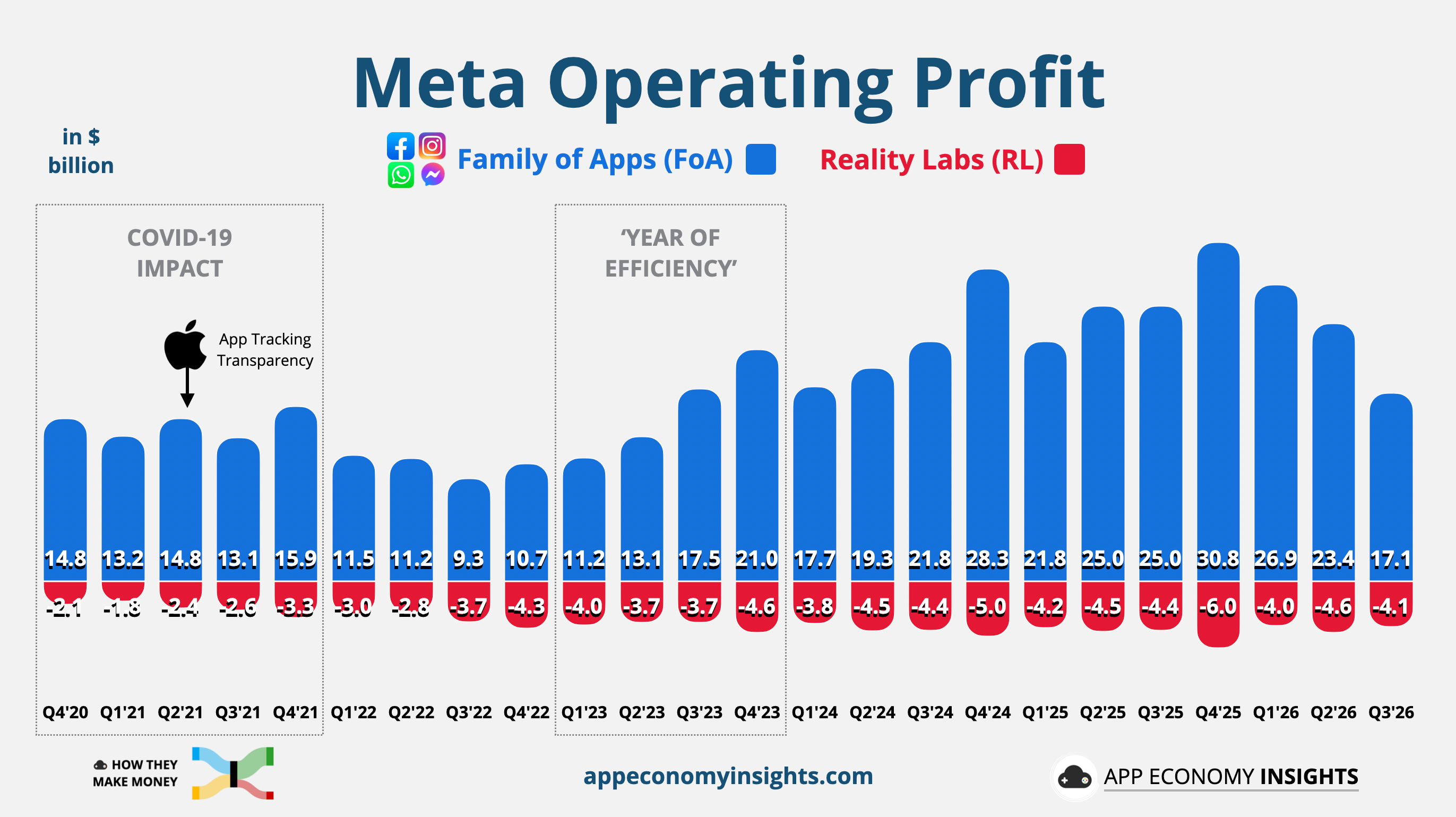
Meta raised the floor of FY26 CapEx guidance again, to $135–145 billion (from $130–145 billion). Even excluding the legal charge, operating margin declined to roughly 35% from 40% a year ago as AI infrastructure depreciation and R&D spending increased.
Reality Labs lost another $4.1 billion. Management now expects annual losses of $18–19 billion for the segment in FY26 and approximately $15 billion in 2027 as resources shift toward AI.
Meta also announced a new class of non-voting shares, effectively creating a 2-for-1 stock split in January 2027. The Class C shares could fund acquisitions, employee compensation, or future capital raises without diluting Zuck’s voting control. It’s a notable move for a company that historically funded its ambitions through advertising cash flow.
More legal risks loom. Beyond the $10 billion Q3 charge, a New Mexico judge ordered Meta to pay $25 billion over alleged consumer deception related to privacy and content moderation. Meta plans to appeal, and the judgment is separate from the previously announced multistate settlement.
Meta guided Q4 revenue to $73–76 billion (midpoint above consensus) and raised FY26 expense guidance to $175–179 billion, incorporating the legal charge. Management still expects FY26 operating income, excluding that charge, to exceed last year’s level.
Takeaway: Meta’s ad business remains remarkably strong, and Muse offers a more tangible path toward a new revenue stream. But AI spending now exceeds operating cash flow. Can Muse become a meaningful business before infrastructure costs put further pressure on margins? Early adoption is encouraging, but monetization remains unproven.
2. 🚖 Tesla: $5 Billion CapEx Reversal
Tesla’s Q3 offered a mixed picture. Automotive margins recovered, and FSD adoption accelerated. But vehicle sales remain stagnant, while heavy investment in AI and robotics continues to weigh on profitability.
The biggest surprise? Tesla returned to positive free cash flow after burning cash last quarter, helped by a significant slowdown in capital expenditures.
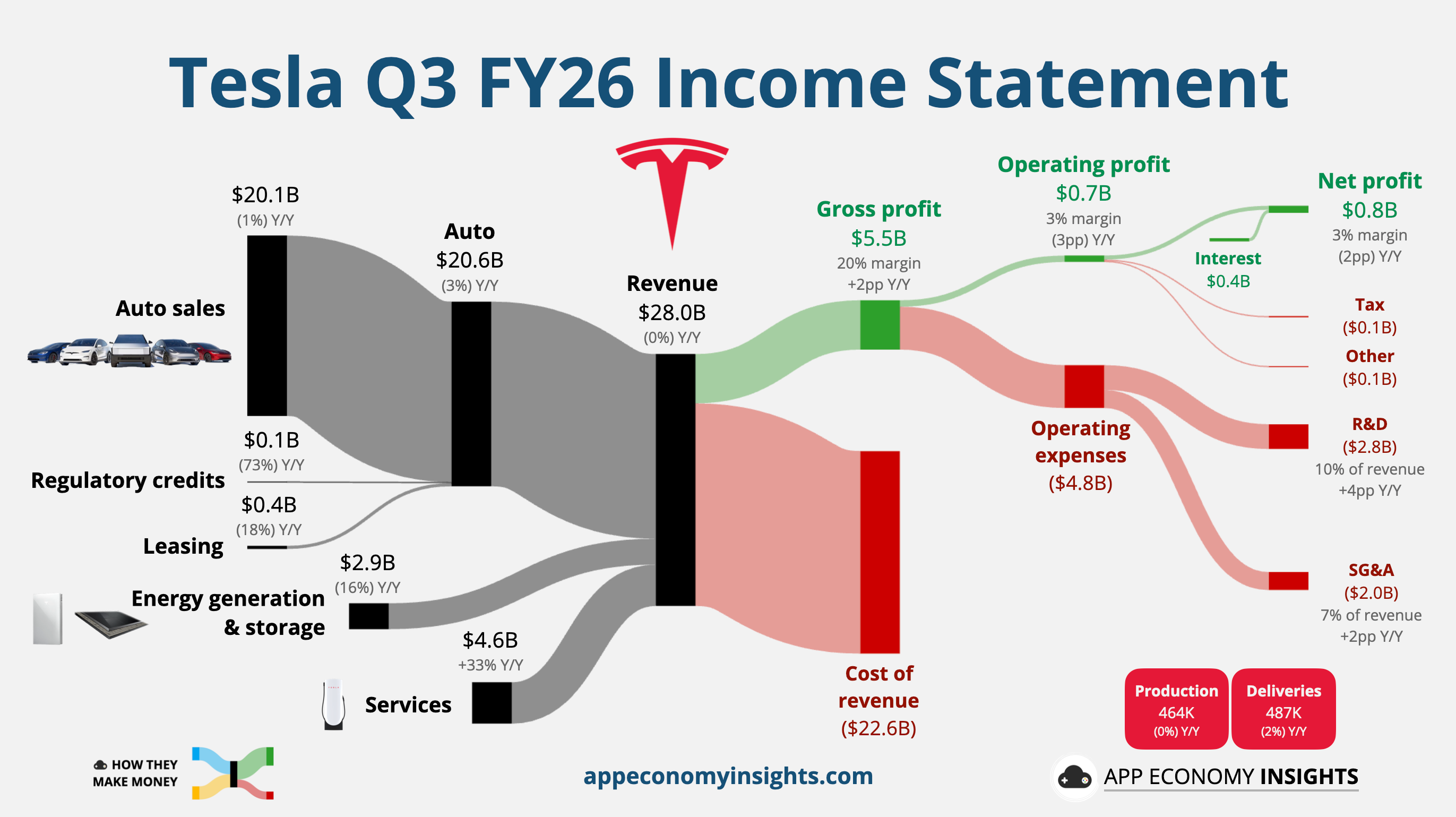
Revenue was flat Y/Y at $28.1 billion ($0.2 billion miss).
Gross margin reached 20% (+2pp Y/Y and +3pp Q/Q).
Operating margin fell to 3% (-3pp Y/Y).
Non-GAAP EPS was $0.48 ($0.03 beat).
Operating cash flow reached $6.3 billion, while free cash flow fell 62% Y/Y to $1.5 billion as CapEx declined Q/Q from $5.8 billion to $4.7 billion.
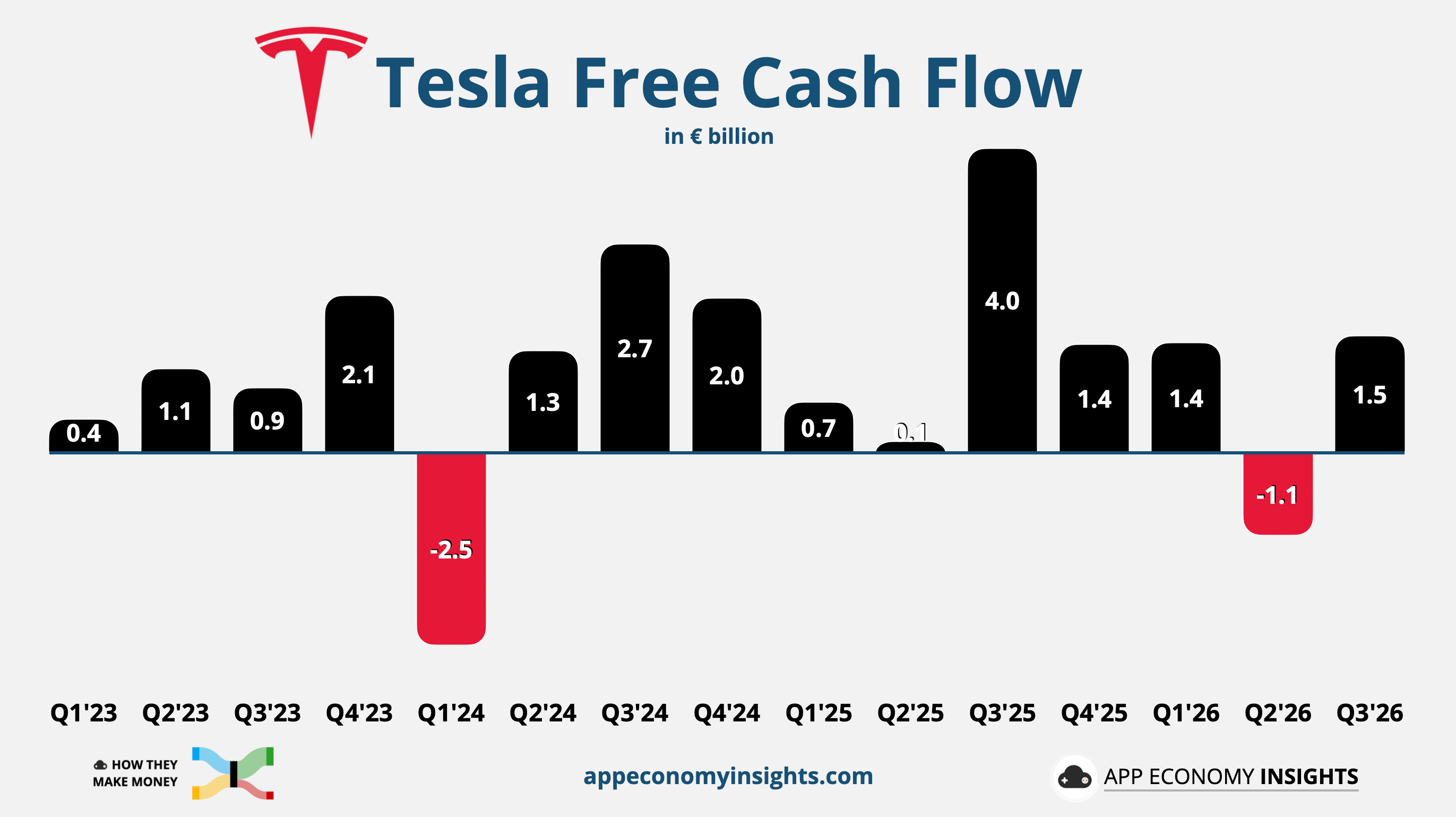
Tesla lowered its FY26 CapEx outlook from more than $25 billion to ~$20 billion. With $13 billion spent through September, that implies roughly $7 billion in Q4, still a meaningful acceleration from Q3.
Management expects spending to grow beyond 2026 as Tesla expands Robotaxi, Optimus, AI compute, solar, and semiconductor manufacturing. Tesla ended Q3 with $45.5 billion in cash and investments, plus about $30 billion in borrowing capacity it does not expect to draw on this year.
Now, here are the main insights from the call: