


Welcome to the Free edition of How They Make Money.
Over 300,000 subscribers turn to us for business and investment insights.
In case you missed it:

Netflix has proved that streaming can generate enormous profits. But can it sustain growth when viewers have more entertainment choices than ever?
Management admits recent execution has been hit or miss, and the company is replacing longtime content chief Bela Bajaria with former Disney executive Peter Rice, signaling a renewed push for watercooler hits.
The stock price has dropped more than 45% over the past year, and the company recently announced its largest round of layoffs since 2022, eliminating roughly 1,000 positions.

Netflix is on track to surpass $50 billion in annual revenue, generates billions in free cash flow, and remains the world's largest paid streaming platform. Yet its share of US television viewing has plateaued, while YouTube and other competitors continue to gain share on TV.
Alongside its core programming, Netflix is experimenting with new ways to capture consumer attention. Live sports, video podcasts, creator content, and partnerships with traditional broadcasters offer new ways to attract and retain subscribers.
Today at a glance:
🍿 Netflix Q3 FY26
📈 YouTube pulls away
📺 Not all viewing hours are equal
💬 Salesforce buys Braze for $5.7B

🍿 Netflix Q3 FY26
Income statement:
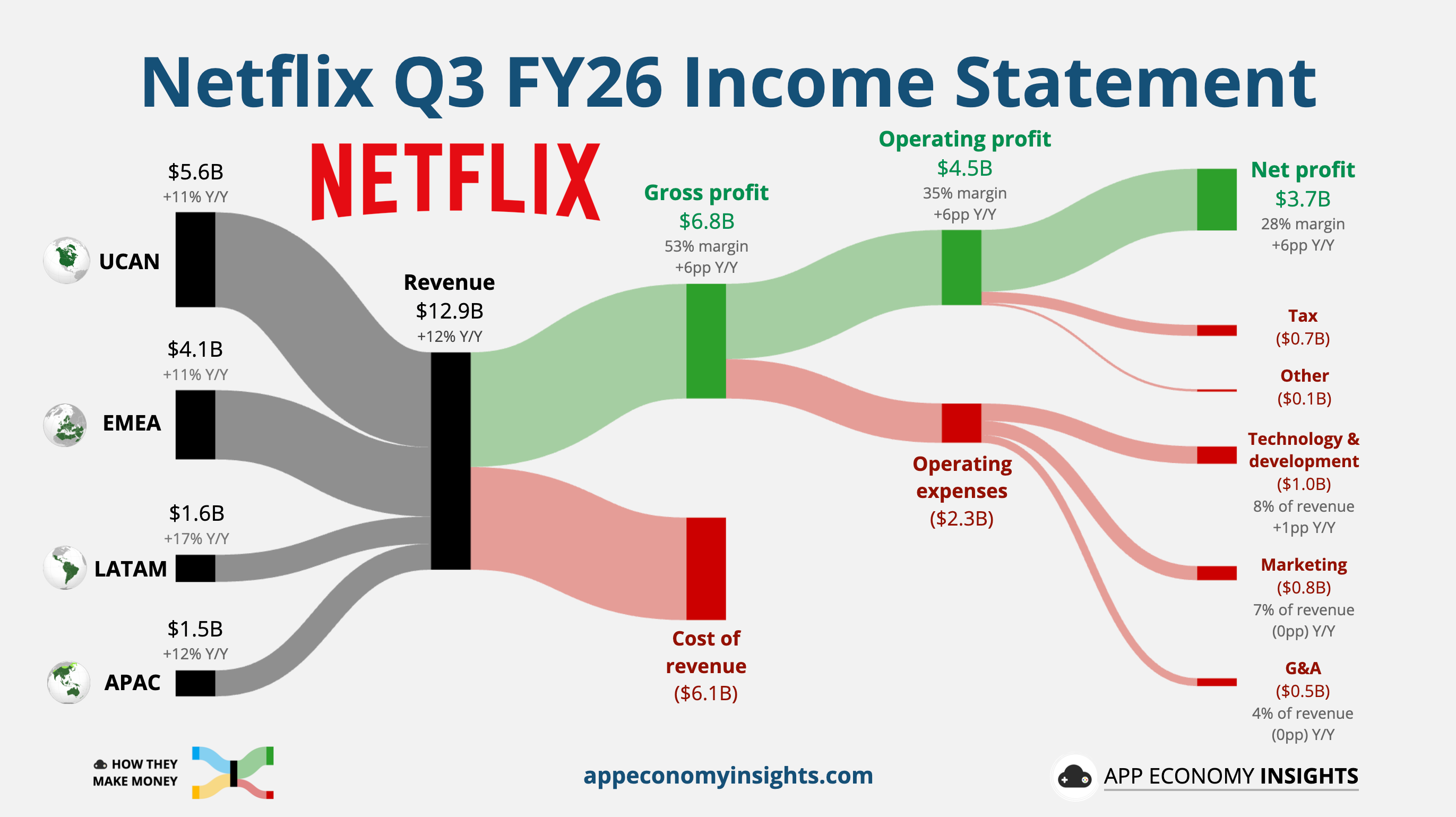
Revenue +12% Y/Y to $12.9 billion (in line).
Operating margin 35% (+6pp Y/Y).
EPS +49% Y/Y to $0.87 ($0.05 beat).
Balance sheet:
Cash and short-term investments: $8.2 billion.
Debt: $15.3 billion.
FY26 guidance:
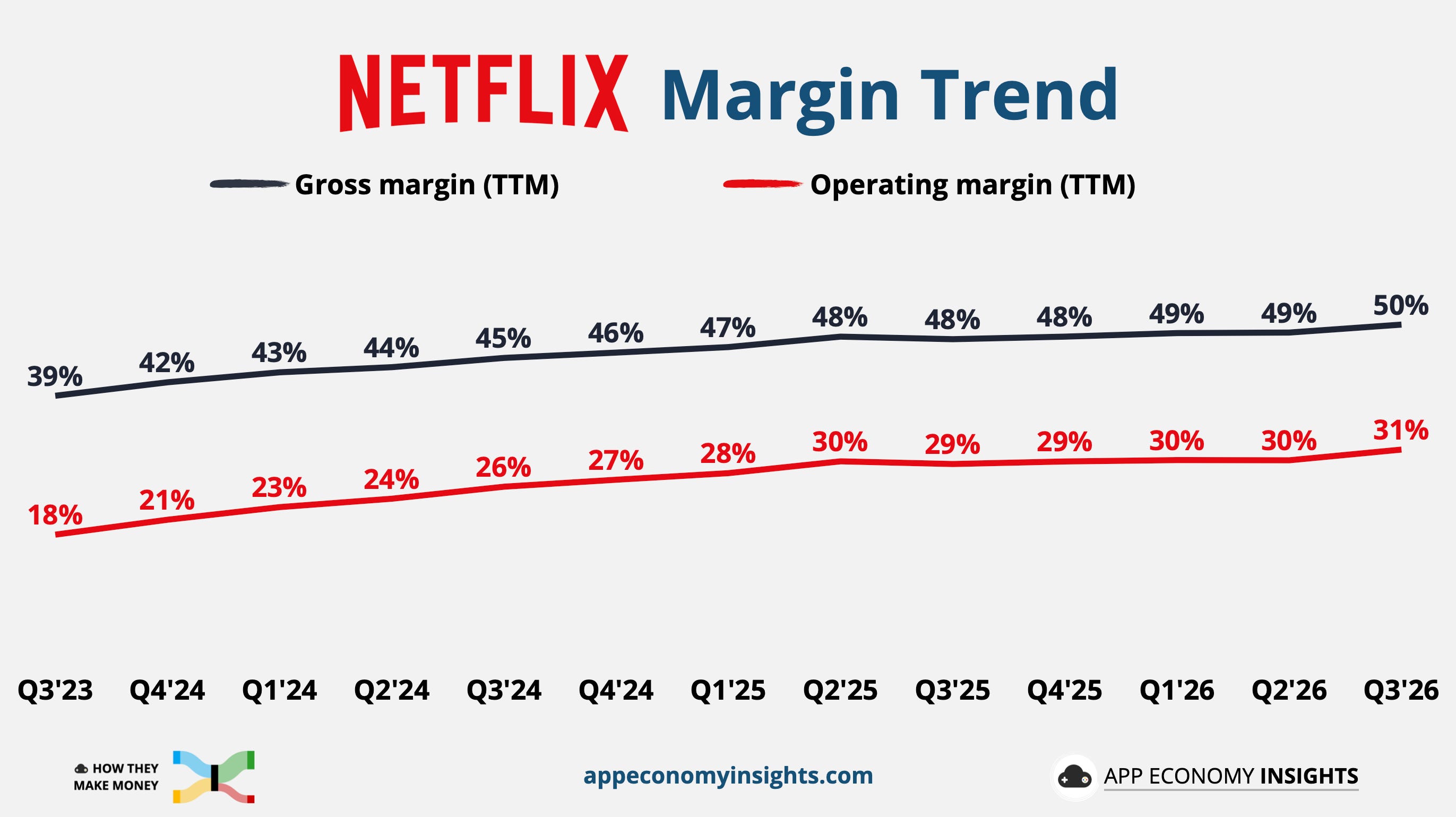
Revenue +13% to $51.1 billion (slightly below the prior midpoint).
Operating margin 31.5% (+2pp Y/Y, unchanged).
Free cash flow ~$12.0 billion (down from $12.5 billion).
So, what to make of all this?
📉 Growth keeps slowing: Revenue growth decelerated to 12%, its slowest pace in nearly three years, with Q4 guidance implying roughly the same rate. Operating margin surged 6 points to 35%, although the beat reflected favorable expense timing. Management reiterated its 31.5% full-year margin target despite restructuring costs in Q4. Subscription revenue is outperforming expectations, supported by price increases, membership growth, and improving churn. But margin expansion alone may no longer satisfy investors.
📢 Ads miss the mark: Netflix cut its 2026 advertising revenue forecast from ~$3 billion to ~$2.7 billion, blaming a slower-than-expected rollout of ad products. That represents a 10% cut, even though ad revenue is still expected to grow over 80% Y/Y. Netflix continues to expand programmatic access and measurement capabilities, with plans to introduce its ad tier in 15 additional countries in 2027. The opportunity remains substantial, but future growth will depend on technical execution and sustained viewer engagement.
🌍 Becoming an entertainment aggregator: Netflix is expanding beyond its own productions by integrating third-party programming directly into its service. Its partnership with French broadcaster TF1 is already generating incremental viewing, while a new Disney licensing agreement brings titles such as Ice Age to the platform. Management is open to additional integrations, potentially including subscriptions to other streaming services. The irony is that Disney is using Netflix to build awareness for its own upcoming theatrical releases. Even Hollywood's largest studios recognize Netflix's distribution value. Netflix may not always have the best original programming, but its distribution advantage is difficult to replicate. That could help the company expand its entertainment offering without continually increasing content spending.
💰 Record buybacks continue: Netflix repurchased another $4.8 billion of stock, its largest quarterly buyback ever, leaving $22.3 billion in remaining authorization. Free cash flow rose to $2.9 billion from $2.7 billion a year ago. Management reduced its full-year FCF forecast from $12.5 billion to about $12 billion, mainly because a real estate transaction is expected to close in Q4. Netflix continues to generate substantial cash and return it to shareholders, even as revenue growth moderates.
📈 YouTube pulls away
Streaming keeps taking share from traditional television, but Netflix isn’t keeping pace. According to Nielsen, streaming reached a record 49.0% of US TV viewing in July, up from 47.3% a year ago.
Netflix captured 7.8% of US TV time, down from 8.8% a year earlier. YouTube, meanwhile, reached a record 14.2%, widening its lead over Netflix from 4.6 to 6.4 percentage points in just 12 months. Americans now spend nearly twice as much time watching YouTube as Netflix on their TVs. And that doesn't even include YouTube TV.
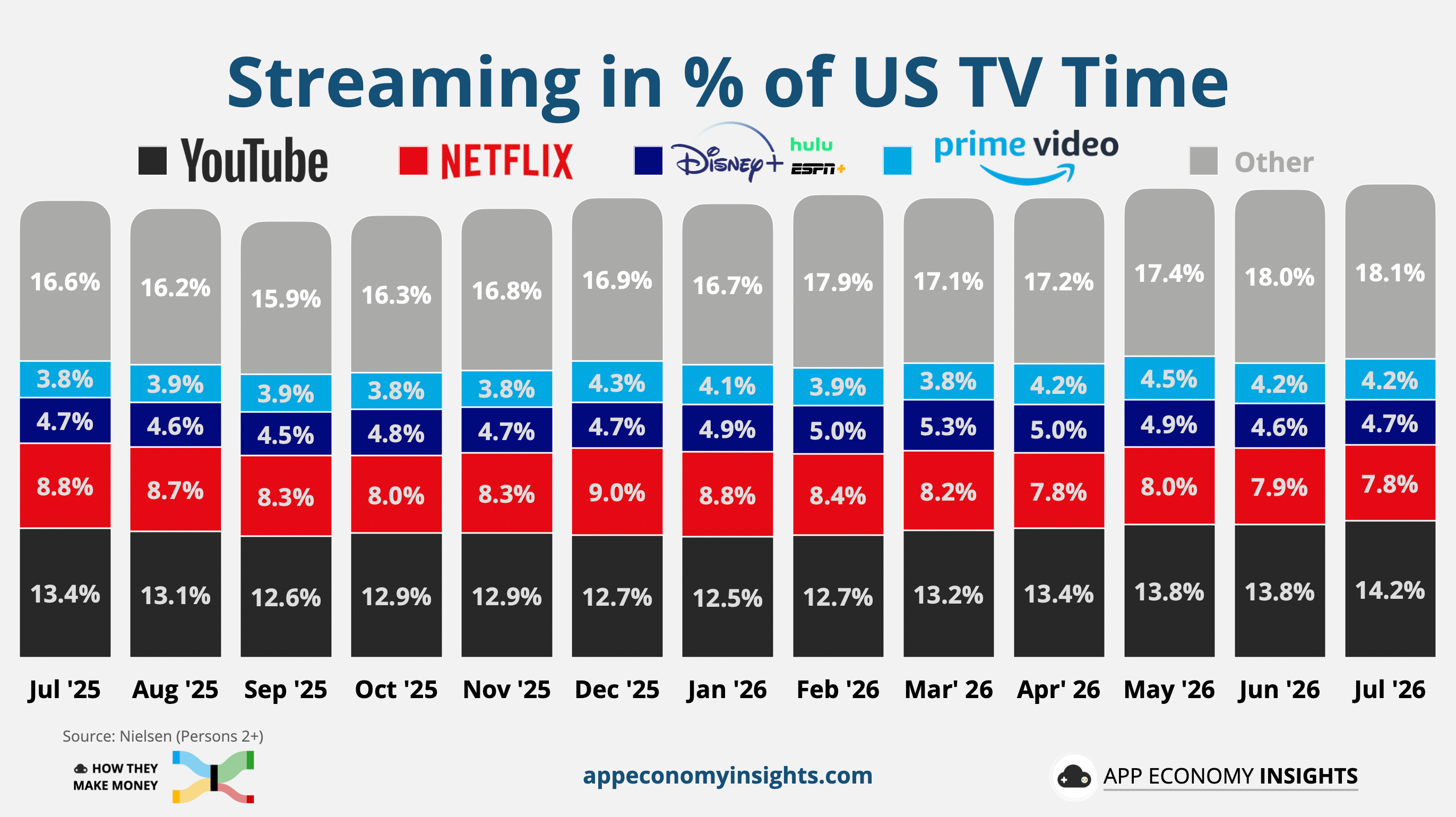
Netflix had an unusually strong summer last year, when Squid Game and other hits dominated the charts. Monthly viewing fluctuates with release schedules, and Nielsen only measures US television screens (excluding mobile and laptop viewing). Still, the trend highlights how difficult it is to sustain engagement against free services and platforms built around seemingly endless creator content.
Netflix has acknowledged the challenge. Co-CEO Ted Sarandos said that engagement wasn’t growing as quickly as he wanted. New content chief Peter Rice previously oversaw Fox Searchlight, which delivered hits like Slumdog Millionaire, before taking senior leadership roles at Disney. His appointment suggests Netflix wants to improve its ability to produce breakout US hits that can travel internationally.
Yet Netflix’s own engagement data paints a more nuanced picture. Worldwide viewing hours rose 2% in H1 2026, up from 1.5% growth in 2025. Netflix hasn’t disclosed Q3 viewing hours, but management reported improving churn globally and in the US. Engagement continued to grow even as Netflix’s share of US television viewing declined. In short, subscriber retention remains healthy, but subscriber loyalty masks a gradual erosion of its share of screen time.
📺 Not all viewing hours are equal
Netflix argues that viewing hours alone don’t capture the value of its programming. Its live events illustrate why. Live programming represents just over 5% of Netflix’s content spending but only about 1% of viewing hours. Yet live events drove six of its 10 biggest sign-up days over the past five years.
That makes sports potentially more valuable than their modest engagement contribution suggests. A major NFL game or boxing match can attract new subscribers, create premium advertising inventory, and generate cultural relevance. The economics depend less on how long viewers watch than on whether they remain subscribers afterward.
Netflix is also exploring lower-cost ways to become a daily entertainment destination. Its partnership with French broadcaster TF1 achieved the broadcaster’s 18-month audience targets in less than three weeks. TF1+ daily audiences increased 16% during launch week, while Netflix reported growing viewing hours for TF1 programming. The early results are encouraging, although they don’t yet establish how much incremental value Netflix captures.
Video podcasts and creator-led programming offer another way to expand viewing occasions without the production costs of premium scripted entertainment. Netflix is even experimenting with theatrical releases. Greta Gerwig’s upcoming Narnia adaptation will receive a wide theatrical release before arriving on the service, testing whether the big screen can help build a streaming franchise.
Still, management isn’t abandoning its core business. Roughly 95% of spending remains focused on its core streaming offering, including series, films, and live events. These newer initiatives complement the core business rather than represent a fundamental shift in strategy.
Netflix’s challenge is to capture more valuable viewing occasions, not necessarily the most viewing hours. A blockbuster can drive sign-ups, a licensed show can improve retention, and live sports can attract advertisers. Each serves a different purpose.
Management points to improving churn and successful price increases as evidence of healthy engagement. But churn could be a lagging indicator. Subscribers could gradually spend less time watching Netflix long before they consider canceling.
Netflix has proven it can raise prices and expand margins. Now it needs to show that it can grow without relying primarily on charging existing subscribers more.
💬 Salesforce buys Braze for $5.7B
Salesforce agreed to acquire customer engagement platform Braze for $5.7 billion in enterprise value, offering $47.50 per share in cash, a 58% premium to its previous closing price. The acquisition raises an obvious question: Why does Salesforce need Braze when it already owns Marketing Cloud?
Braze specializes in real-time customer engagement. Rather than relying on scheduled marketing campaigns, its software reacts to customer behavior across mobile apps, websites, email, and other channels. Think of an abandoned shopping cart triggering a personalized offer, or a streaming service reaching out to a subscriber showing signs of leaving. Customers include Canva, Instacart, and Venmo.
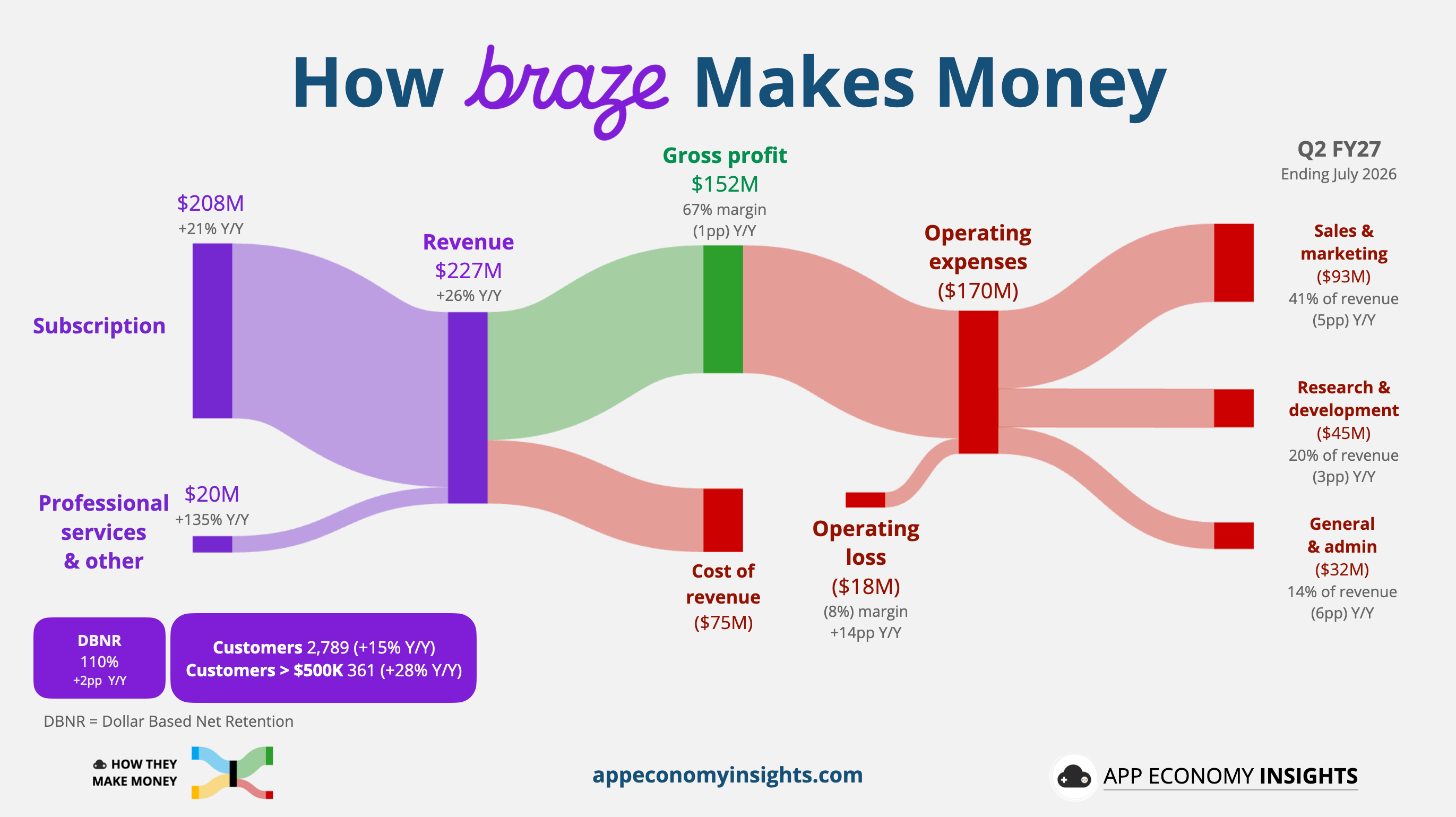
Braze’s Q2 FY27 results illustrate both the appeal and the challenges of the business:
Revenue grew 26% Y/Y to $227 million, with subscriptions accounting for 92%.
Dollar-based net retention reached 110%, indicating continued expansion among existing customers.
Sales and marketing consumed 41% of revenue, contributing to an $18 million operating loss despite a healthy 67% gross margin.
At roughly 6.2x annualized revenue, the acquisition isn’t outrageously expensive for a growing software business. Braze also generated $22 million in quarterly free cash flow, suggesting its underlying economics are improving despite its GAAP losses.
The strategic appeal is clear. Salesforce has customer data, enterprise relationships, and its Agentforce AI platform. Braze adds a specialized engagement engine that can translate those insights into personalized actions across consumer-facing channels. AI agents become more valuable when they can act on customer information. Salesforce could also accelerate Braze’s adoption through its massive enterprise distribution network.
But there are risks. Braze overlaps with Salesforce’s existing Marketing Cloud capabilities, creating potential integration challenges and product confusion. Its appeal as an independent platform could also suffer if customers fear being pushed into Salesforce’s broader ecosystem. And while cross-selling could improve margins, Salesforce must demonstrate that another acquisition actually accelerates organic growth.
The bigger picture is that Salesforce is trying to own more of the customer relationship, from data and AI-driven decisions to the interactions that follow. Braze could help close that loop. But can the integration deliver enough synergies and additional growth to justify the purchase price?

Want to sponsor this newsletter? Get in touch here.
Disclosure: I own CRM and NFLX in App Economy Portfolio. I share my ratings (BUY, SELL, or HOLD) with App Economy Portfolio members.
Author's Note (Bertrand here 👋🏼): The views and opinions expressed in this newsletter are solely my own and should not be considered financial advice or any other organization's views.
Buying back $4.8B of stock in a quarter that generated $2.9B of free cash flow is a strong vote of confidence with shares down 45%. It's also the risk: with $15.3B of debt against $8.2B of cash, the buyback is a bet that pricing power holds while YouTube keeps taking screen time.