


Welcome to the Premium edition of How They Make Money.
Over 300,000 subscribers turn to us for business and investment insights.
In case you missed it:
🤖 Anthropic is going public
The company behind Claude is growing faster than we’ve ever seen in software.
Founded only five years ago, it’s already challenging the world’s largest technology companies for the future of AI.
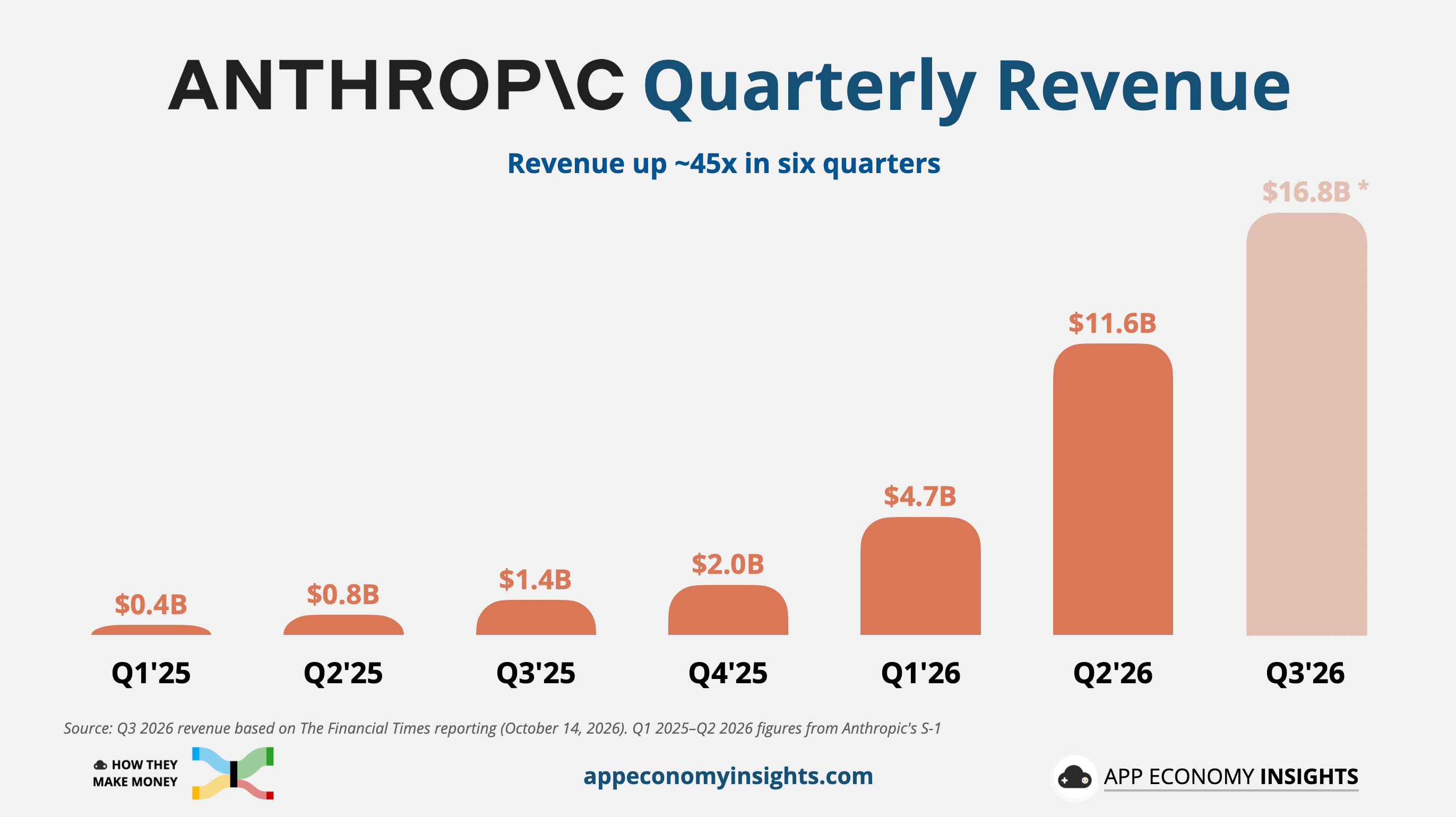
Anthropic finally filed its S-1, revealing a business that generated $16.3 billion in revenue in the first half of 2026, up 14x year-over-year. The Financial Times reported that revenue reached $16.8 billion in Q3 alone.
The investment thesis comes down to three things:
Claude is winning enterprise customers.
AI agents are expanding what software can do.
Compute costs could make or break the economics.
Anthropic may be building one of the most valuable software platforms of the next decade.
But staying at the frontier of AI comes at an unprecedented cost.
I dug through 300+ pages of its S-1 to unpack the business, the financials, and the risks, supported by our signature visuals. By the end, you’ll understand how Anthropic makes money, what its extraordinary growth actually costs, and how to interpret its valuation when the IPO arrives.
Today at a glance:
Overview
Business model
Financial highlights
Risks & challenges
Management
Use of proceeds
Future outlook
Personal take

1. Overview
Anthropic started as an AI safety research lab. Five years later, it’s one of the leading challengers to OpenAI and Google, with Claude increasingly embedded in the operations of some of the world’s largest companies.

Founded in 2021 by seven co-founders, including former OpenAI researchers, Anthropic was built around the belief that increasingly powerful AI systems must also become safer and more reliable. That mission remains central to its identity, but it has also become a commercial selling point: Enterprises need AI they can trust with sensitive data and business-critical work.
The basics
Headquarters: San Francisco, California
Founded: 2021 by Dario and Daniela Amodei and five other co-founders
Ticker: ANT (proposed Nasdaq listing)
Mission: Responsible development and maintenance of advanced AI for the long-term benefit of humanity
Structure: Public benefit corporation (PBC)
From chatbot to coworker
The easiest way to understand Anthropic’s ambition is to look beyond the chatbot.
Most people discovered generative AI through a chat window: Ask a question, get an answer. Anthropic believes that’s just the beginning.
Its S-1 introduces the concept of “Virtual Collaborators” — AI systems capable of planning, reasoning, navigating software, and completing complex tasks autonomously. Instead of merely suggesting what a human should do next, Claude can increasingly execute the work itself.
Claude Code demonstrated this shift for software developers, moving from code suggestions to writing, testing, and debugging entire projects. Claude Cowork extends the same approach to other knowledge workers, handling files, applications, and multi-step workflows.
The ambition is to transform Claude from a tool people consult into a colleague they delegate work to.
Enterprise adoption takes off
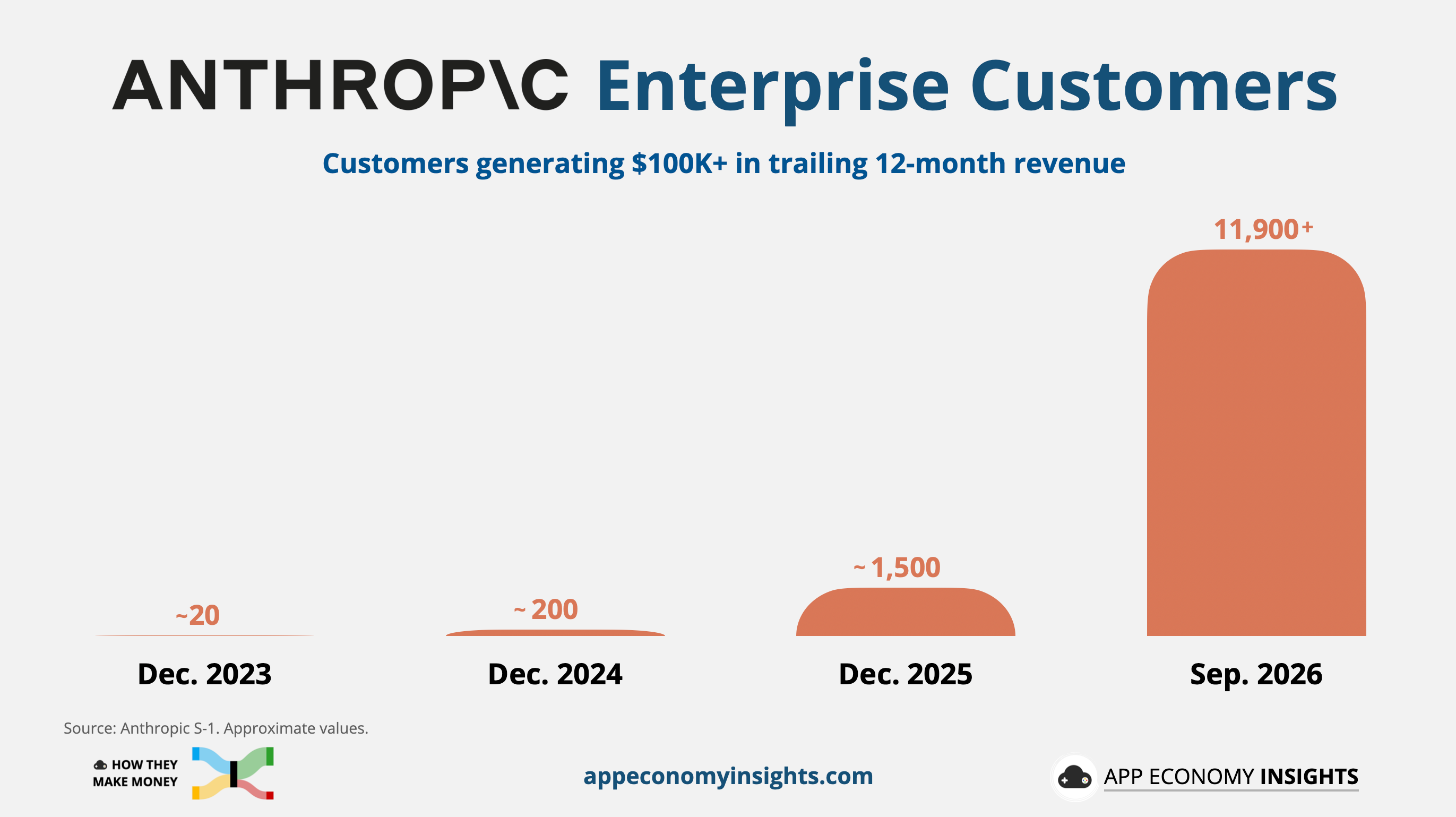
Anthropic had approximately 20 customers spending at least $100K annually at the end of 2023. That figure reached roughly 200 in 2024, 1,500 in 2025, and more than 11,900 by September 2026.
And these aren’t just small experiments:
More than 1,900 customers generated at least $1 million in trailing annual revenue.
Approximately 250 customers generated at least $10 million.
Every Fortune 10 company and more than half of the Fortune 500 were customers spending at least $100,000 annually.
These are actual revenue thresholds. Anthropic has moved remarkably quickly from winning individual developers to becoming a meaningful vendor inside the world’s largest enterprises.
The business is also becoming less concentrated. Anthropic’s top five customers accounted for 21% of Q3 revenue, down from 36% in Q1, even as spending from each of those major customers hit new highs.
But one S-1 metric stands out: 900% net revenue retention.
Understanding what drives that expansion, whether it can last, and how much of it Anthropic can turn into profits is central to the investment case.