


Welcome to the Free edition of How They Make Money.
Over 300,000 subscribers turn to us for business and investment insights.
In case you missed it:
Great investing is 1% buying, 99% waiting
A 100-bagger is a stock that returns 100 times your initial investment.
Put in $10,000 and, eventually, you have $1 million.
Naturally, most investors focus on the first challenge: finding one.
But that is only half the battle.
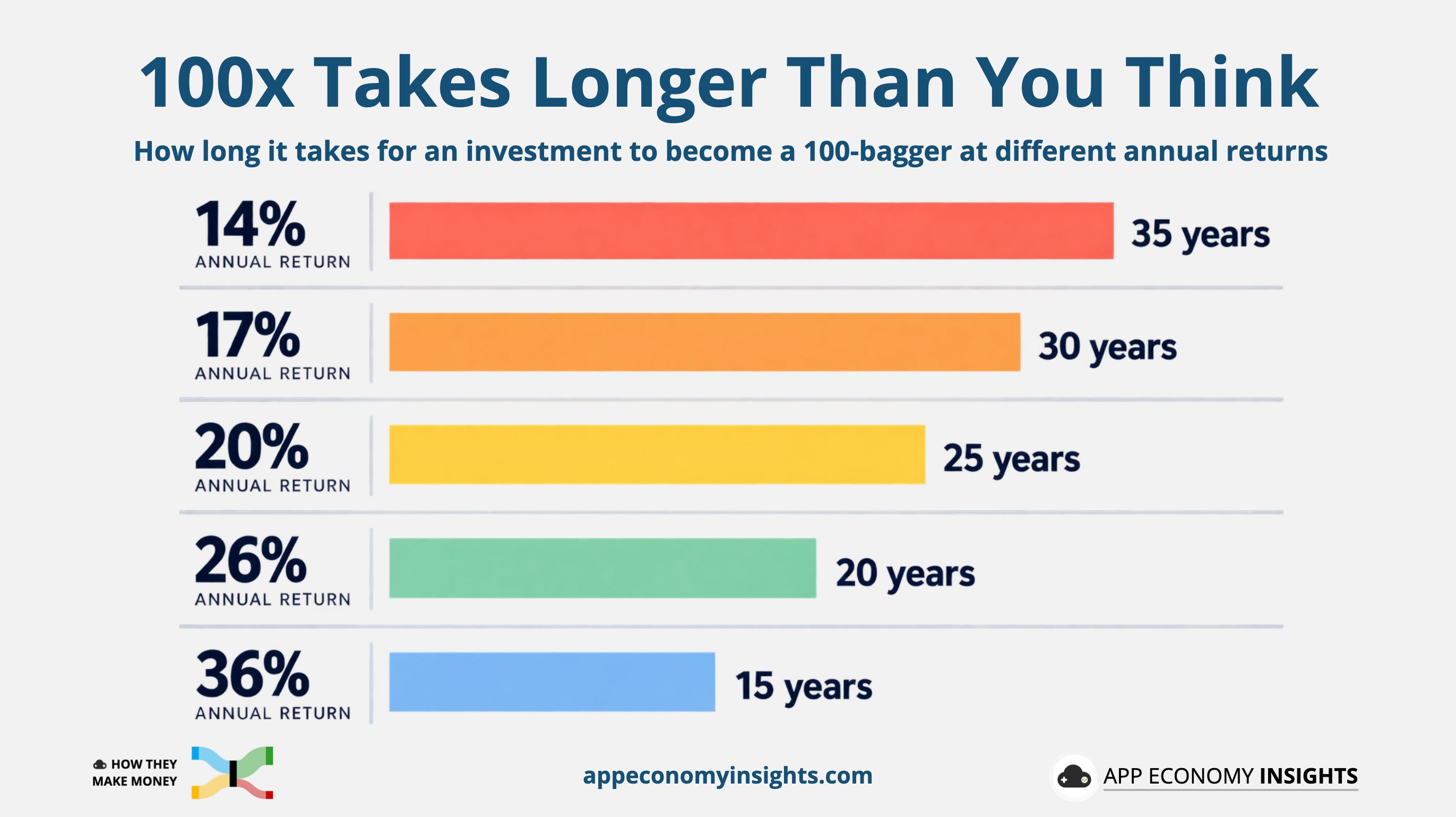
In his book 100 to 1 in the Stock Market, Thomas Phelps showed how long it takes for compounding to turn an investment into a 100-bagger.
A stock compounding at 20% annually needs roughly 25 years to return 100 times your money. Even at an extraordinary 36% annual return, it still takes about 15 years.
And time is only part of the challenge.
Over those 15, 20, or 30 years, even the greatest winners can suffer brutal drawdowns. Apple endured repeated declines of more than 25% on its way to becoming a massive long-term winner, including two drops of roughly 80%.
Finding the right company is hard.
Holding it for 15, 20, or 25 years may be even harder.

📈 Special Report: How To Find 100-Baggers
I put together a free 35-page report on how to identify potential 100-baggers before they become obvious.
You will learn the following:
📊 What to look for
💯 A history of 100-baggers
🔎 Why they’re so hard to find
🧠 The mindset required to hold one
✅ A practical 100-bagger checklist

📈 The power of compounding
A stock appreciates over time through two main forces:
Earnings growth: The business makes more money.
Multiple expansion: Investors pay more for each dollar of earnings.
Over long periods, earnings do most of the work. But exceptional companies can benefit from both. As profits compound and the market finally piles in, the valuation can get overextended.
That success creates the temptation to sell.
Once a stock has doubled or tripled, our natural instinct is to lock in the gains. If the valuation has expanded along the way, selling can feel even more prudent.
But extraordinary returns are heavily back-loaded. At a 20% annual return, an investment goes from roughly 38x after 20 years to nearly 100x after 25.
Those final five years create more wealth than the first 20 combined.
That is why selling a great company too early can be one of the most expensive mistakes an investor makes. Peter Lynch famously described this as “cutting the flowers and watering the weeds.”
The best businesses have a habit of repeatedly exceeding expectations. What looks expensive today can look much more reasonable several years later if earnings keep compounding.
Selling also creates another problem.
What do you buy instead? And when do you get back in?
None of this means you should never sell. If the competitive position deteriorates, earnings falter, or the original thesis breaks, the decision changes.
But I’ve adopted a simple rule:
A rising stock price is never a reason to sell on its own.
Compounding is beautiful. You have to resist the urge to interrupt it.
☕️ Pareto and the Coffee Can Portfolio
Stock returns are not evenly distributed.
In statistics, you’ll hear about two common patterns:
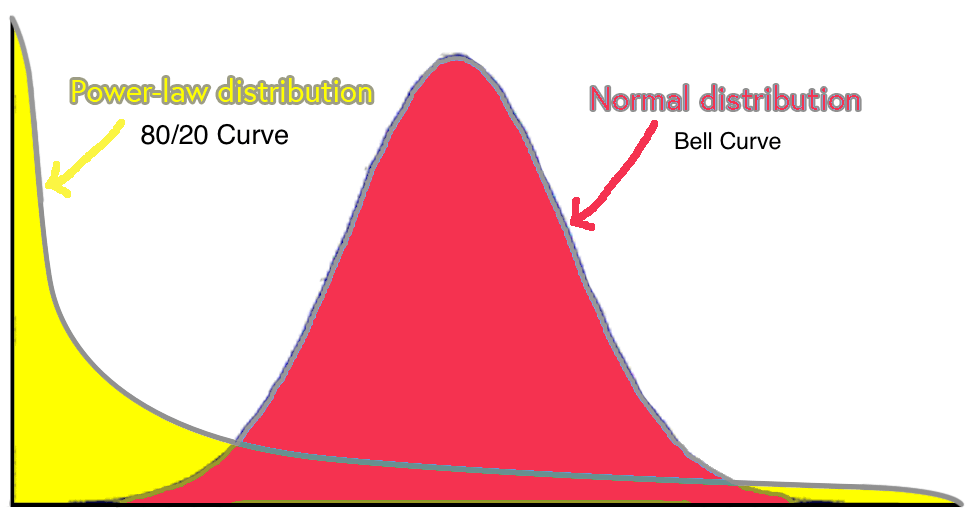
Normal distribution: Most observations cluster around the average, while extreme outcomes are rare. Think human height or many natural measurements.
Power law distribution: A small number of extreme outcomes account for a disproportionate share of the total. Think wealth, company size, or venture returns. Extreme outcomes occur far more often than under a normal distribution, creating a fat tail.
Investing follows the power law. More than a century of market history shows that a relatively small number of stocks have created a disproportionate share of long-term wealth.
That is why constantly rebalancing can work against you.
If one stock compounds much faster than the rest, it will naturally become a larger part of the portfolio. That concentration can feel uncomfortable and make the portfolio look weird.
But it may simply be the consequence of owning something exceptional.
If you repeatedly trim your best performers, you risk systematically cutting exposure to the very companies that can make the portfolio outperform.
Warren Buffett has famously allowed investments such as Coca-Cola and American Express to become very large positions rather than continually trimming them. Apple eventually grew to nearly half of Berkshire’s listed stock portfolio before Buffett began meaningfully reducing the position.
Robert Kirby captured the same idea with his Coffee Can Portfolio.
He once discovered that a client’s husband had quietly copied each of his stock recommendations, investing about $5,000 in every company. But with one crucial difference: he never sold.
Years later, the portfolio contained plenty of mediocre investments. But one position had grown so dramatically that it was worth more than the rest of the portfolio combined.
Kirby described the approach as being “passively active.”
Active: Do the work upfront. Select the businesses carefully and decide what deserves your capital.
Passive: Once you own them, give them time to compound.
Long-term investing demands active selection followed by patient ownership.
I can see that distribution clearly in App Economy Portfolio, the real-money portfolio I’ve shared publicly for the past decade.
A dozen holdings have compounded 5x, 10x, or 20x.
That creates a powerful asymmetry. Without leverage, a loser can cost you at most 100% of your investment. But a 10x or 20x winner can more than offset many losers.
You can see that in the visual below. Even holdings that were nearly wiped out look small next to the biggest winners.

AMD is an extreme example for me. I bought my first shares at $11, and they’ve appreciated roughly 60-fold since 2017. The return shown above is lower because I kept adding at higher prices rather than trimming as the stock rose.
Had I continually rebalanced AMD back toward its original weight, I would have systematically reduced my exposure to one of the best investments in the portfolio.
Your portfolio’s shape should reflect its performance over time.
Give your biggest winners room to run.
📊 The brutal reality of market returns
The Coffee Can approach makes even more sense when you look at how stock returns are actually distributed.
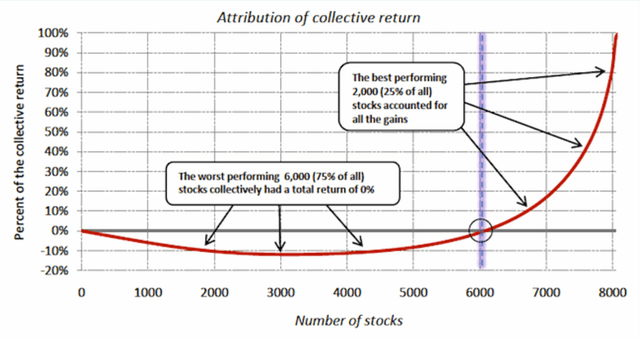
Blackstar Funds studied roughly 8,000 US stocks traded on the NYSE, AMEX, and Nasdaq from 1983 to 2006.
The most striking finding was that roughly 25% of stocks accounted for all of the market’s gains. The remaining 75%, collectively, contributed nothing.
The distribution underneath was brutal:
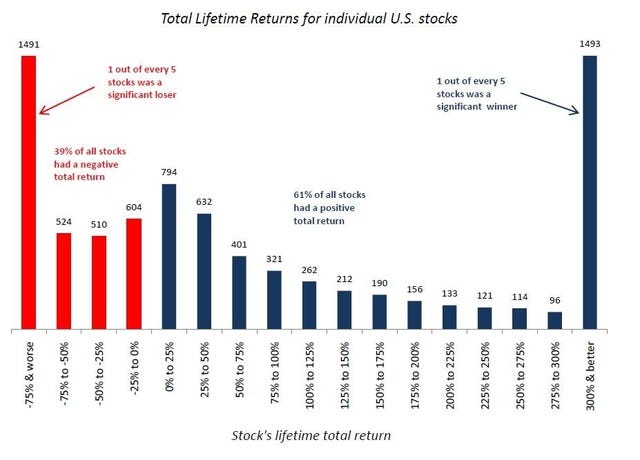
Around 40% of stocks lost money over their lifetimes.
Roughly one in five lost at least 75%.
And simply beating the market was rare:
64% underperformed the Russell 3000 over their lifetimes.
Only about 6% beat the index by more than 500%.
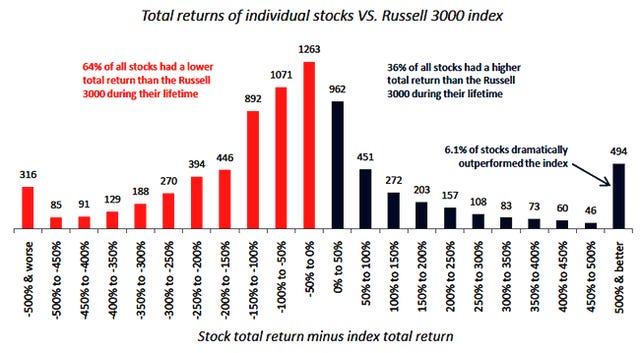
The lesson is uncomfortable but important: most stocks are not great long-term investments.
In a 20-stock portfolio, some will disappoint, and many will be merely average. Fewer than a handful may ultimately drive most of the return.
The problem is that you rarely know which ones in advance.
Selling a winner can mean trimming the very stock you needed most.
You only need a few great investments. The hard part is not getting in their way.
Bottom Line
The secret to long-term investing lies in building a strategy you can stick with for decades, rather than guessing what the market will do next.
There will always be a reason to sell. A recession. A valuation scare. A new competitor. A market correction. But nobody knows what will happen next.
Long-term investing ultimately requires optimism that great businesses will keep adapting, growing, and creating value, despite the uncertainty.
Patience and persistence are among the most precious virtues in investing.
And you need both even if you are lucky enough to find the investment of a lifetime.
Sometimes the hardest thing is simply to leave a great investment alone.
Finding the winner is only the beginning. You have to let it get there.
💯 Free 35-page report: How To Find 100-Baggers
That's it for today.
Happy investing!
Want to sponsor this newsletter? Get in touch here.
Disclosure: I own AMD, ANET, AAPL, SHOP, and NVDA in App Economy Portfolio. I share my ratings (BUY, SELL, or HOLD) with App Economy Portfolio members.
Author's Note (Bertrand here 👋🏼): The views and opinions expressed in this newsletter are solely my own and should not be considered financial advice or any other organization's views.
The 38x to nearly 100x jump between years 20 and 25 is the clean part of the math. The messy part is that the same power law cuts the other way. Bessembinder found most US common stocks since 1926 lost to one-month T-bills over their lifetimes. So "never sell on price alone" works for the tail and quietly fails for the median holding. The thesis check has to do the heavy lifting, not the holding period.