


Welcome to the Free edition of How They Make Money.
Over 300,000 subscribers turn to us for business and investment insights.
In case you missed it:
🇺🇸 Historic week at the polls
Democrats swept both chambers of Congress in the midterms, setting the stage for two years of divided government.
Wall Street initially cheered, with the S&P 500 rallying 1.6% on Wednesday. But the celebration was short-lived. Stocks reversed sharply on Thursday, with the Nasdaq plunging more than 5% as investors reassessed the AI infrastructure boom.
The AI data center buildout is becoming a political battleground. Of 41 local measures on Tuesday’s ballot, 40 went against data center development, amid concerns over electricity costs and environmental impacts. The backlash could make existing data centers more valuable while raising costs for future projects.
Today at a glance:
↗️ AMD: The 2027 Leap
🕵️ Palantir: Commercial Takes Over
🚖 Uber: Robotaxi Ramp

📈 64 Stocks You MUST Know
After months of research, our 64-stock Hidden Compounders Watchlist is ready.
Inside are 64 small companies that could compound for years.
Discover what they do in plain English, and why each made the list.
Download the free watchlist below:


1. ↗️ AMD: The 2027 Leap
AMD’s Q3 revenue jumped 45% Y/Y to $13.4 billion ($290 million beat), while adjusted EPS surged 74% to $2.09 ($0.15 beat). Operating margin jumped 7 points to 21%, showing strong operating leverage.
Data Center revenue nearly doubled to $8.5 billion (+97% Y/Y, +27% Q/Q), now representing 64% of total revenue, up from 58% in Q2. The segment’s operating margin expanded to 34%, up from 31% in Q2.
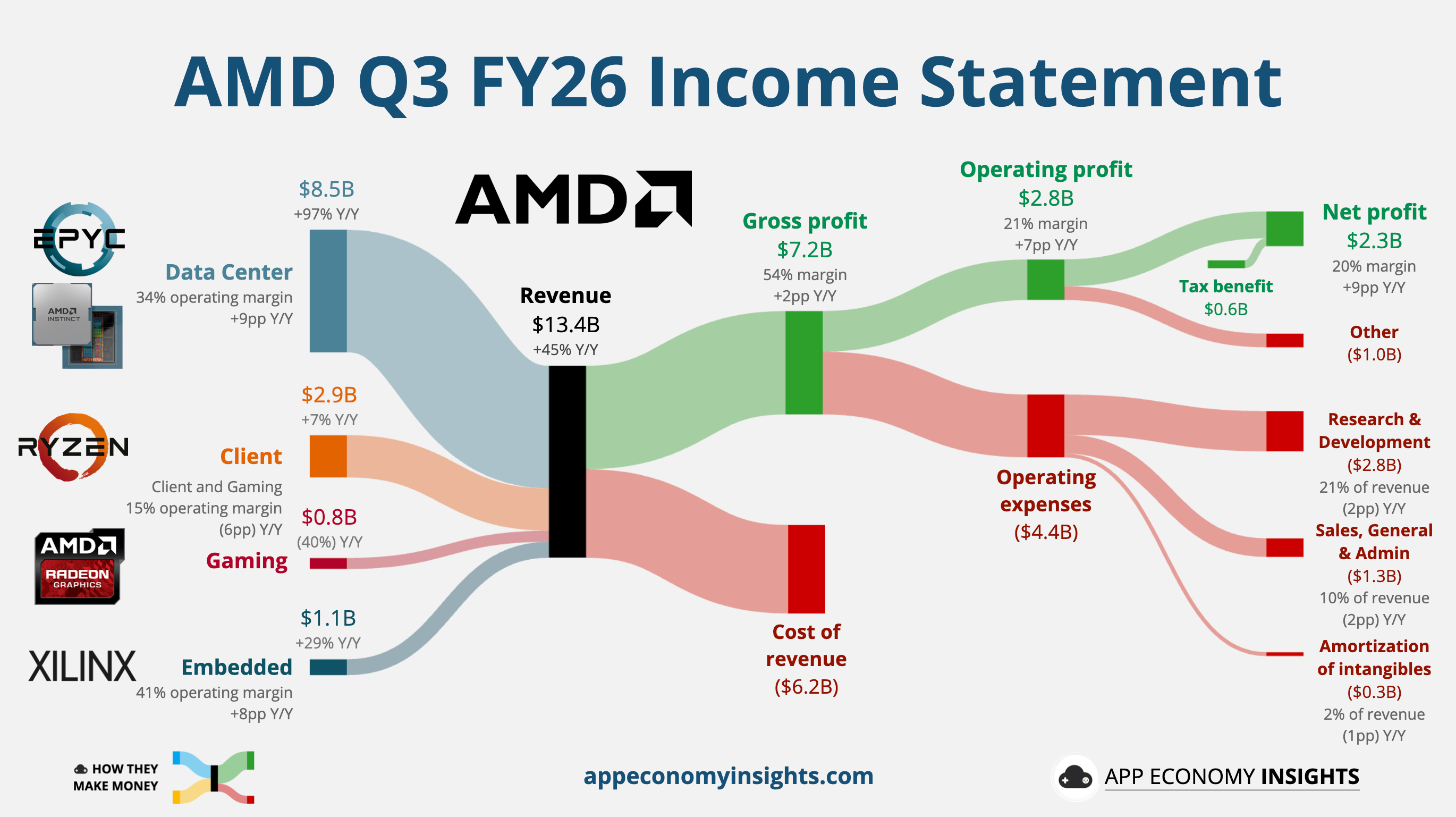
Both AI accelerators and server CPUs are driving the expansion. The Instinct MI450 series entered volume shipments, while cloud providers continued ramping EPYC deployments for agentic workloads. Meta, Microsoft, OpenAI, Anthropic, and Oracle are already running workloads on AMD’s first Helios rack-scale systems.
Outside Data Center:
Client revenue grew 7% to $2.9 billion, slowing sharply as rising memory prices pressured PC demand.
Gaming fell 40% to $773 million amid weaker console and graphics sales.
Embedded accelerated to 29% growth, reaching $1.1 billion.
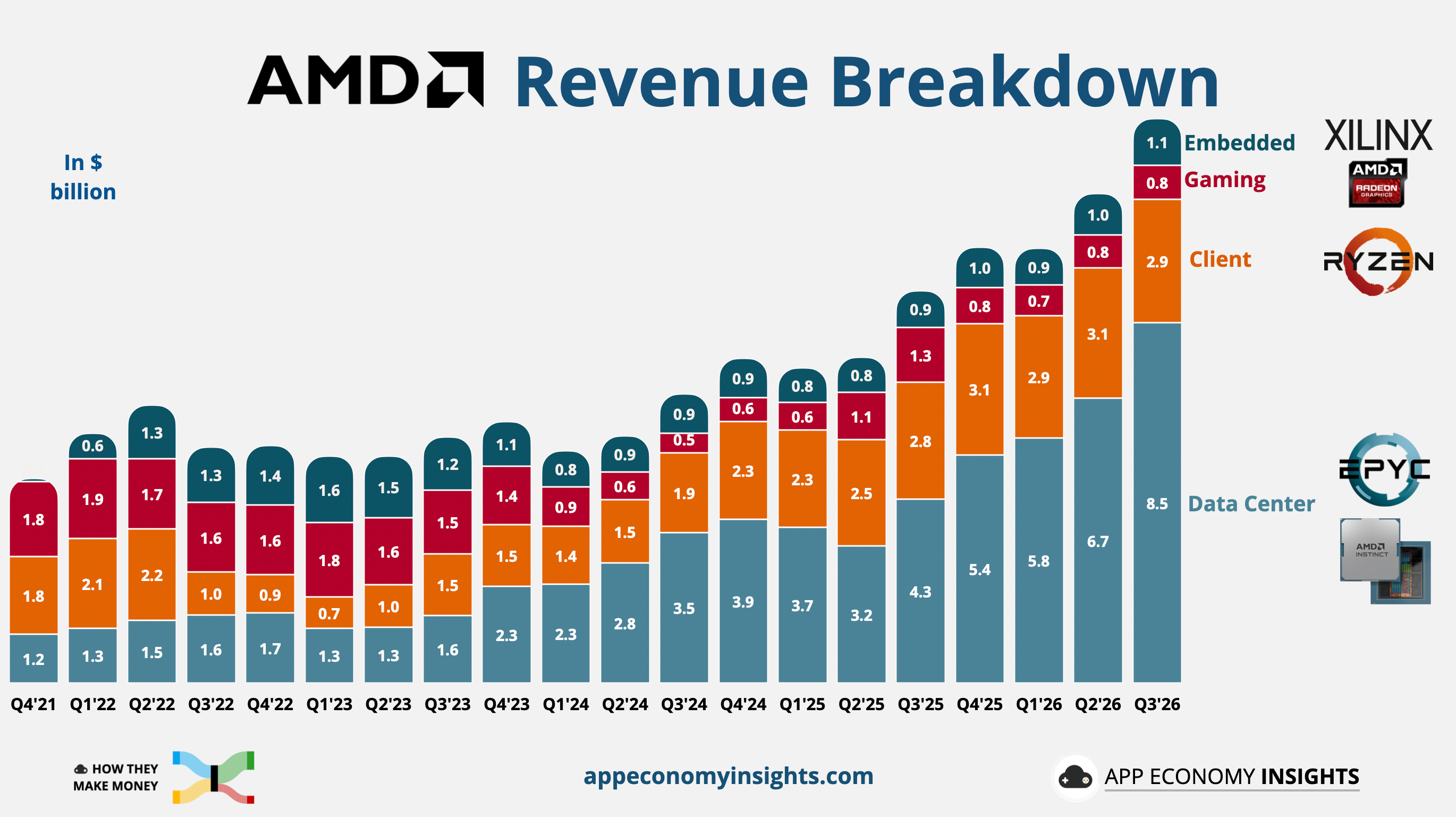
The outlook was the big surprise. AMD guided Q4 revenue to $17 billion at the midpoint (roughly $0.8 billion above consensus), implying 66% Y/Y growth and a 27% sequential increase. Data Center alone should grow roughly 50% Q/Q, with AI accelerator revenue surpassing server CPU revenue for the first time.
Looking further ahead, Lisa Su now expects more than 80% revenue growth in 2027, with Data Center representing over 80% of the business. Server CPU revenue should double, while Data Center AI revenue is expected to grow even faster.
There are some trade-offs. Q4 gross margin is expected to ease from 56% to 55% as AI accelerators make up a larger share of the mix. Free cash flow fell to $554 million, from $1.6 billion in Q2, as inventory increased by $3 billion to support the infrastructure ramp.
AMD is delivering on the AI opportunity faster than anticipated, with Helios moving into production and EPYC benefiting from the explosion in agentic workloads. Now the 2027 outlook raises the stakes considerably.
Shares initially rallied following earnings, only to plunge more than 17% in Thursday’s broader AI-stock rout. The reversal highlights how quickly investor sentiment toward AI infrastructure can shift, even as AMD’s outlook remains unchanged.
2. 🕵️ Palantir: Commercial Takes Over
Palantir’s Q3 revenue surged 96% Y/Y to $2.3 billion ($130 million beat), marking its 13th consecutive quarter of accelerating growth. Adjusted EPS reached $0.44 ($0.03 beat), while adjusted operating margin held at 62%. The Rule of 40 score climbed to an extraordinary 158%.
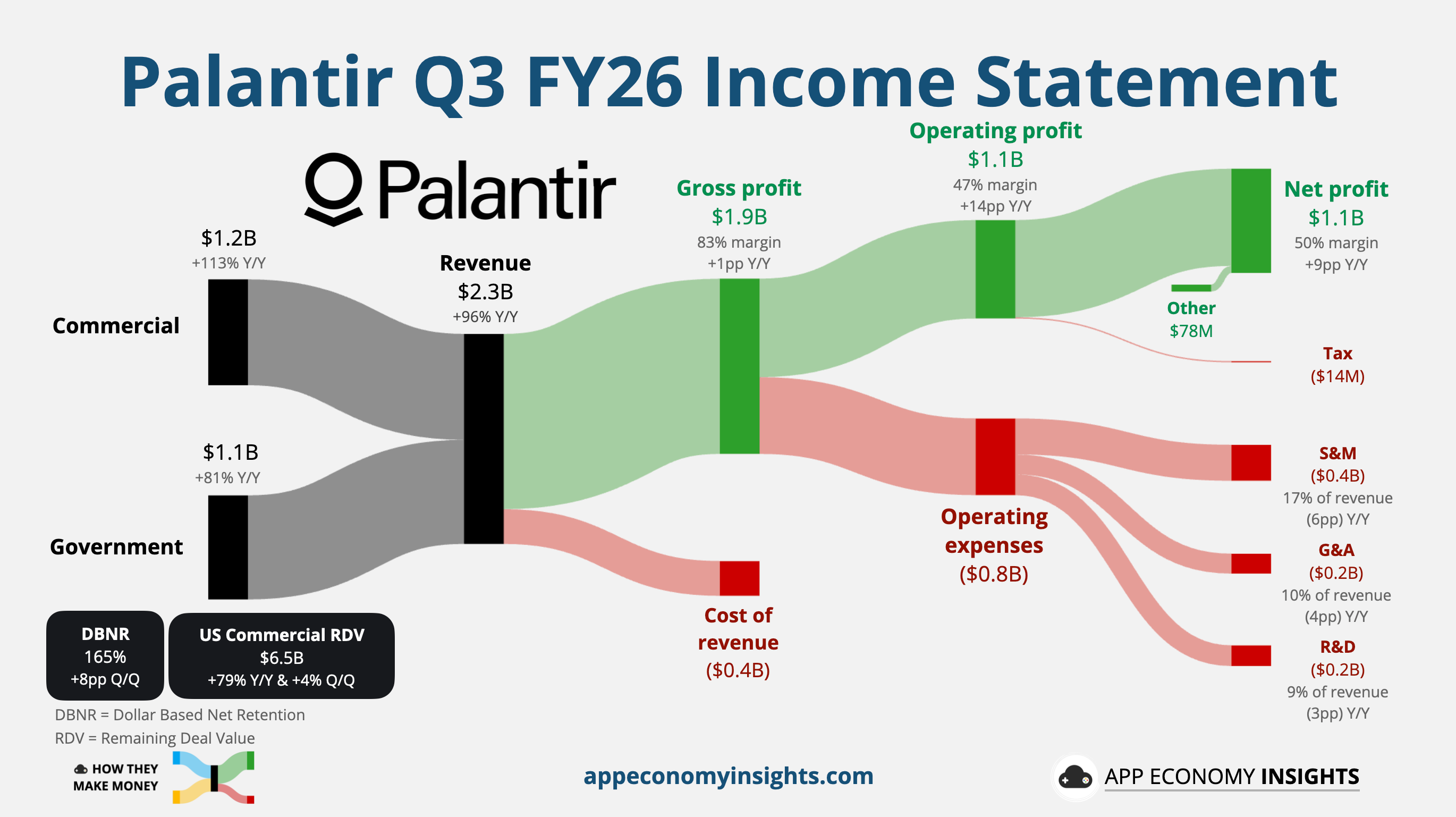
The biggest milestone was US commercial revenue surpassing government revenue for the first time:
💼 US Commercial: $984 million (+148% Y/Y, +29% Q/Q).
🪖 US Government: $953 million (+96% Y/Y, +18% Q/Q).
Total US revenue reached $1.94 billion (+119%), now accounting for 84% of Palantir’s business. Net dollar retention climbed eight points sequentially to 165%, showing existing customers are rapidly expanding spending.

However, the pipeline showed some cracks:
Total Contract Value (TCV) fell 13% Q/Q to $2.92 billion, with US commercial TCV dropping 31% to $1.46 billion. Its Y/Y growth slowed sharply from 153% in Q2 to just 11%.
US commercial Remaining Deal Value (RDV) reached $6.52 billion, up just 4% sequentially after growing 27% in Q2. Palantir also closed fewer deals above $10 million, declining from 73 to 64.
Management attributed part of the slowdown to shorter initial Sovereign AI contracts, including several eight-figure deals. CEO Alex Karp argued that customers are moving into production faster, with opportunities to expand contracts dramatically over time. That could explain the weaker bookings metrics, although investors will want to see those initial deals translate into larger, longer-term commitments.
Adjusted free cash flow remained strong at $1.2 billion, but its margin declined from 63% in Q2 to 53%.
Palantir raised FY26 revenue guidance by another $380 million to $8.53 billion, implying 91% annual growth. Q4 guidance of $2.65 billion exceeded consensus by ~$0.2 billion, although it implies sequential growth slowing to 15% (from 20% in Q3).
Palantir continues delivering extraordinary financial results. But at a valuation exceeding $400 billion (roughly 76x forward EBITDA), investors have little tolerance for slowing momentum. What to watch in Q4? Whether those smaller initial deals are turning into much larger contracts.
3. 🚖 Uber: Robotaxi Ramp
Uber’s Q3 revenue grew 10% Y/Y to $14.8 billion ($100 million beat), with UK accounting changes reducing reported growth by 8 percentage points. Adjusted EPS rose 35% to $0.88 ($0.01 beat).
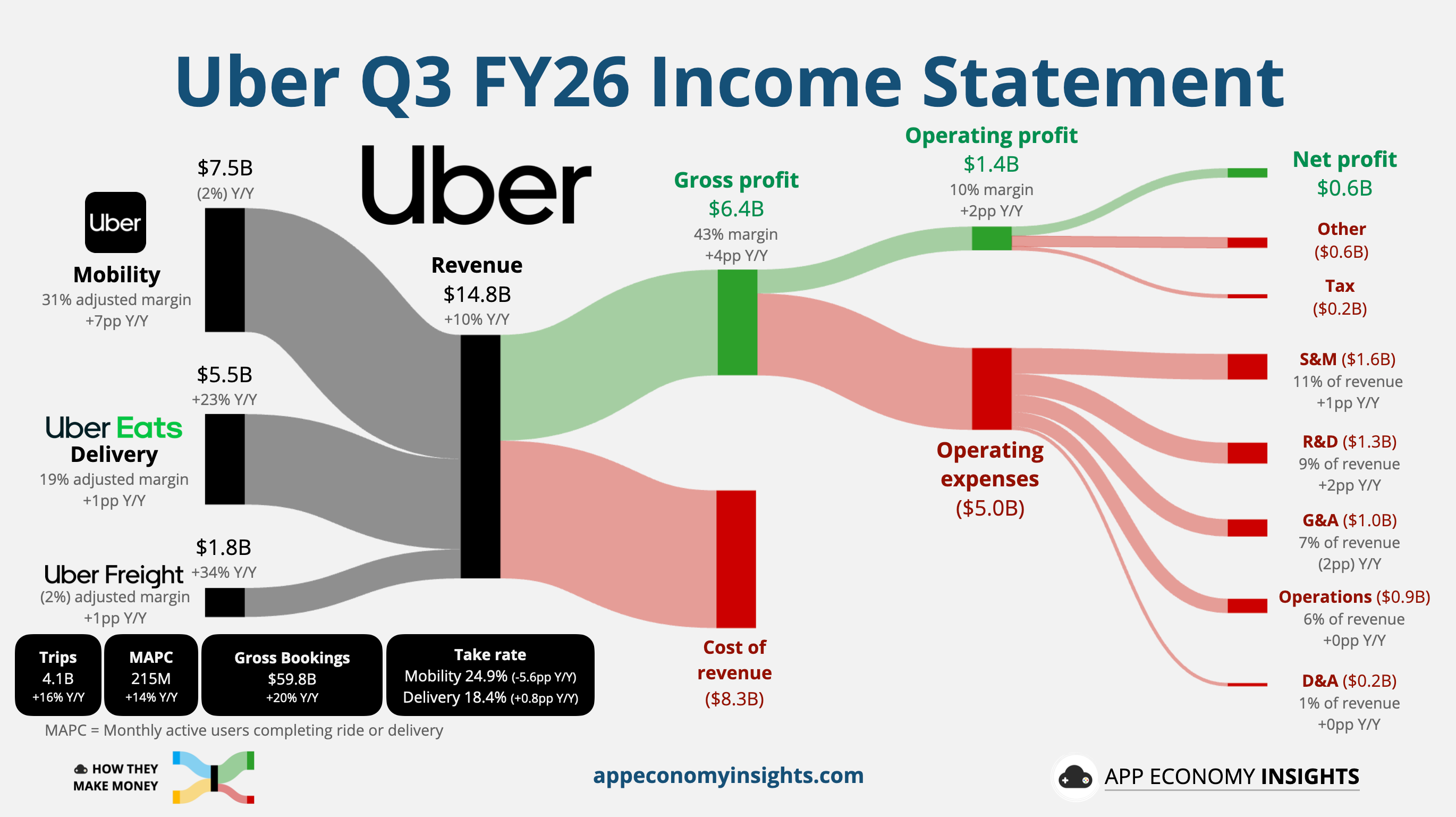
Gross Bookings grew 20% to $59.8 billion, marking the fifth consecutive quarter of 20%+ growth, although slowing from 24% in Q2. Trips increased 16% to 4.1 billion, supported by 14% growth in monthly users.

🚗 Mobility bookings grew 17% constant currency to $29.5 billion, slowing from 20% in Q2. Driver shortages in Brazil, India, and Canada, compounded by higher fuel prices, constrained supply despite healthy demand. Management increased driver incentives and reported early improvements in October.
🛵 Delivery bookings grew 23% constant currency to $28.5 billion, nearly matching Mobility. Grocery and Retail reached a $15 billion annualized run rate (+40%), while Uber One membership expanded to 55 million.
Adjusted EBITDA rose 31% to $3.0 billion, with margin reaching 5.0% of Gross Bookings. Trailing free cash flow climbed to a record $10.4 billion.
The bigger story remains autonomous vehicles (AVs).
Uber expects approximately 700 fully driverless vehicles on its platform by year-end and more than 2,000 in 2027, ahead of a larger ramp in 2028.
Crucially, management says its US AV partners complete roughly 30% more trips per vehicle per day through Uber than first-party deployments nationwide. That’s early evidence that Uber’s demand aggregation and fleet operations could improve robotaxi economics.
But this strategy requires capital. Uber has outlined approximately $10 billion in conditional commitments to AV partners and fleets, while developing financing structures to attract third-party investors.
For Q4, management guided Gross Bookings to $63.25–65.25 billion (+18%–22% constant currency) and non-GAAP EPS to $0.95–0.99, slightly below consensus at the midpoint.
Uber’s core business continues generating substantial cash. The big test ahead is whether Uber can scale robotaxis profitably while preserving its marketplace economics as autonomous supply expands.

Stay tuned for tomorrow’s PRO issue with 50 companies visualized!
Apple, Shopify, AppLovin, MercadoLibre, and more.
That’s it for today!
Happy investing!
Want to sponsor this newsletter? Get in touch here.
Disclosure: I am long AMD, PLTR, and UBER in App Economy Portfolio. I share my ratings (BUY, SELL, or HOLD) with App Economy Portfolio members.
Author’s Note (Bertrand here 👋🏼): The views and opinions expressed in this newsletter are solely my own and should not be considered financial advice or any other organization’s views.
Worth adding from AMD's 8-K: inventories rose ~$3.0B and receivables ~$1.9B in Q3, which took the free cash flow margin to 4% from 14% in Q2, while total debt climbed to $7.1B from $3.2B. AMD is effectively pre-funding that $17B Q4 guide. If Thursday's rout makes customers hesitate, the working-capital lines will show it before the income statement does.