


Welcome to the Free edition of How They Make Money.
Over 300,000 subscribers turn to us for business and investment insights.
In case you missed it:
🗓️ The earnings flood continues!
This week, we’re visualizing more than 50 earnings reports across tech, healthcare, commerce, and everything in between.
Today at a glance:
🚖 Uber: AV Anxiety
🍄 Nintendo: Software Cushion
🛍️ Shopify: Deceleration Dodged

🚖 Uber: AV Anxiety
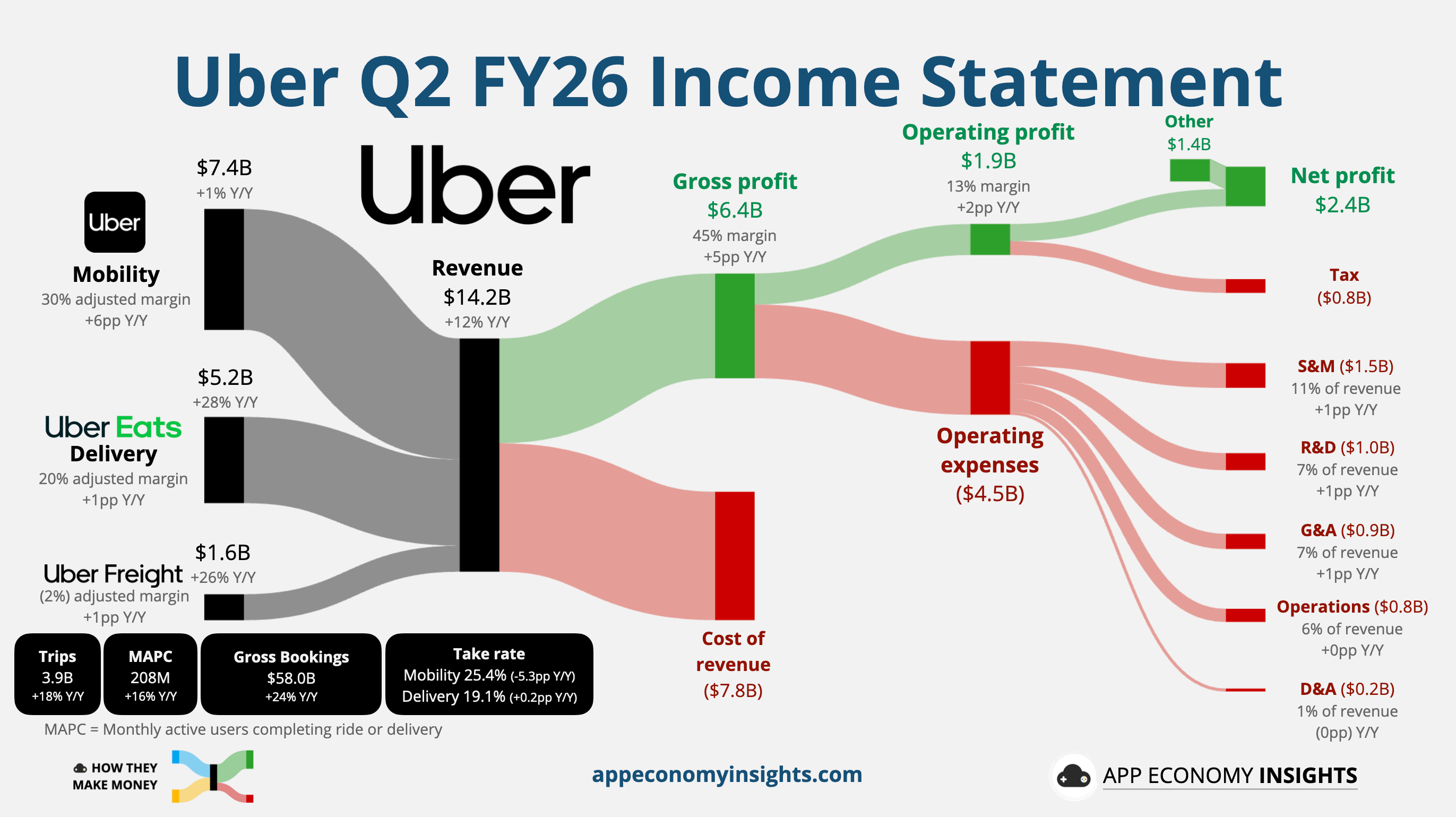
Uber’s Q2 revenue rose 12% Y/Y to $14.2 billion ($70 million miss), though an accounting shift from a merchant to an agency model in UK Mobility reduced reported growth by 8 points.
Gross Bookings grew 24% (or 22% constant currency) to a record $58.0 billion, marking the fourth consecutive quarter above 20%.

Trips rose 18% to 3.9 billion, driven by 16% growth in monthly users. The 2-point slowdown in trip growth came entirely from Brazil, Uber’s highest-volume market, where competition for two-wheel drivers constrained supply. US Mobility actually accelerated as insurance savings funded lower prices, with trip growth strongest in markets like San Francisco and Los Angeles where fares fell the most.
Mobility bookings grew 20%, while Delivery accelerated to 25%. That growth is increasingly flowing through to profits. Adjusted EBITDA rose 33% to $2.8 billion, with margin reaching 4.9% of Gross Bookings. Trailing-12-month free cash flow crossed $10 billion for the first time, giving Uber more room for buybacks, M&A, and AV investment.
Autonomy remains the valuation debate. Uber is now live with AVs in seven cities and still targets 15 by year-end. Management argues its advantage is not building the autonomous driver itself, but aggregating demand, dispatching vehicles, handling fleet operations, insurance, and regulators. In mature AV markets including San Francisco, Los Angeles, and Phoenix, Uber says its overall category share is actually higher than a year ago.'
Yet the valuation already reflects plenty of AV anxiety. At roughly 10x 2027 adjusted EBITDA, Uber trades at a modest multiple for a business still growing bookings above 20%. The market is clearly pricing in some future erosion of Uber’s economics.
Uber guided Q3 Gross Bookings to $58.25–$60.25 billion, implying 18–22% constant-currency growth, while EPS guidance of $0.84–$0.88 was roughly in line.
Bottom Line: Uber’s core business keeps getting stronger and its Delivery Hero acquisition could deepen its flywheel. The market’s question has simply moved further out: how much of today’s economics does Uber retain once robotaxis scale?
🍄 Nintendo: Software Cushion
Nintendo Q1 revenue (June quarter) fell 10% Y/Y to ¥518 billion (~$3.3 billion), but still beat expectations, while operating profit surged 151% to ¥143 billion, nearly double consensus. Net income rose 54% to ¥147 billion. The catch was that roughly $300 million of refunded US tariffs reduced cost of sales, providing a large one-time boost to profitability.
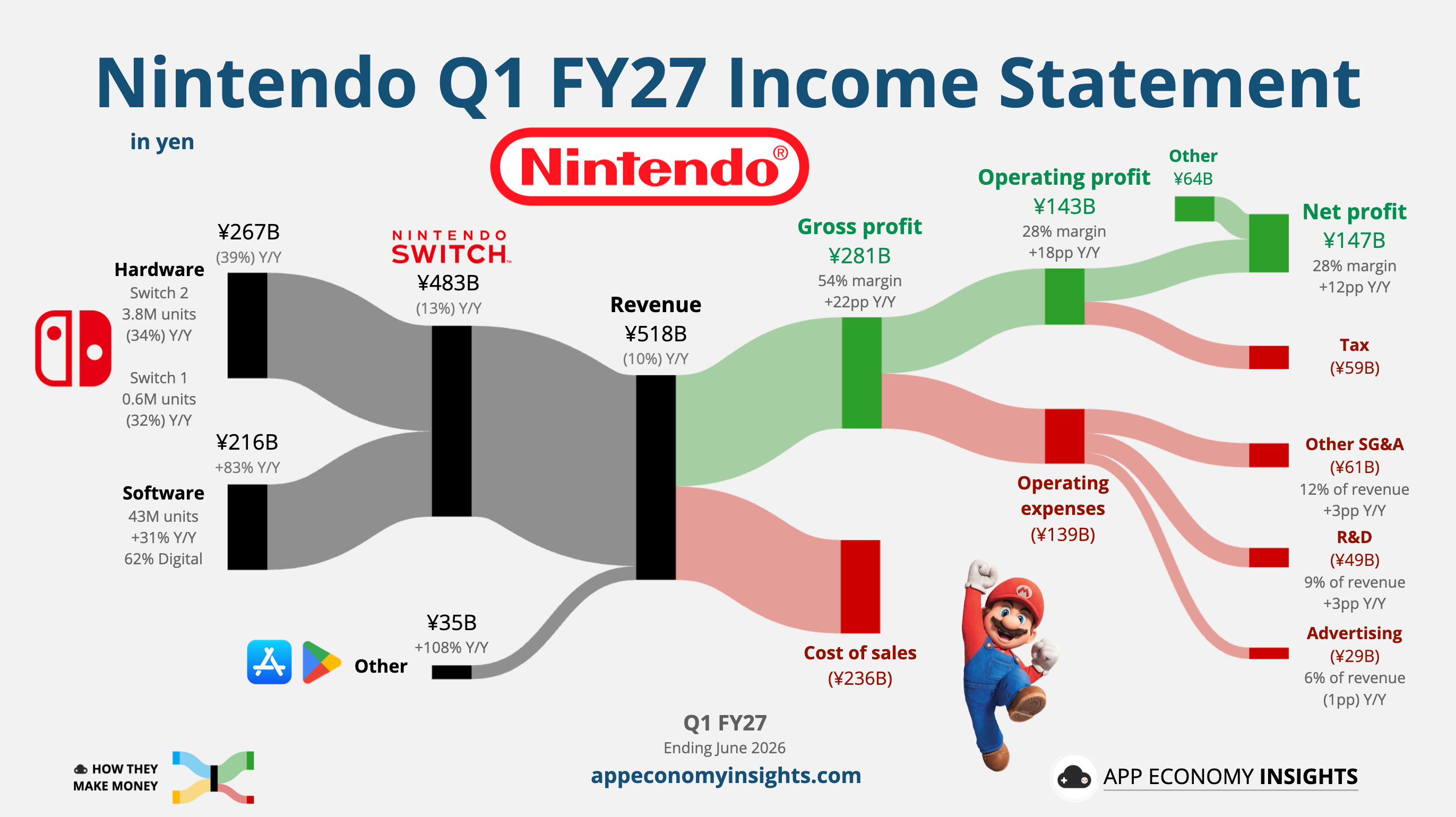
Switch 2 sold 3.8 million consoles, down 34% against last year’s launch quarter but already 23% of Nintendo’s 16.5 million FY27 target. It now has an installed base of 23.7 million units globally. That compares to 17.8 million units sold by the original Switch a year after launch.
The big surprise was that the original Switch software sales jumped 39% to 34 million units, versus just 9.5 million Switch 2 games. Tomodachi Life: Living the Dream sold 7.9 million units and Pokémon Pokopia 1.3 million, showing that backward compatibility is keeping the 150M+ Switch ecosystem economically relevant even as hardware migrates. Digital sales nearly doubled to ¥133 billion and reached 62% of software revenue.
IP-related revenue more than doubled to ¥35 billion, helped by The Super Mario Galaxy Movie, which has already passed $1 billion at the global box office. That higher-margin software and IP mix helped gross margin jump 22 points to 54%, although the tariff refund materially amplified the improvement.
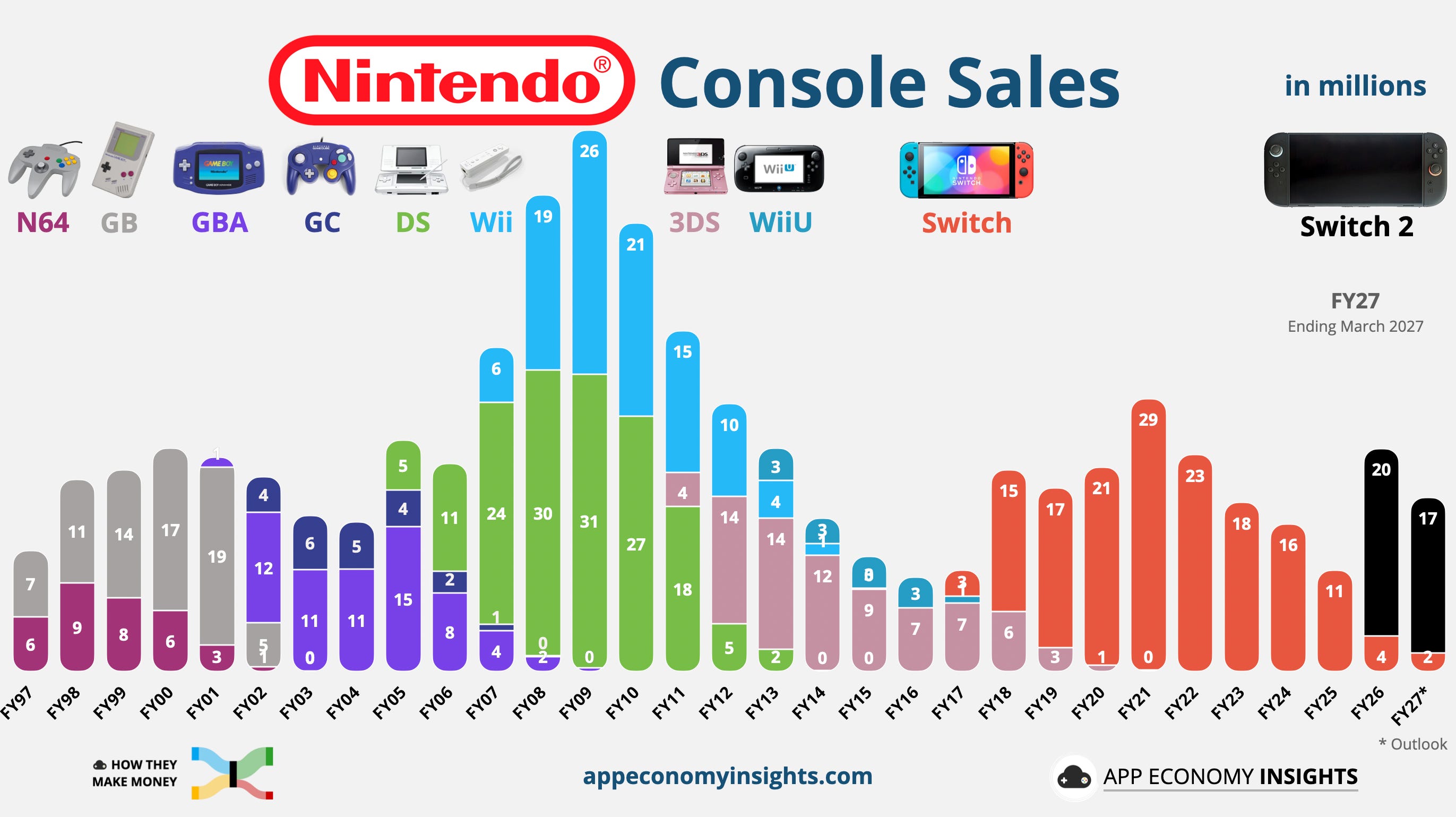
Bottom Line: Nintendo left FY27 guidance unchanged at 16.5 million Switch 2 consoles, 60 million Switch 2 games, ¥2.05 trillion of revenue, and ¥370 billion of operating profit. The real test still starts in September, when a price hike takes the Switch 2 to $500 heading into the holiday season.
🛍️ Shopify: Deceleration Dodged
Shopify’s Q2 revenue jumped 34% Y/Y to $3.6 billion ($140 million beat), while GMV grew 32% to $115.6 billion. Free cash flow reached $654 million at an 18% margin, up from 15% last quarter. Shares surged as the recent deceleration scare proved premature.
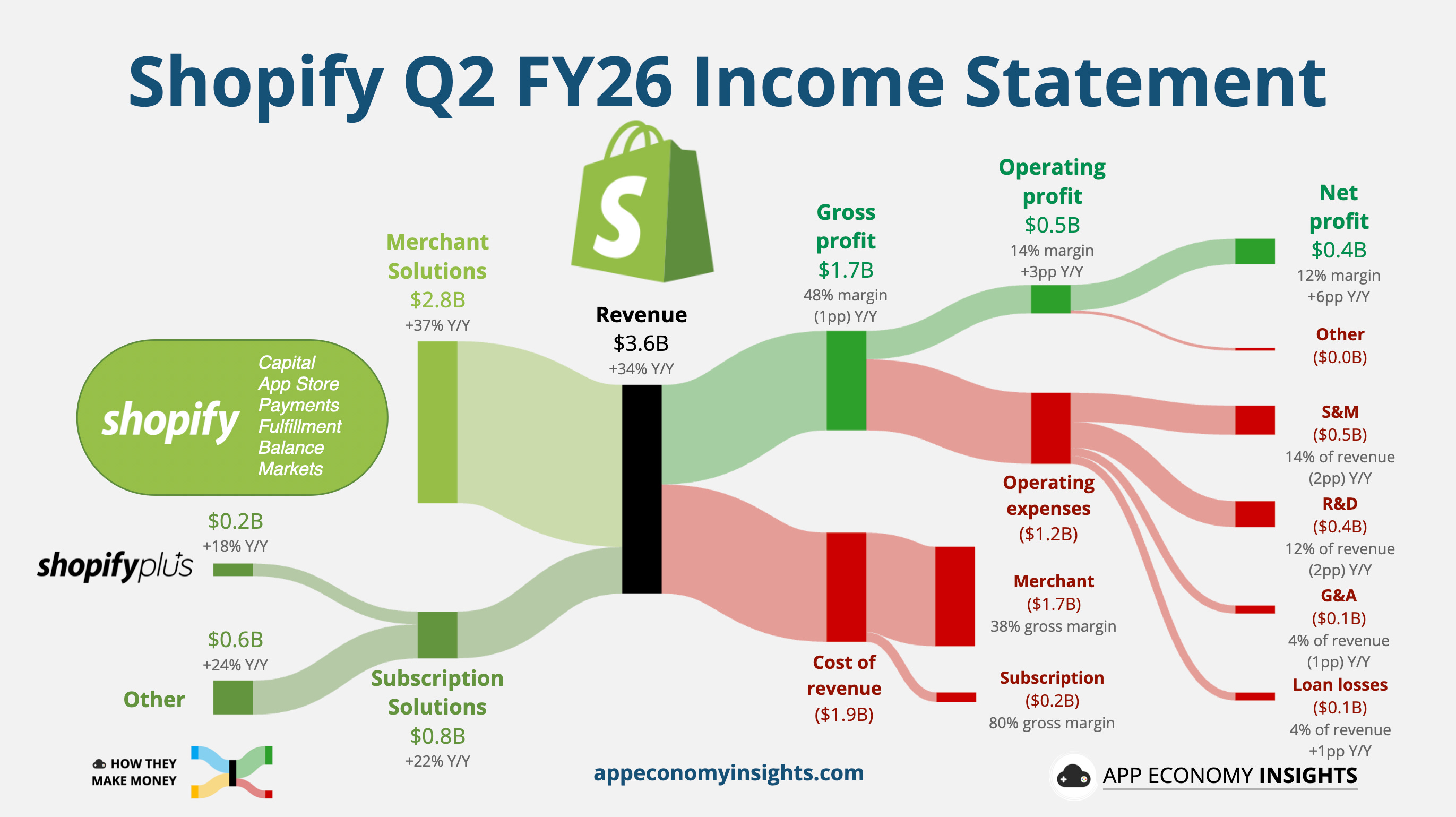
Growth remained broad across merchant sizes, geographies, and channels. Shopify Payments penetration reached 68% of GMV (+3pp Y/Y), while Shop Pay has now processed more than $400 billion in GMV since launch.
AI commerce is also becoming more tangible. AI-driven traffic and orders to Shopify stores both tripled Y/Y, with AI-attributed orders converting at roughly twice the rate when agents use Shopify’s structured Catalog rather than scraped web data. Importantly, 75% of AI-attributed orders came from outside Shopify’s top 100 categories, suggesting AI discovery disproportionately benefits smaller merchants.
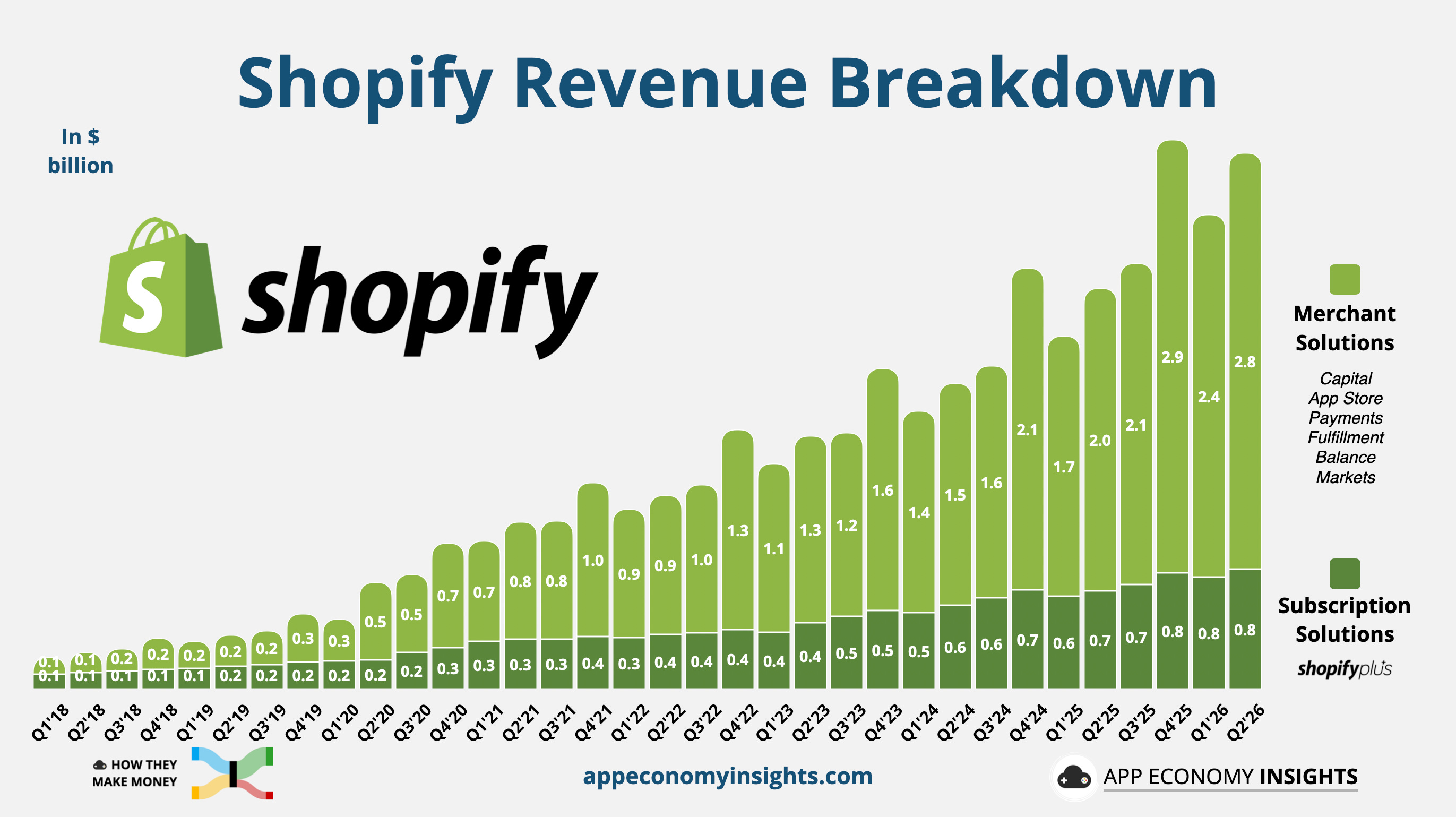
Shopify guided Q3 revenue growth to the low-30s%, well above the ~27% consensus and implying a sixth consecutive quarter above 30%. Free cash flow margin should also improve to the ‘high teens’ to ‘low 20s.’
Bottom Line: Q1 raised the question of whether Shopify was finally slowing. Q2 answered it decisively. GMV and revenue remain above 30%, margins are expanding, and AI is increasingly looking like a distribution tailwind rather than the disruption risk investors feared.
Next up: Saturday’s massive PRO edition, with over 40 companies visualized, including Eli Lilly, AppLovin, Sony, Airbnb, Spotify, and more.
That’s it for today!
Stay healthy and invest on!
Want to sponsor this newsletter? Get in touch here.
Thanks to Fiscal.ai for being our official data partner. Create your own charts and pull key metrics from 50,000+ companies directly on Fiscal.ai. Start an account for free and save 15% on paid plans with this link.
Disclosure: I am long SHOP and UBER in App Economy Portfolio. I share my ratings (BUY, SELL, or HOLD) with members.
Author's Note (Bertrand here 👋🏼): The views and opinions expressed in this newsletter are solely my own and should not be considered financial advice or any other organization's views.