


Welcome to the Free edition of How They Make Money.
Over 300,000 subscribers turn to us for business and investment insights.
In case you missed it:
Life after Jensen
For the first time in 33 years, Jensen Huang is no longer running NVIDIA.
He resigned last week following revelations of extramarital affairs, including one with a former executive of Singapore-based Megaspeed, an NVIDIA customer under investigation for potential violations of US chip export restrictions.
The controversy raises serious questions about corporate governance and national security. The SEC has reportedly opened an investigation into NVIDIA's disclosures. CFO Colette Kress has stepped in as interim CEO, and the board has established a new committee dedicated to export controls.
NVIDIA started as a company selling graphics cards to gamers. Today, its products are considered critical to national security. Washington increasingly expects NVIDIA to police where its chips ultimately end up, much like banks or defense contractors are expected to comply with sanctions and export restrictions.
Few founders have been as closely associated with their company’s success. Jensen shaped NVIDIA’s culture, its technology roadmap, its relationships with the world’s largest companies, and even US industrial policy.
His departure comes at a pivotal moment. AI infrastructure spending is reaching unprecedented levels, competition is intensifying, and NVIDIA is putting more of its own capital at risk to finance the buildout.
Can NVIDIA dominate the AI economy without the man who saw it coming?
Let’s dive in.
Today at a glance:
NVIDIA’s Q3 FY27
Business highlights
Key quotes from the call
What to watch moving forward

1. NVIDIA Q3 FY27
NVIDIA’s fiscal year ends in January, so the October quarter was Q3 FY27.
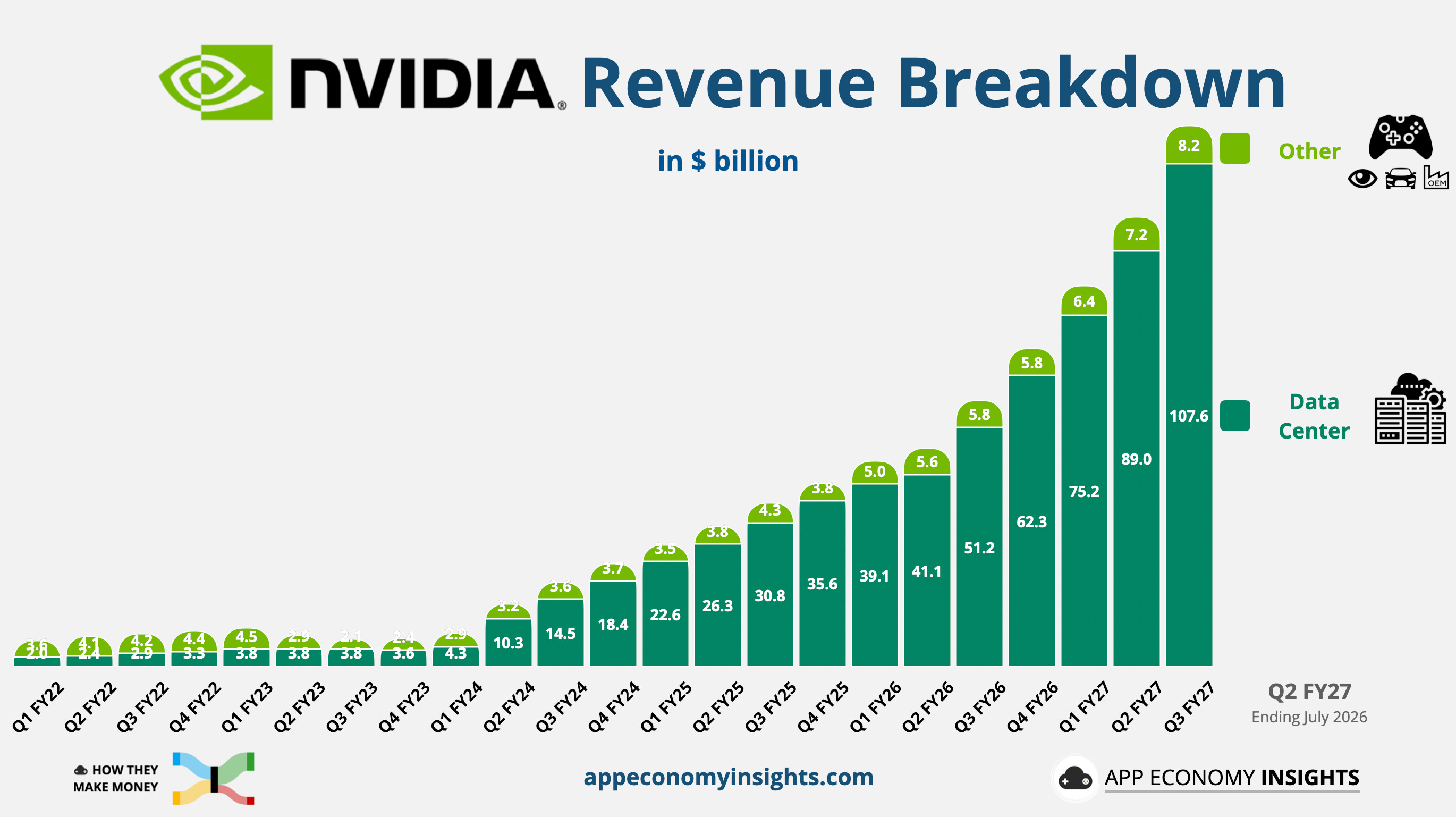
Data Center revenue crossed $100 billion for the first time, as illustrated below.
Income statement:
Revenue +103% Y/Y to $115.8 billion ($7.1 billion beat).
Data Center +110% Y/Y to $107.6 billion.
Edge Computing +42% Y/Y to $8.2 billion.
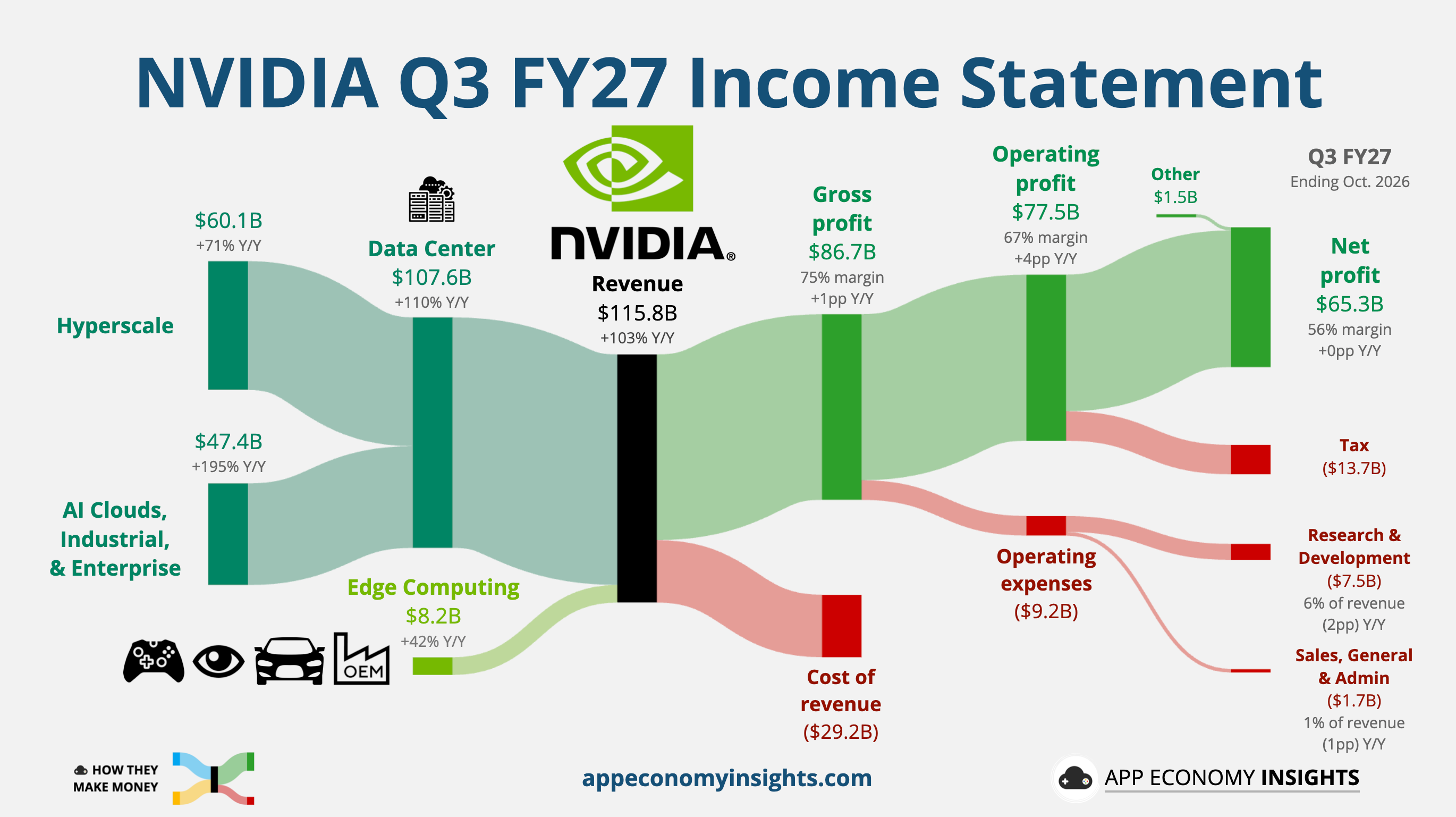
Gross margin was 75% (+1pp Y/Y).
Operating margin was 67% (+4pp Y/Y).
Non-GAAP EPS was $2.68 ($0.21 beat).
Cash flow:
Operating cash flow +103% Y/Y to $48.3 billion.
Free cash flow +98% Y/Y to $43.8 billion.
Balance sheet:
Cash and debt securities: $53.5 billion.
Public equity investments: $44.2 billion.
Private investments: $65.5 billion.
Debt: $32.4 billion.
Q4 FY27 Guidance:
Revenue +12% Q/Q and +91% Y/Y to $130.0 billion ($5.1 billion beat).
Gross margin of 71%-72%.
Guidance assumes no Data Center compute revenue from China.
Q4 benefits from an additional week.
So, what to make of all this?
📈 Growth remains extraordinary: NVIDIA added nearly $20 billion in sequential revenue, its largest quarterly increase in absolute dollars to date. Revenue more than doubled Y/Y for the second consecutive quarter.
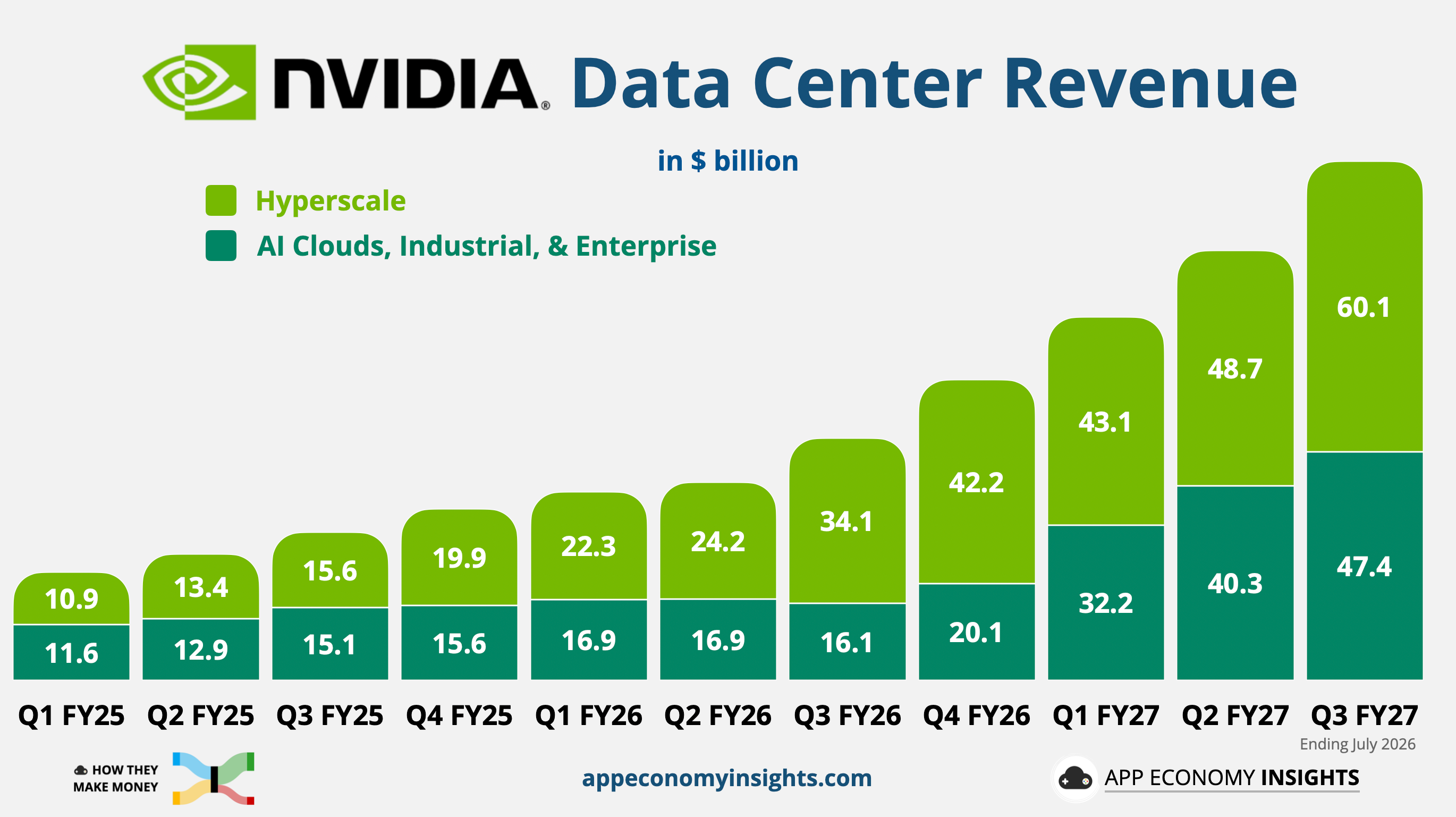
☁️ Hyperscale growth reaccelerates: Hyperscale revenue rose 23% Q/Q to $60.1 billion, while AI Clouds, Industrial, and Enterprise grew 18% Q/Q to $47.4 billion. Demand remains strong across both customer groups.
⚡ Rubin hits the ground running: Vera Rubin generated nearly $20 billion in revenue in its first quarter of production shipments, making it the fastest product ramp in NVIDIA’s history. Demand for previous generations remains strong.
📉 Margins are holding up better than expected: Gross margin stayed near 75% despite soaring memory costs. Management expects margins to bottom in Q4 at 71%-72% before recovering to 72%-73% in FY28.
💰 Record shareholder returns: NVIDIA returned $28.1 billion to shareholders, including $22.1 billion in buybacks. The board added $150 billion to its share repurchase authorization in September, with $227 billion still available at quarter-end.
🔮 FY28 outlook raised: Q4 guidance calls for another $14 billion in sequential revenue growth. In addition, management now expects ~75% revenue growth in FY28, up from 70% previously and off a higher FY27 base.
Big picture: NVIDIA’s leadership is in turmoil, but its operating performance remains exceptional. These results largely reflect decisions made under Jensen. The real test of NVIDIA without him is still ahead.
2. Business highlights
🏭 AI factories in a box
At GTC Berlin in October, NVIDIA unveiled DSX POD, a blueprint for modular AI factories built inside shipping containers.
Partners assemble and test Rubin systems, networking, power distribution, and liquid cooling before delivering them to customers. NVIDIA says this approach can cut on-site deployment time from six months to just 14 days, assuming the site has the necessary utilities.
Partners include Dell, HPE, Lenovo, Schneider Electric, and Vertiv, with the first deployments expected in early 2027.
NVIDIA previously went from selling individual chips to selling entire racks. It’s now standardizing how customers build entire AI factories. The sooner customers can generate revenue from their infrastructure, the sooner they can reinvest in additional capacity.
🧠 NVIDIA goes after the CPU market
The rise of agentic AI is creating a new growth opportunity for NVIDIA.
While GPUs run AI models, CPUs handle many of the tasks that agents perform between model interactions, such as executing code, retrieving data, and using external tools.
In October, Oracle announced plans to make 150,000 NVIDIA Vera CPUs available across its cloud regions, with OpenAI among its first customers.
This week, NVIDIA also unveiled a rack-scale system featuring 192 Vera CPUs designed for scientific workloads like climate modeling and molecular simulations.
NVIDIA is increasingly competing with AMD and Intel in the server CPU market. Management expects CPU revenue to more than double in FY28, with agentic AI driving extraordinary demand.
🤝 If you can’t beat them, connect them
NVIDIA is finding ways to benefit from the proliferation of custom AI chips.
Earlier this month, the company announced a partnership with South Korean chip designer Rebellions and SK Telecom. Using NVIDIA’s NVLink Fusion technology, Rebellions plans to integrate its own AI accelerators into NVIDIA’s rack architecture.
As cloud providers and governments develop their own AI chips, NVIDIA can still sell networking components and extend its technology's reach.
In other words, NVIDIA doesn’t need to win every chip socket to win the data center.
3. Key quotes from the earnings call
Check out the earnings call transcript on Fiscal.ai here.
Chairman Harvey Jones:
On the CEO search:
“The NVIDIA board unanimously accepted his resignation and does not intend to reinstate Jensen as CEO. [...] We’re going to look into internal candidates as well as external candidates. The board appreciates that we’re living in a world where the advanced silicon technologies and national security dynamics are making major changes in our marketplace. Our new CEO will have to navigate those waters very carefully.”
Jensen publicly expressed his willingness to return as CEO just hours before the earnings call. The board’s response was unequivocal. Even if Jensen is ultimately cleared of any involvement in chip smuggling, his personal misconduct and strained relationship with Washington could make a comeback politically untenable.
The next CEO will need to be as comfortable dealing with Washington as with Silicon Valley and Taiwan. That could favor a very different leadership profile from Jensen’s. According to Bloomberg, Arm CEO Rene Haas, who previously spent seven years at NVIDIA, is among the candidates approached.
Interim CEO Colette Kress:
On supply chain relationships:
“I see right now the leadership even from TSMC that was in our offices just this week, also fully engaged in helping us. We’ve secured memory, we’ve secured advanced packaging.”
NVIDIA has supply agreements extending through the end of the decade, and its purchase commitments jumped from $279 billion to $390 billion in three months. Whatever happens to Jensen’s personal relationships with suppliers, much of NVIDIA’s near-term capacity is already secured.
On financing the AI buildout:
“As the market matures and additional sources of capital become available, we are rigorously evaluating future investments, commitments, and guarantees.”
Kress indicated that NVIDIA would prioritize financing its suppliers’ capacity expansion and helping select customers secure land, power, and data center facilities. She also committed to returning all excess free cash flow, net of strategic investments, to shareholders. We could be entering a new era of capital allocation at NVIDIA. At the end of Q3, NVIDIA had $118 billion in financial guarantees and $32 billion in commitments associated with neocloud agreements.
On GPU rental prices:
“Token prices have fallen nearly 60% since May, accelerating token usage and demand for compute. As a result, GPU rental prices are rising across generations. Hopper GPUs have recontracted at up to twice their original price under the multi-year agreements, while the B300 rates have risen more than 60% since their introduction.”
Older GPUs are becoming more valuable even as newer generations deliver dramatic efficiency gains. This is Jevons paradox playing out in real time: cheaper intelligence is stimulating more demand for compute. So far, technological obsolescence hasn’t been the problem many feared.
4. What to watch next
NVDA is down nearly 40% from its peak.
The stock trades at only about 10x forward earnings, well below the multiple it commanded earlier in the AI boom and well below the rest of US Big Tech.

In semiconductors, a low P/E can sometimes signal peak earnings rather than a bargain. At the current valuation, the market appears increasingly skeptical of NVIDIA's ability to sustain its extraordinary profitability.
Was NVIDIA’s past growth artificially boosted by Chinese demand, whether through illegal chip diversion or previously legal remote access to overseas data centers? NVIDIA has been supply-constrained for much of the AI boom, so many of those chips would likely have found buyers elsewhere. Despite tighter US export controls introduced this week, NVIDIA raised its FY28 growth outlook. The bigger financial risk may be regulatory penalties rather than a near-term shortfall in demand.
Here’s what I’m watching:
👤 Life after Jensen: NVIDIA’s CUDA ecosystem and technology roadmap aren’t going away. However, talent retention is an immediate concern, with management reportedly bringing forward pay raises and equity grants to reassure employees. Jensen himself was part of NVIDIA’s moat. As Ben Thompson put it, he was “a one-person coordination function,” convincing Asian suppliers to commit enormous resources to the AI buildout. Internally, Jensen famously had 60 direct reports, allowing NVIDIA to operate at startup speed despite its enormous scale. Can the company preserve these advantages without its founder?
💰 A more disciplined NVIDIA? Jensen was reportedly already reconsidering NVIDIA's aggressive financing strategy before his departure. New leadership could accelerate that shift. But NVIDIA’s financial support for neoclouds served a strategic purpose: fostering alternatives to the hyperscalers developing their own AI chips. A more conservative approach could reduce NVIDIA’s financial risk while inadvertently strengthening its biggest competitors. With nearly $110 billion in public and private equity investments, NVIDIA is increasingly exposed to the AI cycle through both its income statement and its balance sheet.
☁️ Google becomes a chip vendor: TPU systems sales were already a meaningful contributor to Google Cloud’s Q3 growth, with a more substantial revenue ramp expected in 2027. Google’s partnership with Oracle will make TPUs available through another hyperscaler for the first time. NVIDIA’s customers increasingly have access to competing silicon without designing their own chips or switching cloud providers. Google is also lowering the software barriers to adopting its chips, partnering with Meta to develop TorchTPU, an open-source solution that enables native PyTorch support.
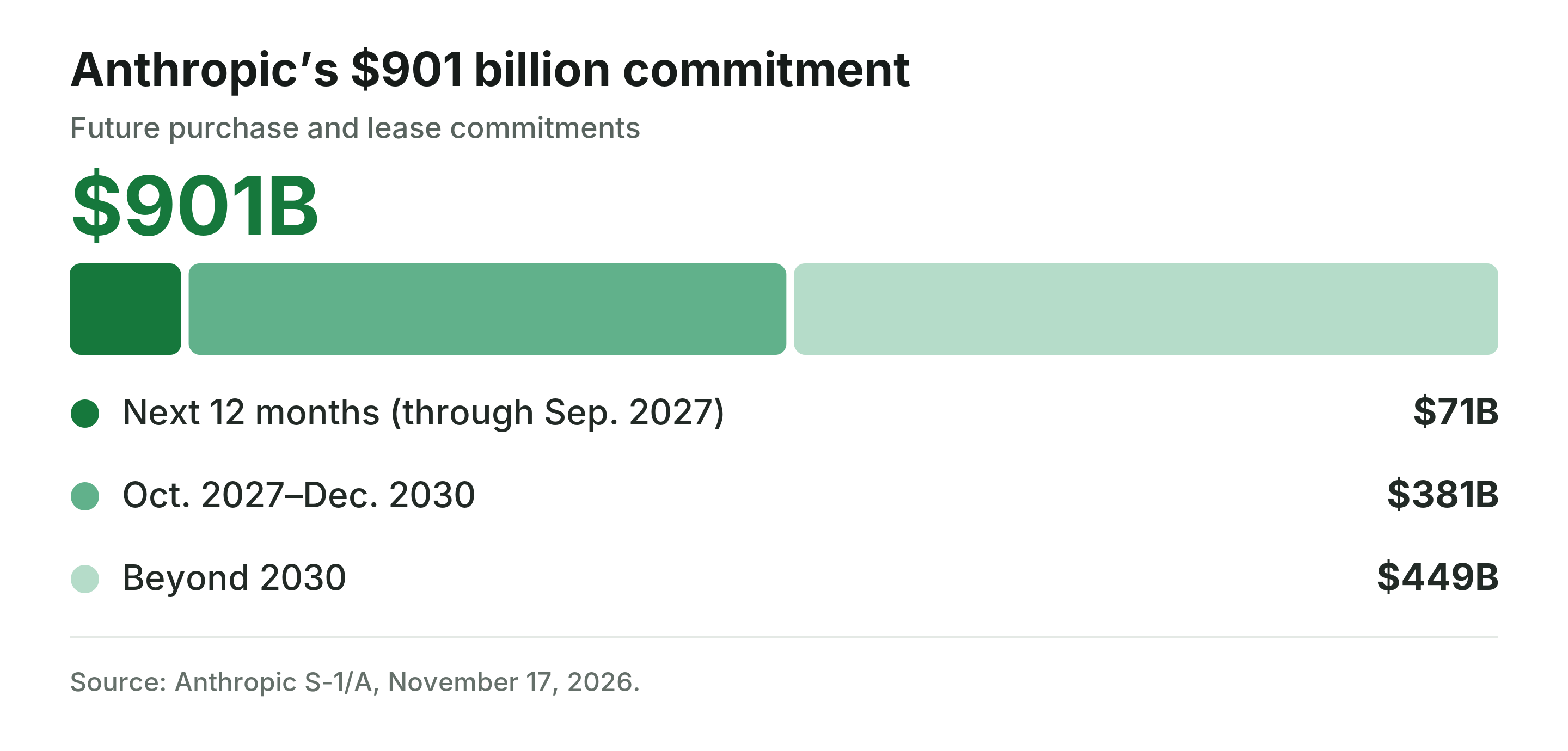
Meanwhile, Anthropic just raised a record $81 billion in its IPO at a $1.5 trillion valuation. Its prospectus offers a glimpse into the road ahead for the AI industry. The company has committed to approximately $901 billion in future spending, almost entirely related to compute and infrastructure, including $452 billion by the end of 2030.
Crucially, Anthropic’s compute strategy spans four chip platforms: AWS Trainium, Google TPUs, NVIDIA GPUs, and AMD GPUs. The company is even using Claude to accelerate the adoption of new chip architectures.
AI itself is lowering the barriers to adopting competing silicon, challenging NVIDIA’s software moat. The infrastructure opportunity keeps getting bigger, but NVIDIA’s dominance is far from guaranteed.
📉 The bear case is that Jensen’s departure erodes NVIDIA’s advantages in supply chain management, innovation, and ecosystem development just as custom silicon gains traction.
📈 The bull case is that NVIDIA has built an enduring computing platform, and the expansion of the AI economy more than offsets any loss of market share.
At today’s depressed valuation, management no longer needs to deliver quite as extraordinary a future to generate attractive shareholder returns.

That’s it for today!
Happy investing!
Want to sponsor this newsletter? Get in touch here.
Disclosure: I am long AMD, AMZN, META, MSFT, NVDA, GOOG, and TSM in App Economy Portfolio. I share my ratings (BUY, SELL, or HOLD) with App Economy Portfolio members.
Author’s Note (Bertrand here 👋🏼): The views and opinions expressed in this newsletter are solely my own and should not be considered financial advice or any other organization’s views.
nvidia is now backing $118 billion in guarantees for the smaller cloud companies that rent out its chips. at the $43.8 billion of free cash flow it made last quarter, that's about eight months of cash. so if those customers stumble, nvidia doesn't just lose sales, it may also have to cover what they owe. that could be part of why the stock sits at only about 10 times next year's earnings even with revenue doubling.