


Welcome to the Free edition of How They Make Money.
Over 300,000 subscribers turn to us for business and investment insights.
In case you missed it:
NVIDIA Without Jensen Huang
In a stunning development, Jensen Huang resigned as NVIDIA’s CEO on Thursday, ending 33 years at the helm of the company he co-founded. CFO Colette Kress has been appointed interim CEO.
His departure comes amid an independent investigation involving a suspected Chinese intelligence operation and potential diversion of restricted NVIDIA chips to China. NVIDIA has not specified the reason for his resignation and maintains that it has no indication company secrets were compromised.
But the implications go far beyond NVIDIA’s leadership.
Huang was the architect of NVIDIA's technological dominance and a key financier of the AI boom, using NVIDIA's financial strength to support customers and infrastructure providers.
NVIDIA says its technology roadmap and existing customer commitments remain intact. But will its next CEO be as willing to bankroll the AI ecosystem?
That’s particularly relevant for neoclouds like CoreWeave, which depend on NVIDIA not only for GPUs but also for financial backing.
The leadership shakeup comes at a particularly sensitive moment for the AI industry, as investors question whether the enormous infrastructure spending will deliver adequate returns.
Anthropic’s updated S-1 offers a timely reminder of what’s at stake.
Q3 revenue surged 47% Q/Q to $17 billion, but compute and infrastructure expenses grew even faster, rising 77% Q/Q to $9.9 billion.
Compute consumed 58% of revenue, up from 48% in Q2. Despite massive revenue growth, Anthropic reported a $567 million operating loss.
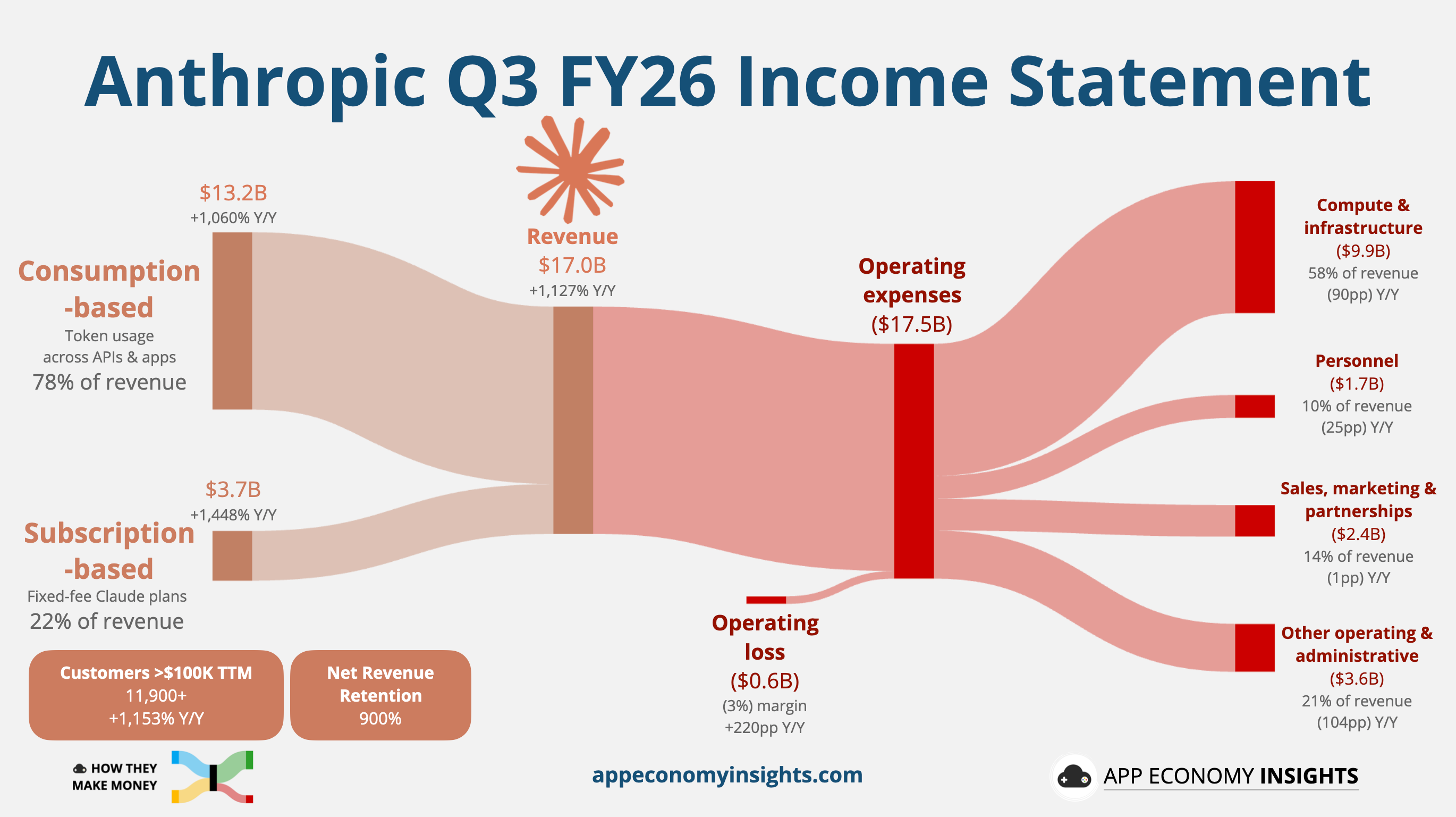
The company also disclosed nearly $900 billion in multiyear infrastructure commitments, illustrating the enormous cost of competing at the AI frontier.
For AI infrastructure providers, the opportunity is enormous. But meeting that demand is becoming increasingly complicated.
Last week’s elections offered a warning: Voters favored limiting data center development in 40 of 41 local ballot measures. Growing opposition over electricity costs and resource consumption could become another bottleneck for the AI buildout.
That tension between surging demand and the challenges of expanding capacity is at the heart of the investment case for neoclouds like CoreWeave.
Today at a glance:
🧱 CoreWeave: GPUs Get a Second Life
🎮 Take-Two: GTA VI’s $1B Head Start
🌊 Sea: Monee IPO Takes Shape

1. 🧱 CoreWeave: GPUs Get a Second Life
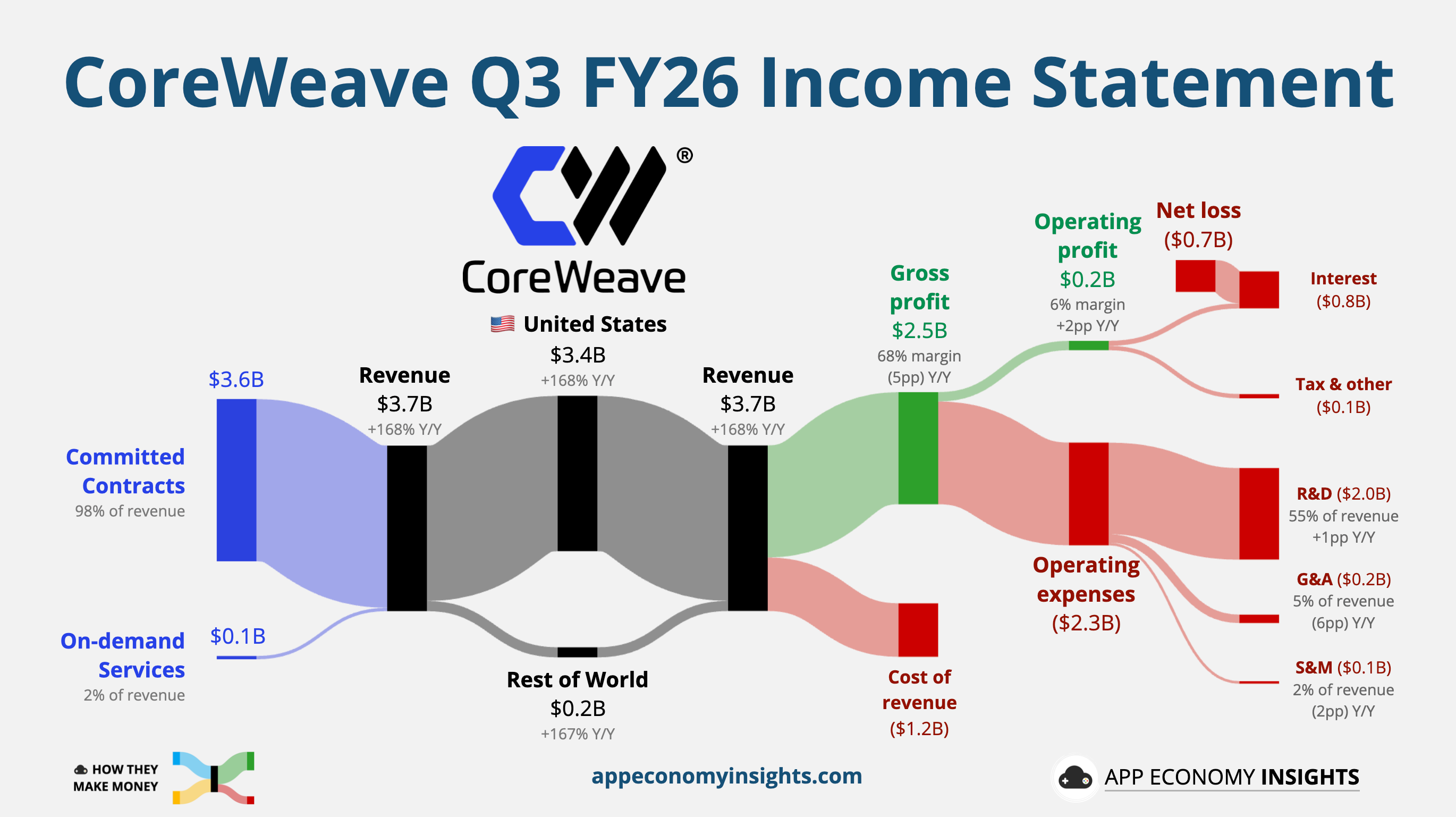
CoreWeave’s Q3 revenue surged 168% Y/Y to $3.7 billion ($0.1 billion beat). Operating income rebounded to $207 million, while adjusted operating margin doubled sequentially to 10%, reaching double digits a quarter ahead of schedule.
However, $846 million in interest expense contributed to a $709 million net loss. CapEx reached a staggering $14.5 billion, nearly four times quarterly revenue.
Management raised FY26 revenue guidance to $13.0–13.3 billion and expects to exit the year at a $20–21 billion annualized revenue run rate.
What stood out?
📚 Demand is still outrunning supply: Backlog reached $132.5 billion, up from $104 billion in Q2. Management says qualified demand is roughly 10 times available capacity through 2027, with most near-term capacity sold out.
💰 Pricing power is accelerating: CoreWeave raised prices by approximately 25% in July and another 10% later in Q3. Older Ampere and Hopper GPUs saw prices increase 30–50% Q/Q, challenging assumptions that previous-generation chips rapidly lose their earning power.
♻️ Old GPUs could become cash machines: More than 130,000 GPUs come off contract in 2027, followed by another 170,000 in 2028. Management estimates recontracting could generate nearly $4 billion in additional annualized revenue in 2027, potentially reaching $10 billion including 2028 renewals. Crucially, the original contracts are designed to repay the hardware debt, allowing these GPUs to generate revenue without new hardware CapEx. These opportunities are not yet included in the backlog.
🏦 Financing concerns are easing but not disappearing: CoreWeave expects approximately $9 billion in customer prepayments and deposits over the next three months, including more than $3 billion tied to existing infrastructure. Its average borrowing cost fell 250 basis points Y/Y to 7.9%, although total debt reached $46.9 billion. Management expects adjusted net profitability in H1 2028.
🤝 NVIDIA’s backing faces a new test: NVIDIA owns nearly 13% of CoreWeave and has committed $6.3 billion to purchase qualifying unsold computing capacity through 2032. Huang’s departure doesn’t cancel those contractual obligations, but raises questions about whether new leadership will be as aggressive in financing the AI ecosystem. CoreWeave depends on NVIDIA as its key GPU supplier, investor, and capacity backstop.
🏗️ Power remains the bottleneck: Active capacity exceeded 1.7 GW, with more than 4.6 GW contracted. Management sees no material impact on 2027 deliveries from recent data-center regulatory developments, citing existing permits and construction progress.
Meanwhile, managed inference surpassed $250 million in booked ARR, suggesting CoreWeave is gradually expanding beyond raw GPU rentals.
Takeaway: CoreWeave is beginning to demonstrate the operating leverage promised by the neocloud model. Rising prices and GPU renewals could dramatically improve returns on existing infrastructure. But with $37–39 billion in planned 2026 CapEx and interest expense expected to exceed $1 billion in Q4, the financial risks remain substantial. Management is betting that higher margins and revenue from existing GPUs will eventually outpace the rising cost of servicing its debt.

🔎 How We Found 64 Hidden Compounders
We screened for small companies with the ingredients to compound for years:
🔬 Small size: Market cap below $3 billion.
💰 Strong profitability: Net margins > 10% and ROIC > 15%.
📈 Consistent growth: EPS growth above 11% annually.
🛡️ Financial discipline: Manageable debt and no share dilution.
The result? Our free 64-stock Hidden Compounders Watchlist, explaining what each company does in plain English and why it made the list.
2. 🎮 Take-Two: GTA VI’s $1 Billion Head Start
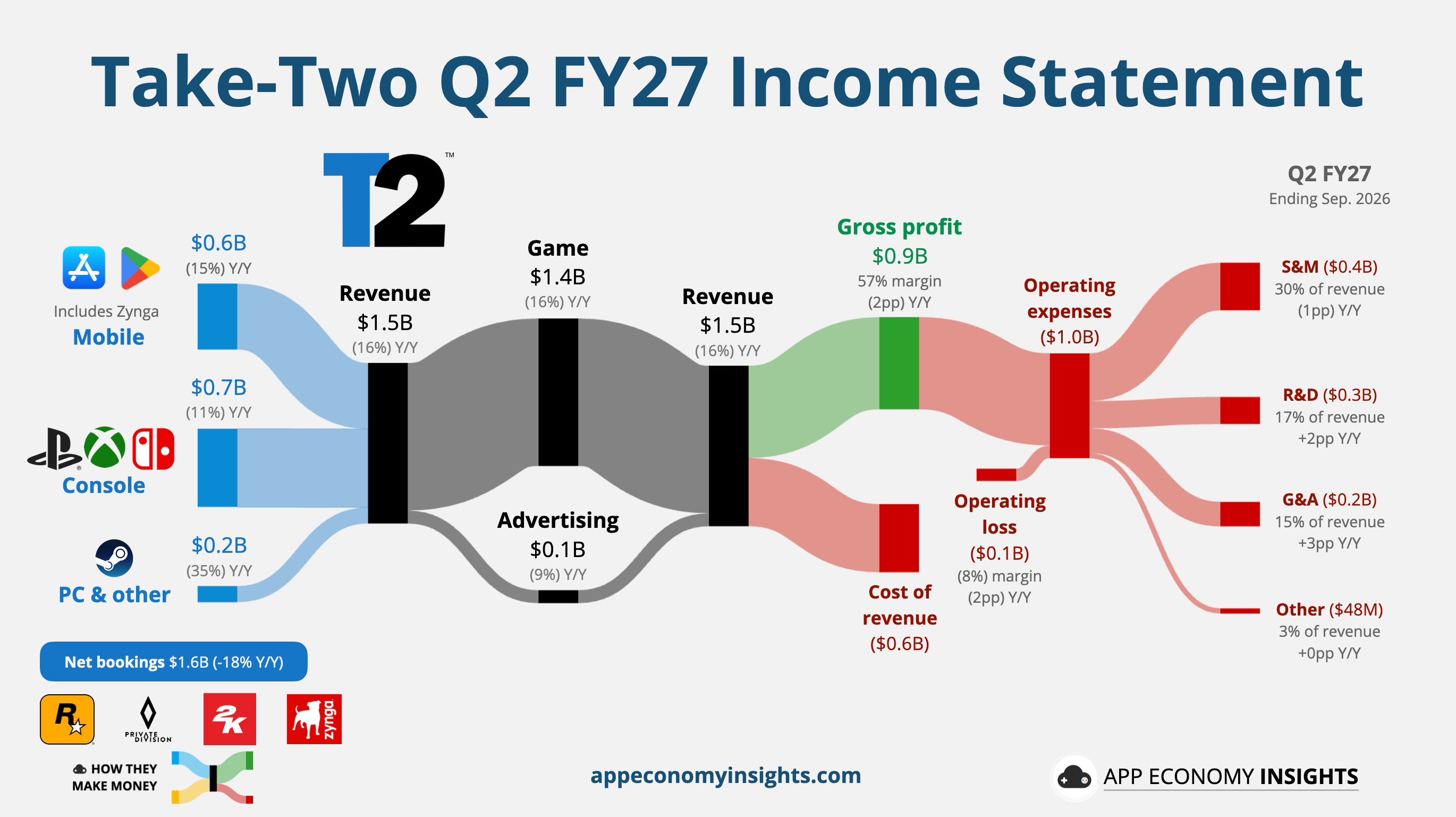
Take-Two Q2 revenue fell 16% Y/Y to $1.50 billion ($170 million miss), while GAAP EPS of -$0.29 beat by $0.57. Net bookings declined 18% to $1.60 billion, below the $1.62–$1.67 billion guidance. Recurrent consumer spending fell 9% and accounted for 81% of bookings.
NBA 2K27 sold 4 million copies, making it the franchise’s second-largest launch, but still fell short of expectations. CEO Strauss Zelnick suggested that some gamers may be holding back purchases ahead of GTA VI, alongside intense competition in September.
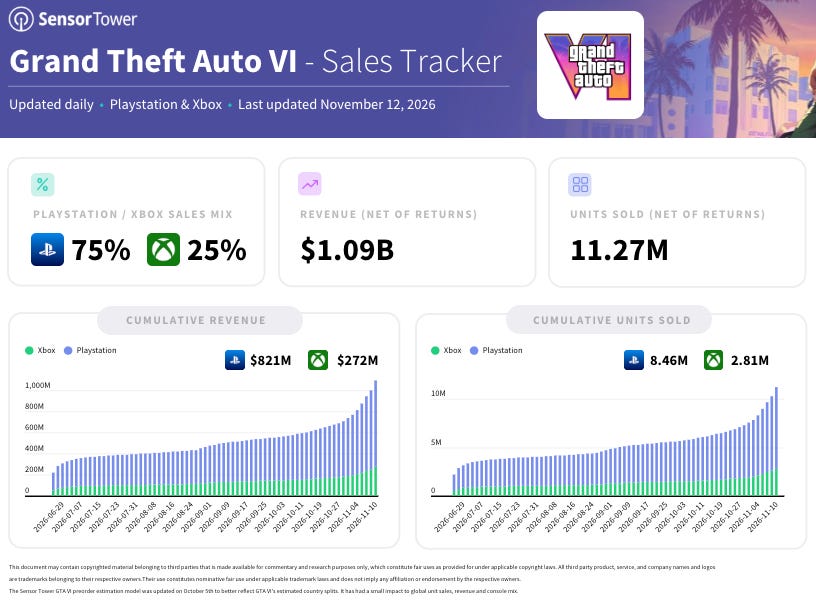
Meanwhile, GTA VI launches November 19, with preorders tracking far above management’s initial expectations. Sensor Tower estimates already over 11 million digital preorders worth more than $1 billion. That makes it already the most pre-ordered game of all time with days to spare. Nearly 90% of preorders in late August were reportedly for the $99.99 Ultimate Edition, highlighting Take-Two’s successful premium strategy. BMO Capital Markets estimates GTA VI could sell 45 million copies by year-end.
Despite this momentum, management maintained FY27 net bookings guidance at $8.0–$8.2 billion, below the $8.64 billion consensus. Q3 bookings guidance of $3.35–$3.50 billion also came slightly below expectations. Zelnick argued there was little reason to revise forecasts just ten days before launch.
The company still expects over $1 billion in operating cash flow this fiscal year.
Takeaway: GTA VI is on track for the largest entertainment launch in history, but management is refusing to raise expectations before seeing actual sales. With preorder demand already exceeding forecasts, the next few weeks could set up a historic beat for Take-Two’s Q3 performance.
3. 🌊 Sea Limited: Monee IPO Takes Shape
Sea Q3 revenue jumped 43% Y/Y to $8.6 billion ($0.5 billion beat). Adjusted EBITDA grew 29% to $931 million, below the $990 million consensus. Operating income increased 40% to $664 million.
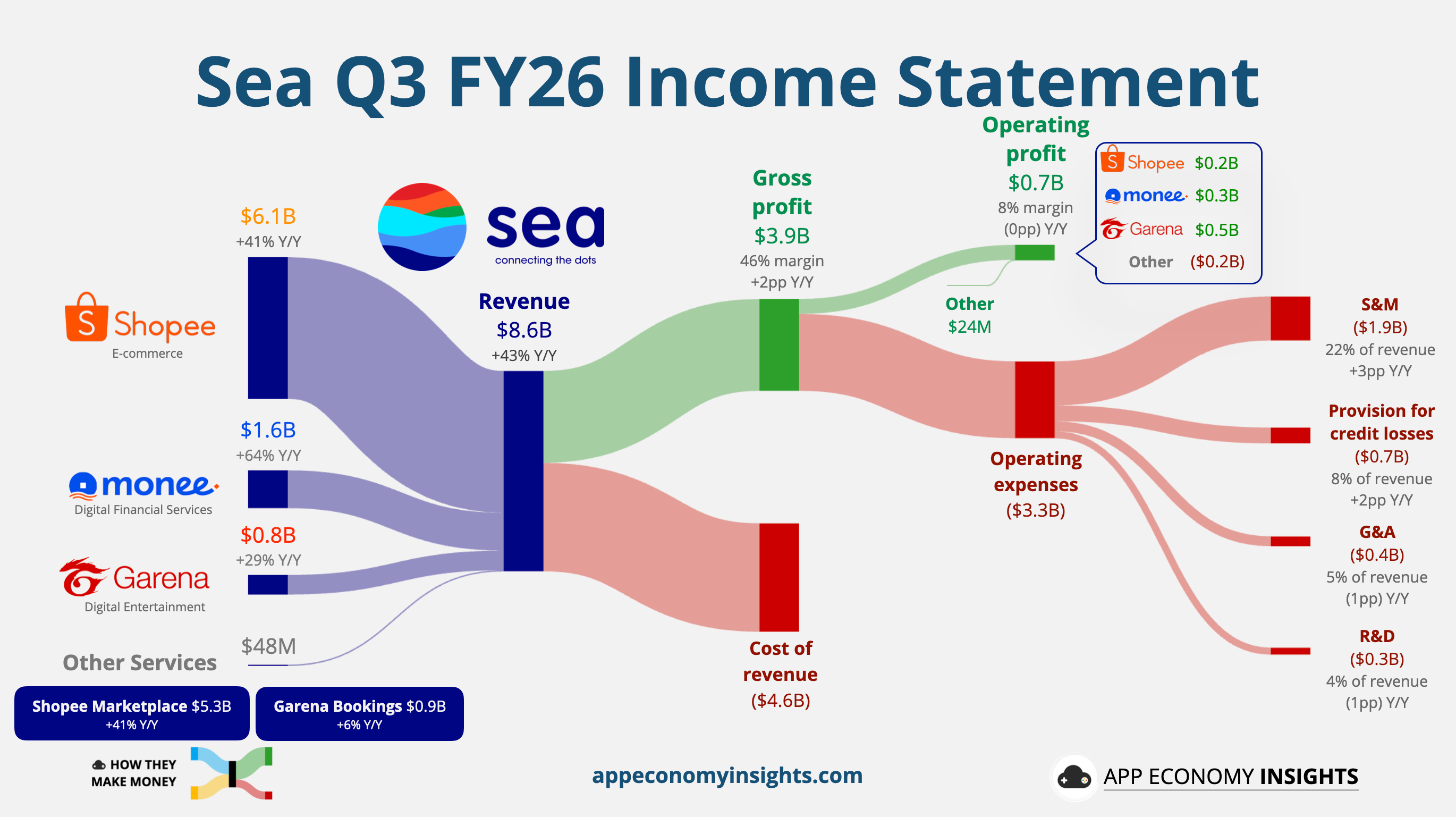
🛒 Shopee GMV grew 23% to $39.7 billion, while revenue jumped 41% to $6.1 billion as monetization continued to improve. Core marketplace revenue increased 51%, driven by advertising growth above 55%. Adjusted EBITDA rose 45% to a record $269 million, although profitability remained nearly flat Q/Q as Shopee reinvested in logistics, fulfillment, and customer acquisition. ShopeeVIP surpassed 21 million members (+40% Q/Q), accounting for nearly 25% of GMV. Management maintained its FY26 targets of approximately 25% GMV growth and $1 billion in adjusted EBITDA.
💳 Monee revenue surged 64% to $1.6 billion, with its loan book expanding 60% to $12.6 billion. However, adjusted EBITDA grew just 16% to $298 million, compressing its margin to 18% from 26% a year ago. Credit quality weakened slightly, with 90-day NPLs rising to 1.3% from 1.0% in Q2. Importantly, 60% of loans now originate outside Shopee, demonstrating Monee’s growing independence from the marketplace.
🎮 Garena revenue increased 29% to $840 million, while bookings rose just 6% to $890 million. Adjusted EBITDA jumped 46% to $458 million, supported by continued engagement in Free Fire.

The biggest strategic announcement was management’s intention to list Monee independently within the next 1–3 years. With nearly 44 million active credit users, Sea believes the fintech business is mature enough to access capital independently while maintaining its relationship with Shopee.
Sea is also building Sea Cloud, aiming to commercialize its internal AI infrastructure and agentic software capabilities. Management emphasized a capital-light approach, prioritizing software over data center ownership and requiring customer commitments before major investments.
Takeaway: Shopee’s monetization and profitability are improving, but Monee’s margin compression continues to limit consolidated operating leverage. A potential Monee IPO could unlock substantial value by separating a fast-growing fintech platform from Sea’s e-commerce operations. Meanwhile, Sea Cloud introduces another long-term opportunity, although its economics remain unproven.

That’s it for today!
Happy investing!
Want to sponsor this newsletter? Get in touch here.
Disclosure: I am long NVDA and SE in App Economy Portfolio. I share my ratings (BUY, SELL, or HOLD) with App Economy Portfolio members.
Author’s Note (Bertrand here 👋🏼): The views and opinions expressed in this newsletter are solely my own and should not be considered financial advice or any other organization’s views.