


Welcome to the Premium edition of How They Make Money.
Over 300,000 subscribers turn to us for business and investment insights.
In case you missed it:
📊 PRO: Apple, Shopify, MercadoLibre


DoorDash just agreed to acquire Instacart for $17 billion, one of the biggest bets yet on the future of online grocery.
But Instacart is more than a grocery delivery app. Nearly 30% of its revenue comes from advertising and other services, and its technology powers online shopping for retailers beyond its own marketplace.
For DoorDash, the appeal goes well beyond adding grocery orders. The combination could bring together its massive delivery network with Instacart’s retailer relationships, advertising platform, and commerce software.
The strategic logic makes sense. But with a 26% acquisition premium, substantial cash financing, and Deliveroo still being integrated, is DoorDash paying a reasonable price for its next growth engine?
Today at a glance:
DoorDash’s growth engine
Inside Instacart
The strategic fit
The synergy playbook
The $17 billion question
Beyond delivery

🔎 How We Found 64 Hidden Compounders
We screened for small companies with the ingredients to compound for years:
🔬 Small size: Market cap below $3 billion.
💰 Strong profitability: Net margins > 10% and ROIC > 15%.
📈 Consistent growth: EPS growth above 11% annually.
🛡️ Financial discipline: Manageable debt and no share dilution.
The result? Our free 64-stock Hidden Compounders Watchlist, explaining what each company does in plain English and why it made the list.
1. DoorDash’s growth engine
DoorDash entered the Instacart deal from a position of strength. Q3 revenue grew 34% Y/Y to $4.6 billion, while adjusted EBITDA surged 41% and crossed $1 billion quarterly for the first time.
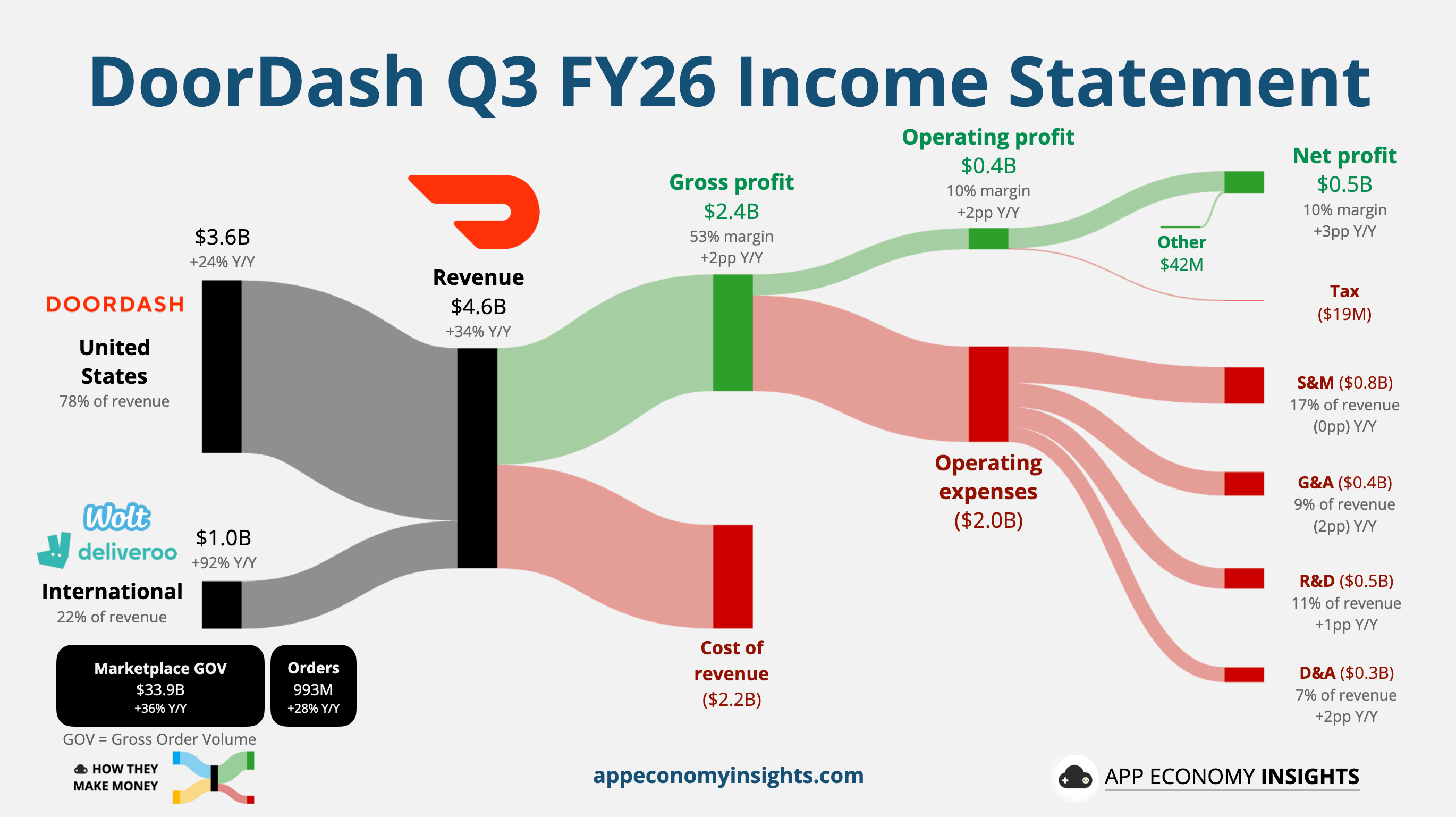
Total orders grew 28% to 993 million.
Marketplace Gross Order Value (GOV) increased 36% to $33.9 billion.
Deliveroo contributed to that growth, but the underlying business remained strong. Excluding the acquisition, orders rose 17%, while GOV and revenue grew 23%, matching Q2’s organic growth.
The momentum extends beyond restaurant delivery:
US restaurants: GOV growth accelerated slightly despite tough comparisons, supported by stronger customer acquisition and continued DashPass adoption.
Grocery and retail: GOV grew more than twice as fast as restaurants, with improving order frequency and broader merchant selection.
International: Wolt and Deliveroo continued expanding, with profitability exceeding management’s expectations.
Importantly, DoorDash is becoming more profitable as it scales. Contribution profit margin improved to 5.2% of GOV, up from 5.0% in Q2, while quarterly free cash flow reached $787 million.
DoorDash already has the consumer base, delivery network, and growing grocery demand. The Instacart acquisition adds capabilities beyond its existing marketplace.
So what exactly is DoorDash getting for $17 billion?
2. Inside Instacart
Instacart enters the deal with solid momentum.
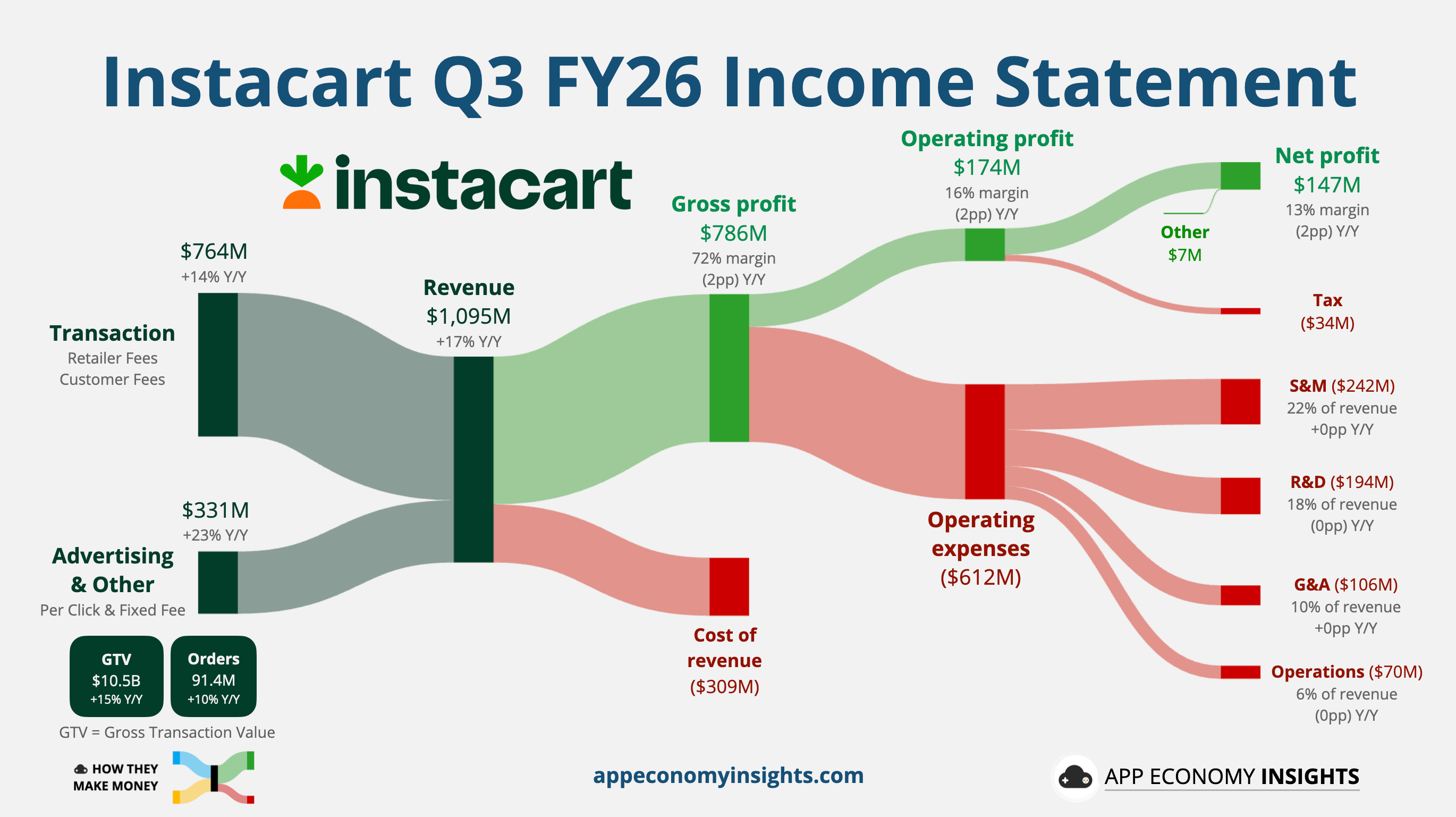
Q3 Gross Transaction Value (GTV) grew 15% Y/Y to $10.5 billion, supported by 91.4 million orders (+10%).
Revenue increased 17% to $1.1 billion, representing 10.4% of GTV.
The business generates revenue from two main sources:
Transaction: Revenue grew 14% to $764 million, primarily from fees paid by retailers and customers for grocery orders and fulfillment.
Advertising & Other: Revenue surged 23% to $331 million, as consumer brands paid for sponsored placements and retailers used Instacart’s technology services.
Advertising & Other now accounts for 30% of revenue and 3.1% of GTV (+21 basis points Y/Y), underscoring its growing importance to Instacart’s economics. Instacart generated a 72% gross margin, although down two points Y/Y, and $174 million in operating profit at a 16% margin. Free cash flow reached $307 million.
But Instacart’s reach extends well beyond its own app. The company works with more than 2,200 retail banners representing nearly 100,000 stores, providing e-commerce storefronts, fulfillment technology, in-store tools, and advertising capabilities.
A grocery order can therefore run through Instacart’s technology even when the customer shops directly on a retailer’s website.
That’s an important distinction. DoorDash is acquiring both Instacart's customer delivery volume and its software and deep relationships with grocery retailers.