


Welcome to the Saturday PRO edition of How They Make Money.
Over 300,000 subscribers turn to us for business and investment insights.
In case you missed it:
Premium members get:
📊 Monthly reports: 200+ companies visualized.
📩 Tuesday articles: Exclusive deep dives and insights.
📚 Access to our archive: Hundreds of business breakdowns.
PRO members get everything PLUS:
📩 Saturday PRO reports: Timely insights on the latest earnings.
Today at a glance:
⚡️ TSMC: AI Megatrend Deepens
🔬 ASML: Second Guidance Hike
💊 J&J: Oncology & Icotyde Deliver
💼 UnitedHealth: Turnaround Print
👔 Morgan Stanley: $10 Trillion Milestone
🏛️ Goldman Sachs: SpaceX Leads Deal Run
📈 BlackRock: Assets Cross $15 Trillion
🧬 Abbott: Diagnostics Carry The Quarter
🦾 Intuitive Surgical: Growth Deceleration
🛩️ United Airlines: Premium Absorbs Fuel Spike

⚡️ TSMC: AI Megatrend Deepens
TSMC’s Q2 revenue rose 34% Y/Y to $40.2 billion ($900 million beat), while EPS per ADR surged 74% Y/Y to $4.31 ($0.37 beat). Gross margin expanded to a stunning 68%, operating margin hit 60%, and net profit margin reached 56%. It was the fifth straight quarter of record earnings. After a near-40% run this year, the stock is priced for blowouts, and even this one triggered classic “sell-the-news” profit-taking.
CEO C.C. Wei maintained his bullish tone, saying that “our conviction in the multi-year AI megatrend remains very high.” Advanced nodes (7nm and below) now generate 77% of wafer revenue (up 3pp Q/Q), with 3nm at 30% and 2nm debuting at 3% ahead of a steep ramp in the back half. Management flagged agentic AI as a new demand driver, reviving CPU orders in data centers alongside accelerators. Mature nodes (45/40nm, 28nm, 16nm) all declined sequentially, an early sign that higher memory prices may be pinching mainstream semiconductor demand.
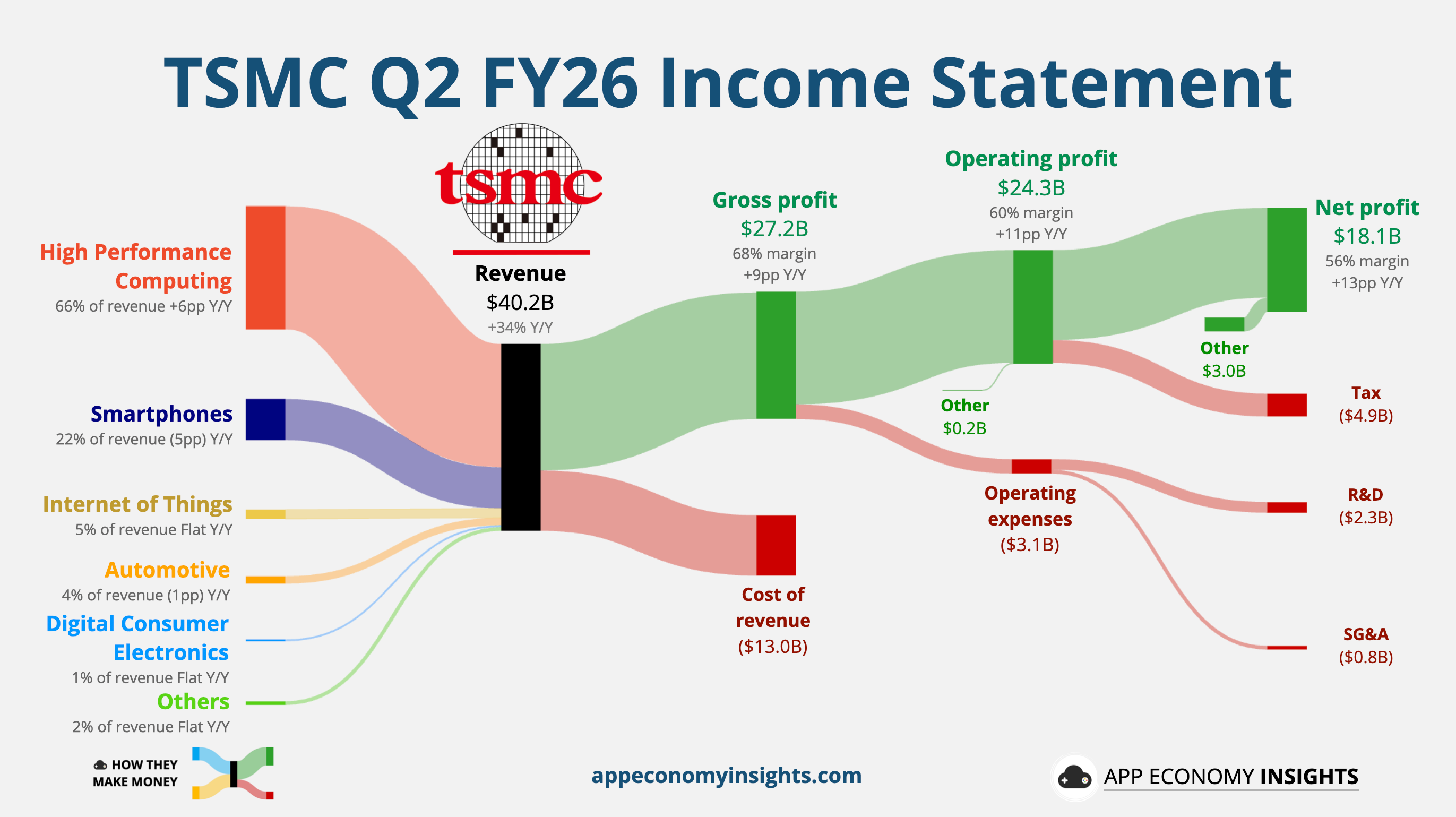
The two big strategic announcements were another $100 billion US investment and a massive CapEx raise:
Total US commitment now reaches $265 billion, funding 12 leading-edge and packaging facilities in Arizona.
FY26 CapEx was raised to $60–$64 billion (from $52–$56 billion).
CFO Wendell Huang said CapEx over the next three years will be “significantly higher” than the past three, with 70–80% of the 2026 budget going to advanced nodes.
TSMC raised FY26 revenue growth guidance to slightly above 40% in USD (vs. ~35% consensus), up from >30% prior. It was the second hike this year. Asked about Samsung and Intel, Wei was dismissive. He explained that foundry partnerships aren't like "buying milk from the 7-11," and customers locked in for years won't switch on price.
The real risk for TSMC is cost. Overseas fab ramps and the 2nm expansion will temporarily weigh on gross margin, just as CapEx surges. Watch whether gross margin can hold near 67% in Q3 while record spending and the steepest phase of the 2nm ramp hit the P&L simultaneously. The widening of capital intensity could start to compress industry-leading margins even as the AI demand cycle extends into 2028.
2. 🔬 ASML: Second Guidance Hike
ASML's Q2 revenue rose 21% Y/Y to €9.3 billion (€400 million beat), with GAAP EPS up 29% Y/Y to €7.59 (€0.60 beat). Gross margin came in at 54%, above guidance, on high-margin Installed Base Management sales. Free cash flow reached €1.3 billion, and ASML repurchased €1.1 billion of shares. Shares are up nearly 70% YTD.
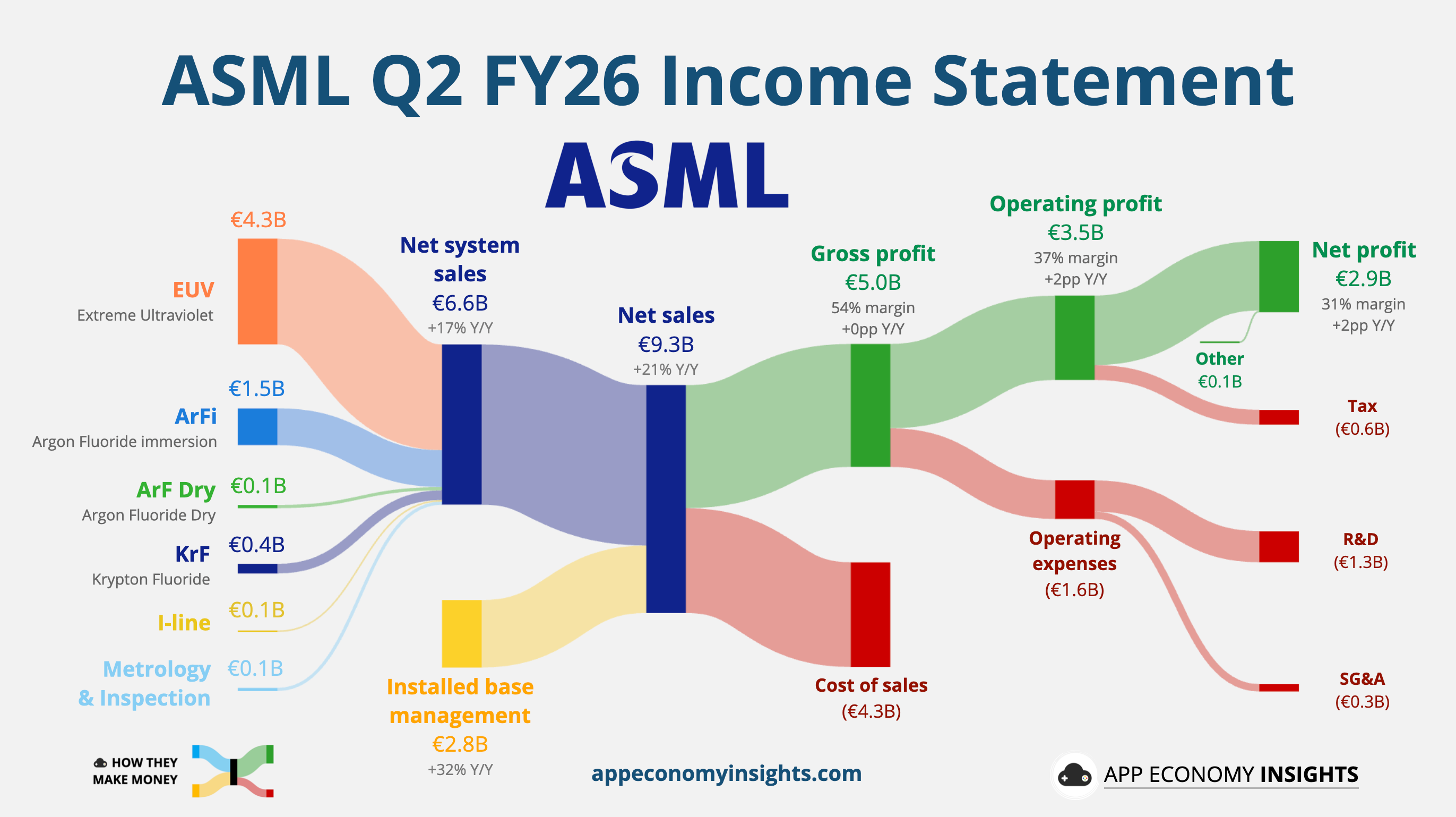
The big news was the second guidance raise of the year, along with concrete multi-year capacity plans:
FY26 revenue guidance was lifted to €43–€45 billion (from €36–€40 billion, and vs. €39 billion consensus).
FY26 gross margin was raised to 54–56% (from 51–53%).
Q3 revenue is now €11–€12 billion (vs. €10.4 billion consensus).
Low-NA EUV capacity is projected to grow ~30% in 2027 to ~85 units, with another ~30% increase in 2028 (~110 units).
DUV immersion capacity is also expanding 30% in each of the next two years.
The AI infrastructure buildout has been a flywheel for ASML. Advanced logic revenue is expected to grow ~25% this year and memory ~75%, with customers “aggressively adding capacity” across 5nm, 4nm, 3nm, and 2nm nodes and already planning for 1.4nm.
Intel Foundry began production on the Intel 18A node using ASML’s most advanced High-NA EUV tool. Meanwhile, TSMC has said it will hold off on High-NA through 2029. CFO Roger Dassen also flagged potential pricing power on Low-NA tools given “current environment” dynamics. It was a nod to the reported pricing dispute with TSMC. China’s share of system sales dropped further to 14% (from 19% in Q1), tracking below the ~20% full-year target.
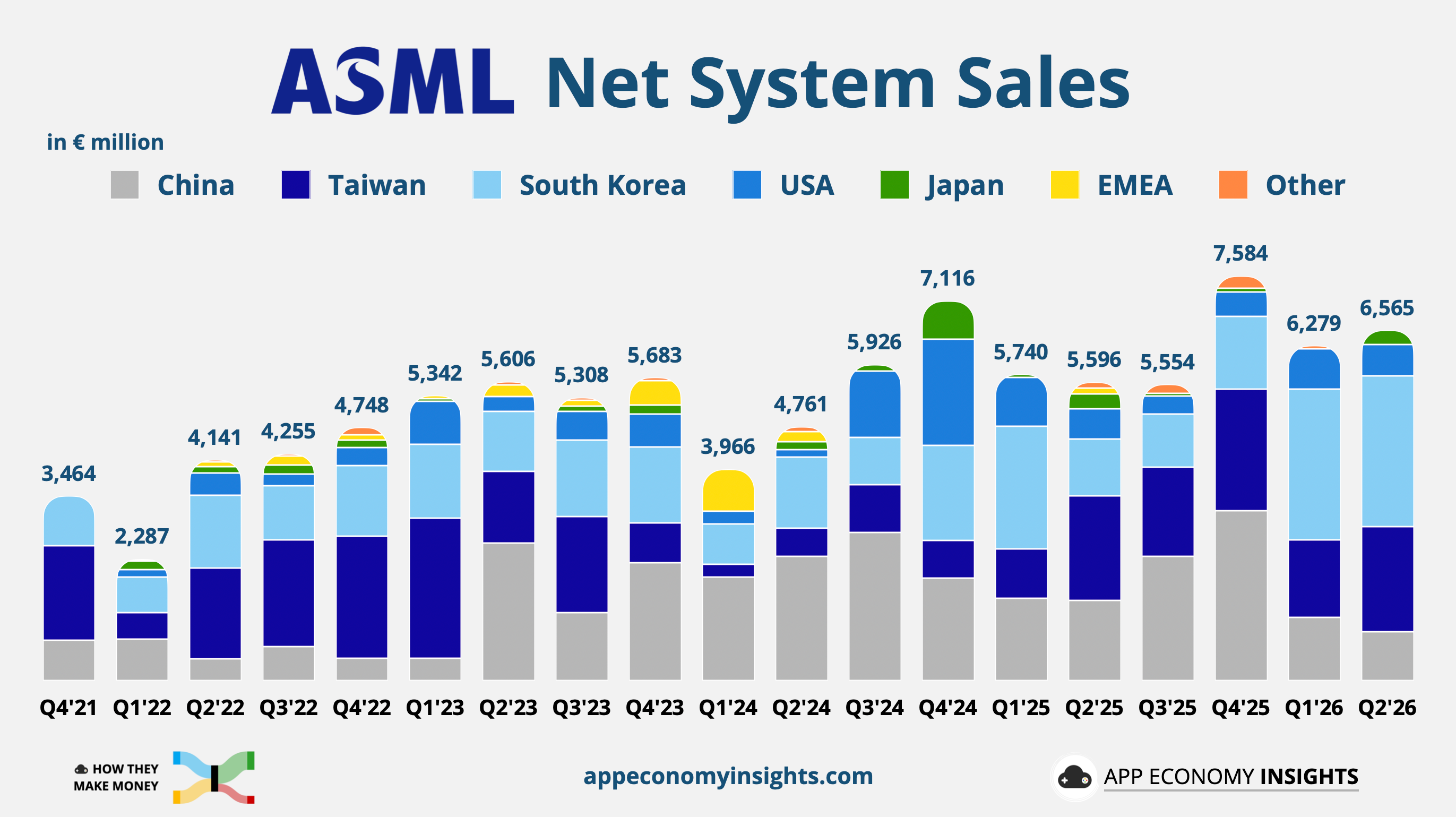
ASML confirmed its Capital Markets Day for June 10, 2027, when it will update long-term outlook. The next question is whether the pricing conversations with customers translate into meaningful ASP gains in 2027, or whether TSMC's pushback caps how much of the AI demand tailwind flows through to ASML's margin structure.