


Welcome to the Saturday PRO edition of How They Make Money.
Over 300,000 subscribers turn to us for business and investment insights.
In case you missed it:
Premium members get:
📊 Monthly reports: 200+ companies visualized.
📩 Tuesday articles: Exclusive deep dives and insights.
📚 Access to our archive: Hundreds of business breakdowns.
PRO members get everything PLUS:
📩 Saturday PRO reports: Timely insights on the latest earnings.
Today at a glance:
🌐 Accenture: AI Creates More Work
👟 Nike: Still Going Downhill
🛳️ Carnival: Europe Comes Back
🎿 Vail Resorts: Pass Sales Slide

1. 🌐 Accenture: AI Creates More Work
Accenture Q4 revenue rose 6% Y/Y to $18.7 billion ($660 million beat), with GAAP EPS of $3.29 ($0.11 beat).
Demand rebounded to a new high. New bookings grew 5% in local currency to $22.2 billion, reversing last quarter's decline. Managed services bookings hit a record $12.8 billion. Shares surged nearly 20% initially, their best post-earnings move on record.

So far, AI is creating more work for Accenture than it is destroying. Consulting revenue grew 6% (or 7% in local currency), and nearly 100 additional clients started their first advanced AI projects during Q4, bringing the FY26 total above 400. Management says much of the demand is coming from companies building the data foundations, digital core, and AI infrastructure needed before deploying agents at scale.
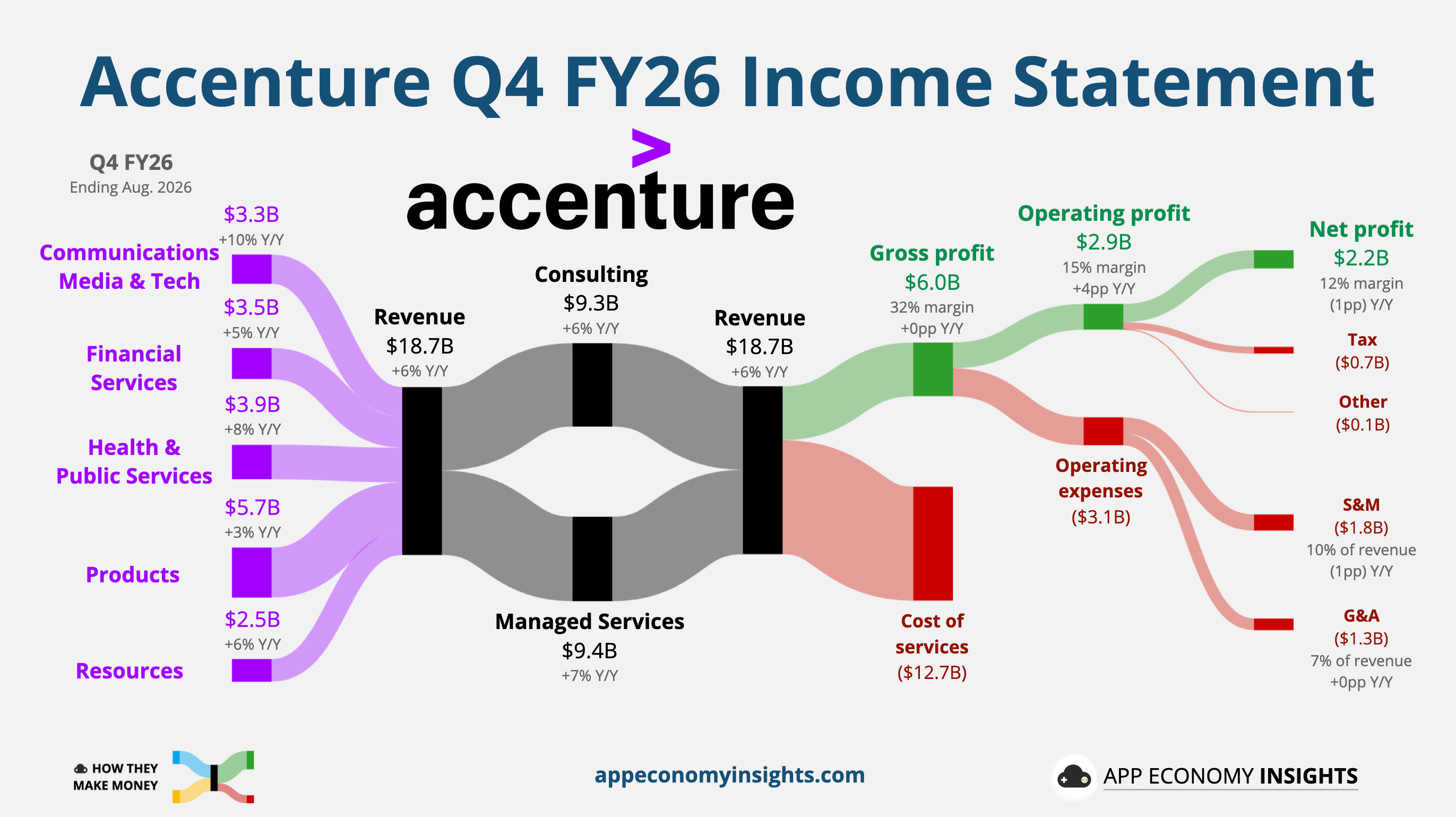
The economics are changing, though. Accenture acknowledged lower pricing in many parts of the business as AI improves productivity and competition intensifies. Hiring will also slow in FY27 as AI changes delivery. So the disruption thesis isn’t disappearing, but it’s showing up first in pricing and labor intensity rather than collapsing demand.
M&A remains another major growth lever. Accenture deployed $1.9 billion in Q4. The previously announced OT-security deals have now closed, and management expects roughly $5 billion of acquisitions in FY27. It also plans to return at least $9.5 billion to shareholders.
For FY27, Accenture guided to 3%–6% revenue growth in local currency. That said, acquisitions are expected to contribute 2%–2.5% to growth, so the organic outlook is considerably more subdued than the headline range.
Takeaway: The quarter doesn’t settle the AI disruption debate, but it brings some much-needed good news. Bookings rebounded, and more enterprises are hiring Accenture to build the infrastructure required for AI. The real pressure may increasingly show up in pricing and headcount rather than demand disappearing altogether.
2. 👟 Nike: Still Going Downhill
Nike Q1 revenue fell 4% Y/Y to $11.2 billion ($110 million miss), while EPS slipped 2% to $0.48 ($0.04 beat). Gross margin improved 60 bps to 42.8%, thanks to lower warehousing and logistics costs.
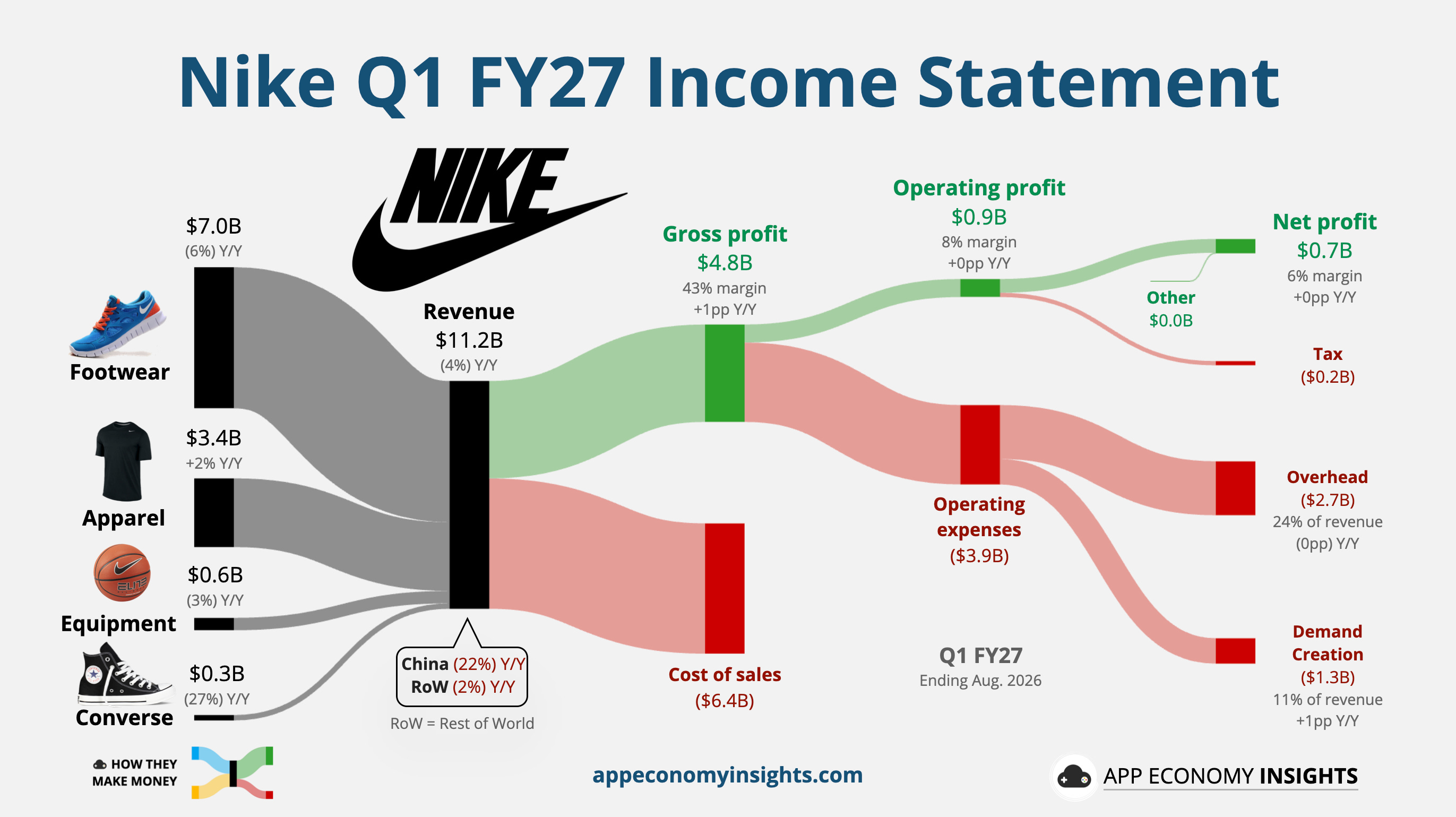
Nike’s performance portfolio remains encouraging. Running, football, training, and basketball collectively grew at a high-single-digit rate, suggesting Elliott Hill’s Sport Offense is gaining traction. But competitive pressure has intensified. Kylian Mbappé recently ended a two-decade relationship with Nike to join On (visualized here), which is now using him to launch its own football business in 2027.
North America was also the only major geography to grow. Elsewhere, the reset remains painful. Nike Sportswear fell by low double digits, while management acknowledged it had oversupplied Jordan retros and is now deliberately reducing launch volume to restore scarcity. NIKE Direct declined 8%, including a 13% drop in digital, while wholesale slipped 1%.
Greater China revenue fell 22% (or 26% in constant currency) to $1.18 billion, with wholesale down 28%. Nike is intentionally reducing promotions and narrowing its digital distribution there, which should improve brand health eventually. But it also means the reset will weigh on revenue for longer.
