


Welcome to the Saturday PRO edition of How They Make Money.
Over 300,000 subscribers turn to us for business and investment insights.
In case you missed it:
Premium members get:
📊 Monthly reports: 200+ companies visualized.
📩 Tuesday articles: Exclusive deep dives and insights.
📚 Access to our archive: Hundreds of business breakdowns.
PRO members get everything PLUS:
📩 Saturday PRO reports: Timely insights on the latest earnings.
Today at a glance:
🛢️ Aramco: Pipeline Holds the Line
📱 Tencent: AI Catch-Up Cost
🌐 Cisco: AI Orders Nearly Double
⚙️ Applied Materials: AI Tailwind Accelerates
🏦 Nubank: Credit Costs Bite
🚚 JD.com: Food Delivery Losses Narrow
🪙 Circle: Arc Steals the Show
🧊 Dynatrace: ARR Crosses $2 Billion
👟 On: Premium Strategy Compounds
🎨 Figma: AI Monetization Lands
💊 Hims & Hers: GLP-1 Comedown
🛍️ Global-e: AI-First Margin Lift
💳 Klarna: Profit Pivot Lands
📆 Monday.com: AI Pricing Pivot
🌎 DLocal: Volume Outpaces Margin

1. 🛢️ Aramco: Pipeline Holds the Line
With Brent hovering near $100, the Strait of Hormuz still effectively closed, and nearly a billion barrels of regional supply already lost to the blockade, Aramco's Q1 print landed in the middle of the most disruptive oil supply shock in decades.
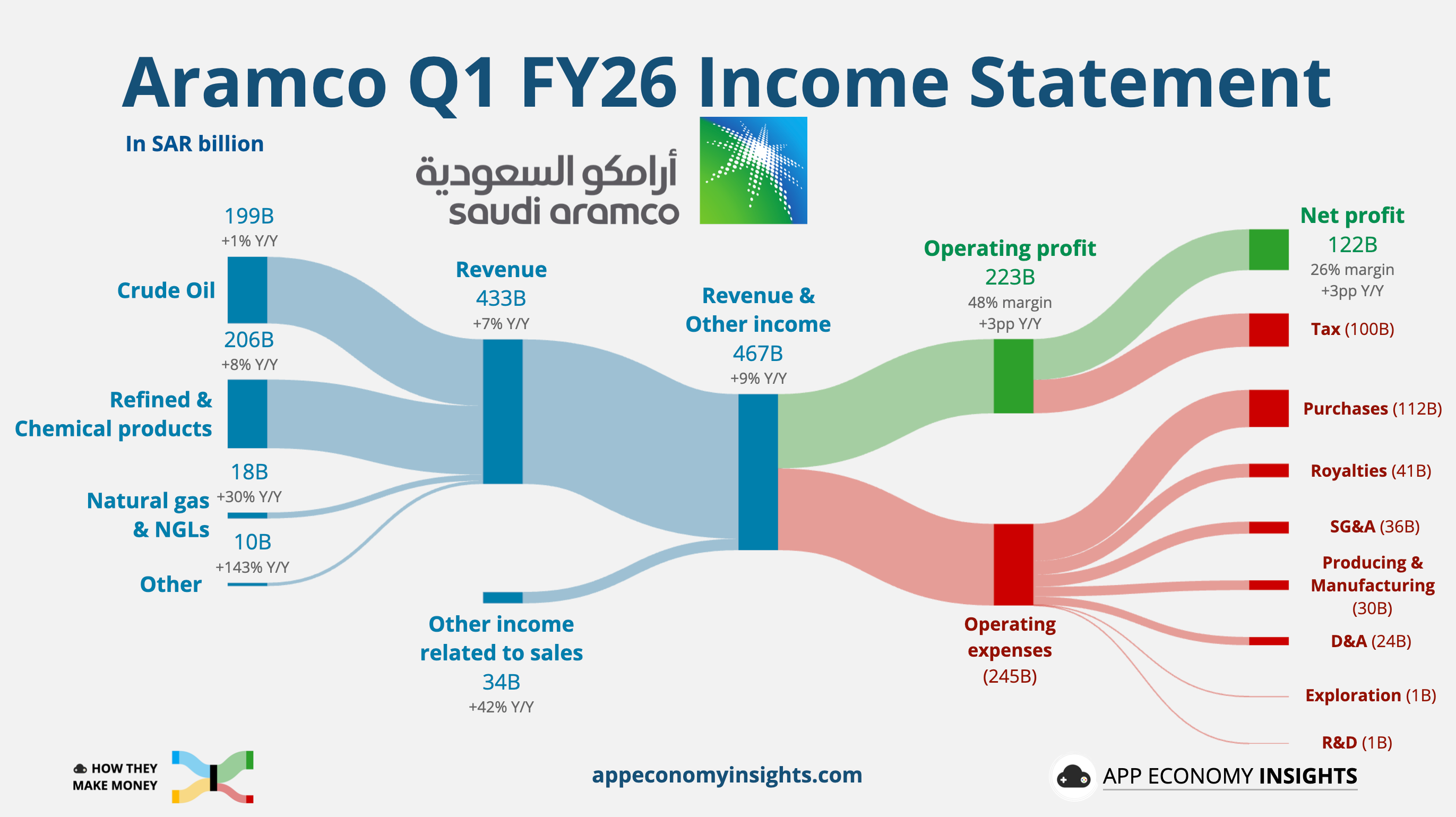
Q1 adjusted net income jumped 26% Y/Y to $33.6 billion ($2.4 billion ahead of consensus) on revenue of $115.5 billion (+7% Y/Y). Aramco's realized crude price climbed to $76.90/bbl from $64.10 in Q4, with Brent rising 95% over the quarter. The $21.9 billion quarterly dividend held — but free cash flow of $18.6 billion came in below the payout for the first time in years, dragged by a $15.8 billion working-capital build tied to crisis-driven inventory and logistics shifts.
The story remains the East-West pipeline, which hit its full 7 million bpd capacity in Q1. CEO Amin Nasser called it a “critical supply artery.” Crude sales volume rose Y/Y but fell sequentially, reflecting the loss of Strait of Hormuz throughput. CapEx of $12.1 billion supports the ongoing $50-55 billion FY26 spending plan. Gearing rose to 4.8% from 3.8% at year-end as the dividend exceeded free cash flow.
Nasser gave a stark warning. If Strait of Hormuz traffic resumes today, oil markets will need a few months to rebalance — but if the disruption persists beyond a few more weeks, the market won’t normalize until 2027. The question for the coming months is whether Hormuz traffic recovers enough to ease working-capital pressure, and whether Aramco can keep crude flowing at pipeline capacity without compromising the dividend if free cash flow continues to run below the $21.9 billion payout.
2. 📱 Tencent: AI Catch-Up Cost
Tencent Q1 revenue rose 9% Y/Y to 196.5 billion yuan (~$29 billion) — its slowest pace in six quarters and a miss versus the 199 billion yuan consensus. Net profit climbed 21% to 59.4 billion yuan, beating expectations. The revenue miss was partly due to a later Lunar New Year, shifting some gaming revenue to Q2. Shares are down over 20% YTD as investors weigh whether Tencent can monetize AI fast enough.
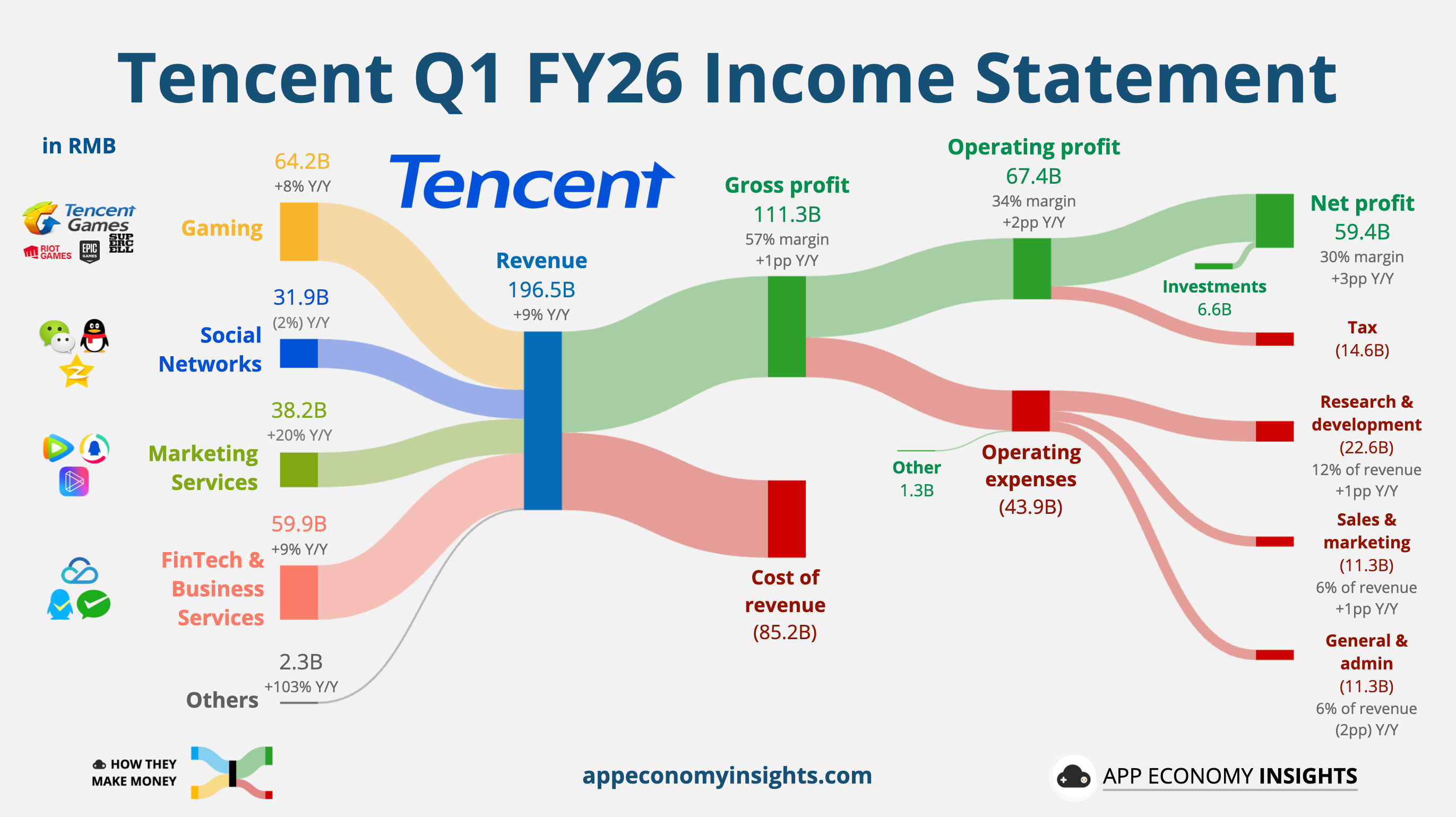
Gaming grew 8%. Domestic gaming grew just 6% on the holiday shift, while International gaming rose 13%, boosted by League of Legends, Wuthering Waves, and Brawl Stars.
Marketing services surged 20% (accelerating from 17% last quarter), the clear bright spot, driven by an upgraded AI-driven ad recommendation model.
FinTech and Business Services rose 9%. Tencent Cloud’s international business (part of this segment) grew over 40%.
Social Networks declined by 2%, primarily due to the later timing of the Spring Festival. Wexin and WeChat now have a combined 1.43 billion Monthly Active Users (MAUs).

Capex jumped 63% sequentially to 31.9 billion yuan (~$4.4 billion), with management pledging “a substantial increase” in H2 as China-designed AI chips become available. CEO Pony Ma candidly explained: “A year ago we thought we were on the boat, then we found it was leaking” — a rare acknowledgment that Tencent is playing catch-up.
The Hy3 preview model launched in April climbed to the top of OpenRouter’s token-usage leaderboard, with WorkBuddy now positioned as China’s most widely used productivity AI agent. Tencent confirmed it’s working to integrate agents into WeChat’s mini-program ecosystem, but gave no timeline. Tencent’s 36 billion yuan ($5 billion) AI spend in 2026 remains conservative versus the $700+ billion combined US hyperscaler budget. The next question is whether agentic AI integration into WeChat starts generating measurable engagement before competitors like ByteDance and Alibaba lock in distribution.