


Welcome to the Saturday PRO edition of How They Make Money.
Over 300,000 subscribers turn to us for business and investment insights.
In case you missed it:
Premium members get:
📊 Monthly reports: 200+ companies visualized.
📩 Tuesday articles: Exclusive deep dives and insights.
📚 Access to our archive: Hundreds of business breakdowns.
PRO members get everything PLUS:
📩 Saturday PRO reports: Timely insights on the latest earnings.
Today at a glance:
🇨🇳 Alibaba: $100 Billion AI Bet
🌐 Accenture: AI Transition Continues
🚚 FedEx: Efficiency Over Expansion
🍪 General Mills: Reinvestment Pains
🫒 Darden: Strategic Shifts
🚖 Didi: Cost of Conquest
🧘🏻 Lululemon: Global Tug-of-War
✍️ DocuSign: Billings Hit $1 Billion
🏥 HealthEquity: Asset & Margin Records
🌎 dLocal: $1 Billion Milestone

1. 🇨🇳 Alibaba: $100 Billion AI Bet
Alibaba’s Q3 FY26 (December quarter) saw revenue rise 2% Y/Y to $40.7 billion ($1.4 billion miss), though like-for-like growth (excluding exited businesses like Sun Art and Intime) was a more robust 9%.
The headline story was a 67% plunge in adjusted net income, as the company doubled down on its investment phase. This aggressive spending centers on three areas: quick-commerce subsidies, user experience, and a massive build-out of AI infrastructure.
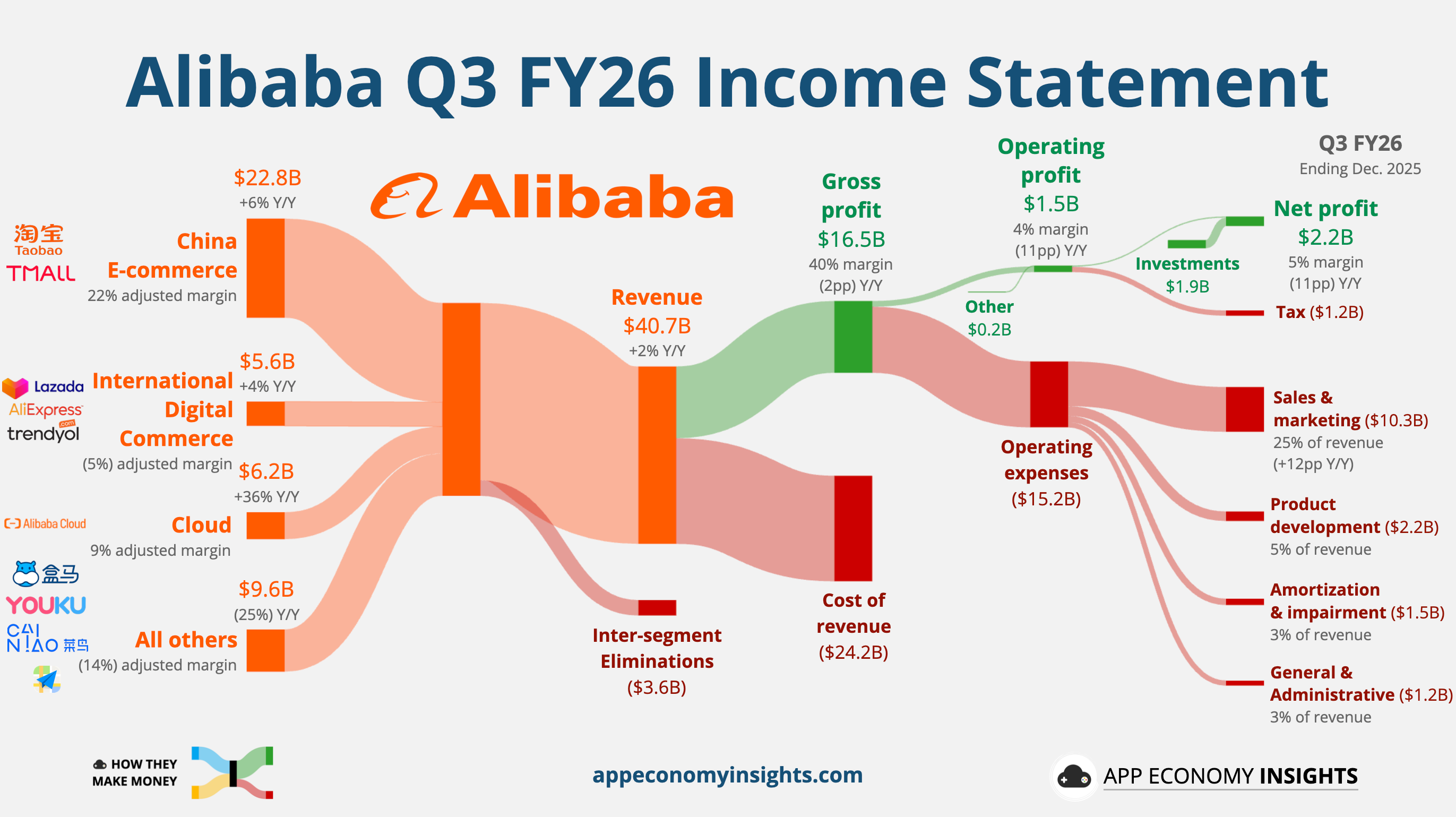
The company is effectively cannibalizing short-term retail profits to fund a full-stack AI future:
Cloud Intelligence Group: Revenue growth accelerated to 36% Y/Y, with AI-related product revenue posting its tenth consecutive quarter of triple-digit growth. CEO Eddie Wu set a bold new target to reach $100 billion in annual Cloud and AI revenue within five years. To accelerate monetization, Alibaba recently hiked prices for cloud and storage services by up to 34%.
T-Head & Token Hub: Alibaba is vertically integrating its AI via its proprietary chip unit, T-Head, which has now shipped over 470,000 AI chips. The newly formed Alibaba Token Hub (ATH) group consolidates all AI units under Eddie Wu to streamline the adoption of “Model-as-a-Service” (MaaS).
China E-commerce & Quick Commerce: While core e-commerce revenue grew 6%, the Quick Commerce segment surged 56% to ~$3 billion. This business is currently a loss leader used to defend market share against Meituan and JD.com, with a goal of hitting RMB 1 trillion in Gross Merchandise Value (~$143 billion) by FY28.

The quarter included significant headwinds. The surprise departure of Junyang Lin, a lead Qwen developer, raised questions about research continuity. In addition, while the Qwen App surpassed 300 million MAUs, the rise of agentic AI has given Tencent’s Weixin/WeChat ecosystem an early advantage.
Alibaba’s management characterized the current profit dip as a deliberate choice. They project that the Quick Commerce segment will turn profitable by FY29 and that the integration of T-Head chips will enable “non-linear leaps” in cloud profitability by reducing reliance on expensive external silicon.