


Welcome to the Saturday PRO edition of How They Make Money.
Over 300,000 subscribers turn to us for business and investment insights.
In case you missed it:
Premium members get:
📊 Monthly reports: 200+ companies visualized.
📩 Tuesday articles: Exclusive deep dives and insights.
📚 Access to our archive: Hundreds of business breakdowns.
PRO members get everything PLUS:
📩 Saturday PRO reports: Timely insights on the latest earnings.
One notable omission from today’s roundup is Amazon. Its Q3 results deserve a standalone deep dive, so we’re saving that analysis for Tuesday’s issue.
Today at a glance:
💻 Microsoft: Azure Breaks Away
💊 Eli Lilly: Volume Machine
📱 Samsung: Sold Out Through 2027
🧠 SK hynix: Sold Out Through 2029
💳 Visa: Cost of Growth
💳 Mastercard: Services Take the Lead
🏭 Intel: AI Can’t Save PCs
🥤 Coca-Cola: Global Divide
🦠 Merck: Keytruda Bridge
🧬 AstraZeneca: Funding the Pipeline
⚡ GE Vernova: Pricing Power Arrives
🔬 KLA: $200 Billion Market
📡 Verizon: Subscriber Turnaround
💾 Sandisk: AI Storage Supercycle
🧑💻 ServiceNow: The AI Paradox
📶 T-Mobile US: Pricing Over Growth
🛩️ Boeing: Recovery Delayed
🛩️ Airbus: Q4 Crunch
🔒 Fortinet: Service Gap
☕️ Starbucks: Turnaround Holds
💡 Cadence: Agentic Moat
📦 UPS: Margin Test
🪶 Robinhood: Prediction Engine
🍪 Mondelez: Volume Takes Over
🍫 Hershey: Volume Problem
🏨 Hilton: AI Lodging Boom
📦 FedEx: Network Payoff
💳 PayPal: Standalone Test
📈 Coinbase: Diversification Takes Hold
👾 Roblox: Retention Payoff
🌯 Chipotle: Traffic Holds Up
👽 Reddit: The Google Problem
🏦 SoFi: Profit Inflection
⚡ Rivian: R2 Takes Over
📌 Pinterest: Advertiser Problem
📦 Etsy: Buyers Are Back
🦷 Align: A New Chapter
🩺 Teladoc: Insurance Gap

1. 💻 Microsoft: Azure Breaks Away
Microsoft’s Q1 FY27 revenue (September quarter) rose 19% Y/Y to $92.3 billion ($1.5 billion beat), while adjusted EPS grew 18% to $4.89 ($0.17 beat).
Azure revenue accelerated to 48% growth, from 43% in Q4, comfortably exceeding expectations. Shares jumped as strong cloud demand and better-than-expected cash generation eased concerns about AI spending.
Microsoft also introduced a new reporting structure, combining its cloud and enterprise software businesses into two main segments:
Agents and Infra, which grew 25% to $76.8 billion.
Devices and Consumer declined 3% to $15.5 billion.
Microsoft revamped its reporting segments just two years ago, so another reshuffle feels like overkill. The visual below breaks down revenue by product and service instead, which I find more comprehensive and insightful.
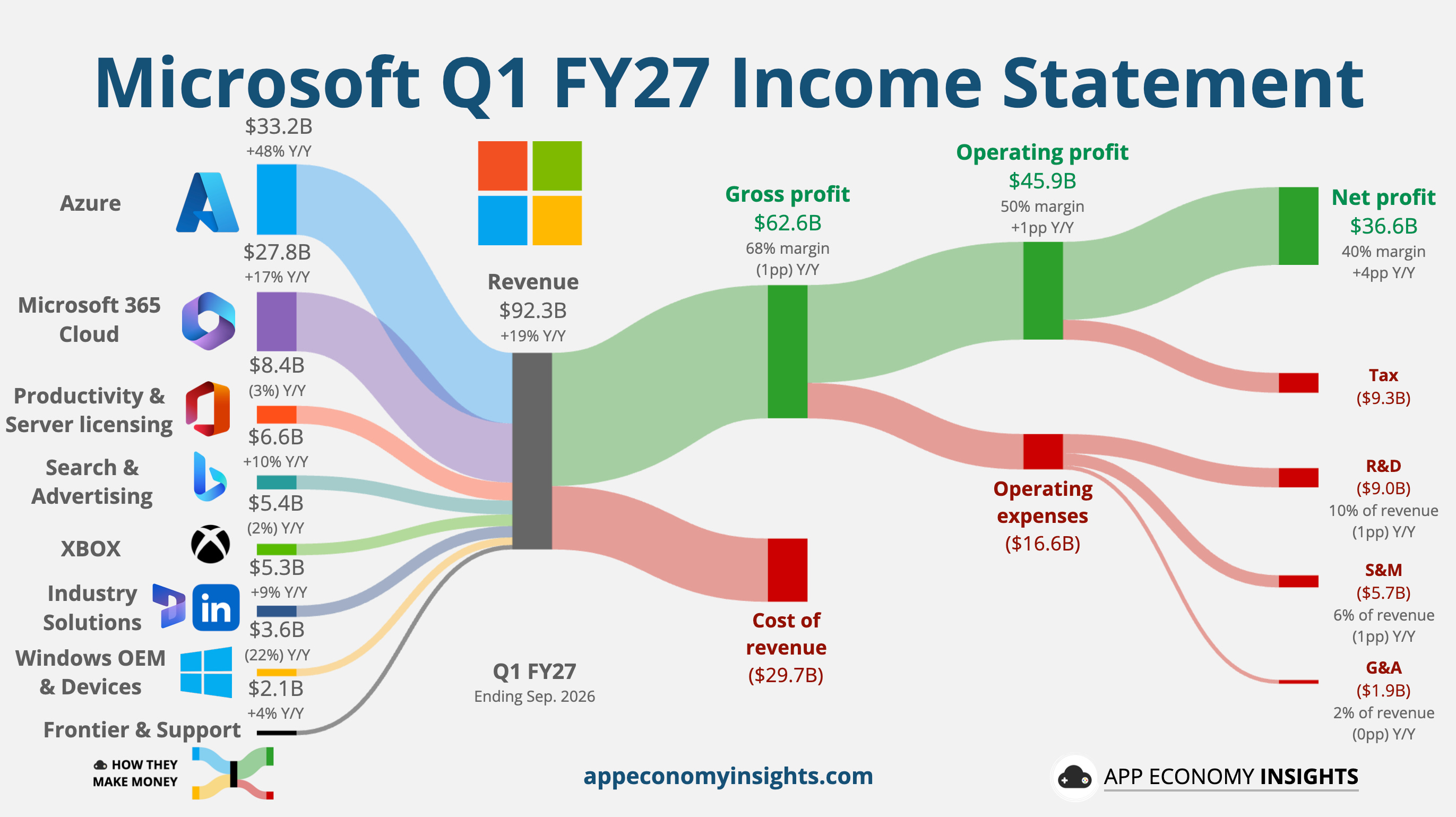
The AI investment cycle is beginning to show tangible returns:
Azure reached $33.2 billion in revenue, with growth expected to accelerate further to 49%–50% in Q2. Demand continues to exceed available capacity.
OpenAI-related commercial revenue reached $10 billion, representing roughly 11% of Microsoft’s total revenue, up from about 7% in FY26. This strengthens AI monetization but also highlights customer concentration.
Microsoft 365 commercial cloud grew 18%, adding another AI monetization source through Copilot. Meanwhile, customers using consumption-based Copilot billing grew more than 75%.
Cash CapEx more than doubled to $39.4 billion, while total capital spending, including leases, reached $45.2 billion. Operating cash flow grew 29% to $58 billion. As a result, free cash flow fell 27% to $18.6 billion. Microsoft expects CapEx to exceed $50 billion next quarter and accelerate further in early calendar 2027.
Commercial RPO remained enormous at $677 billion, up 73% Y/Y but roughly flat sequentially. That backlog provides visibility, though OpenAI likely still accounts for a substantial portion.
Microsoft is showing that AI infrastructure spending can drive accelerating revenue and strong profitability at the same time. The challenge is sustaining those returns as spending rises further, particularly if demand from OpenAI or other large AI customers becomes less predictable.
2. 💊 Eli Lilly: Volume Machine
Eli Lilly’s Q3 revenue surged 39% Y/Y to $24.4 billion ($1.8 billion beat), while adjusted EPS grew 7% to $7.48 ($0.87 beat). Volume increased 53%, more than offsetting a 15% decline in realized prices. Shares jumped more than 6% as Lilly raised its annual revenue outlook by an impressive $5.5 billion.
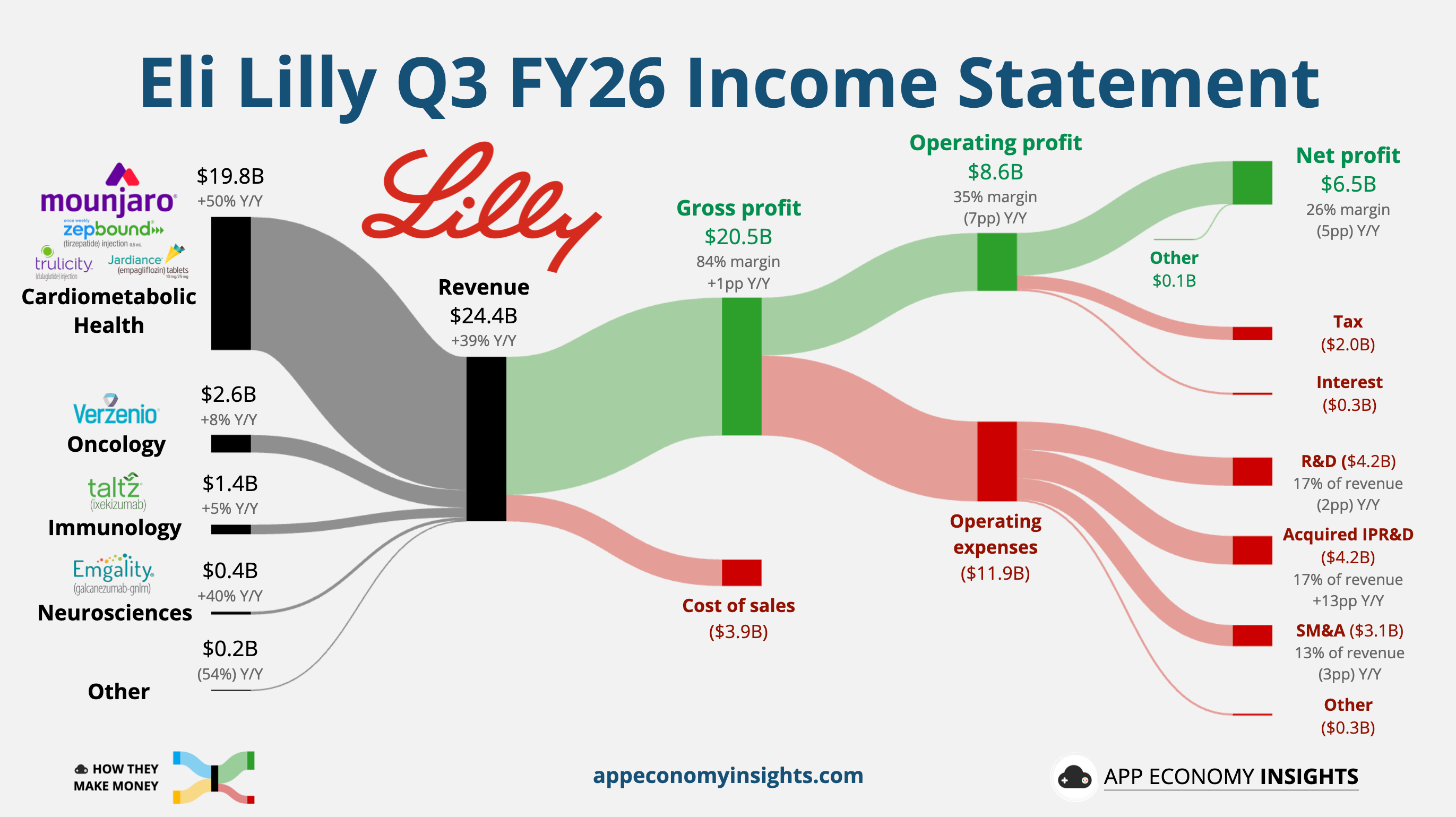
Mounjaro and Zepbound generated a combined $16.1 billion, representing 66% of total revenue:
Mounjaro grew 65% to $10.7 billion, with international sales surging 93% to $5.7 billion despite lower prices, particularly in China.
Zepbound grew 49% to $5.35 billion, benefiting from expanded US insurance coverage. More than 500,000 patients have enrolled in the new Medicare GLP-1 Bridge program, with roughly 70% starting on a Lilly medicine.
Foundayo reached $184 million, up from $98 million in Q2 but below the ~$231 million consensus. Lilly’s oral obesity pill is struggling to match the early adoption of Novo Nordisk’s Wegovy pill.

The quarter also benefited from $900 million in favorable adjustments and milestone payments, including $410 million from Jardiance that will not recur. Meanwhile, retatrutide delivered positive head-to-head Phase 3 results against Ozempic, strengthening Lilly’s next-generation obesity pipeline ahead of a planned Q1 2027 FDA filing.
Lilly raised FY26 revenue guidance to $91–92 billion (from $85–87 billion), while underlying EPS expectations increased by $4.07 at the midpoint. However, $4.57 in acquired R&D charges more than offset that improvement, leaving reported adjusted EPS guidance slightly lower at $35.00–36.00.
Lilly’s GLP-1 franchise continues to grow despite falling prices, with expanding coverage creating a larger addressable market. The challenge is sustaining extraordinary volume growth while building a second generation of treatments that can defend its market leadership.
3. 📱Samsung: Sold Out Through 2027
Samsung’s Q3 revenue surged 127% Y/Y to a record ₩195.3 trillion (~$146 billion), while operating profit climbed nearly ninefold to ₩107.4 trillion (~$80 billion), another record. Operating margin reached an extraordinary 55%, up from 52% in Q2. Yet shares fell more than 4% as earnings missed elevated expectations and investors questioned how much of the AI windfall would reach shareholders.
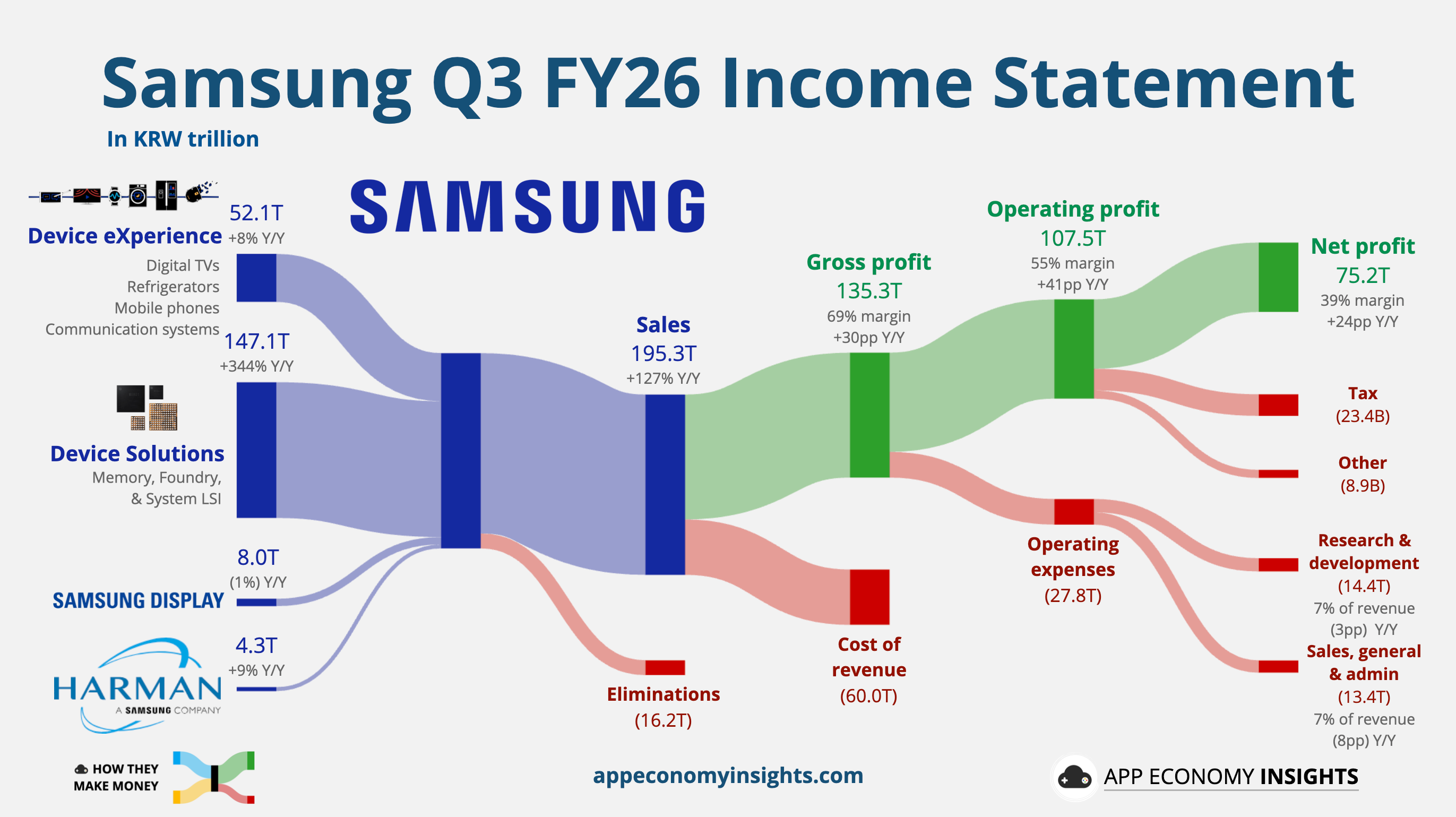
The divergence between Samsung’s businesses is becoming extreme:
Semiconductor revenue rose 15% Q/Q to ₩147.1 trillion, while operating profit climbed to ₩106.5 trillion. The chip division now accounts for 99% of Samsung’s total operating profit.
HBM4 sales more than tripled Q/Q, as Samsung gains ground in next-generation AI memory. Management says 2027 capacity is already fully booked, with supply shortages expected to persist through 2028.
The consumer electronics business lost ₩0.8 trillion as soaring memory prices squeezed profitability in smartphones, TVs, and appliances. The same shortage fueling record semiconductor profits is hurting Samsung’s other businesses.