


Welcome to the Free edition of How They Make Money.
Over 300,000 subscribers turn to us for business and investment insights.
In case you missed it:
AI is leaving the chat box
This week, Anthropic launched a research preview that allows Claude Code and Cowork to take direct control of your computer—pointing, clicking, and typing like a human operator. Through a new feature called Dispatch, users can assign a complex task from their phone and return later to a finished deliverable on their desktop.
It follows the recent hype around OpenClaw, whose founder, Peter Steinberg, just joined OpenAI. Steinberg’s move is a clear signal that OpenAI is preparing its own response. It’s the latest display of the intensifying AI agent race. While Anthropic is doubling down on autonomous work, others can no longer afford to fall behind.
Today at a glance:
🤖 OpenAI: The End of Side Quests
🏭 Terafab: The Silicon Bottleneck
📱 Apple: Maps Turn Into Ad Space

🤖 OpenAI: The End of Side Quests
OpenAI spent the last two years acting like it could build everything at once: the chatbot, the coding assistant, the browser, the shopping layer, the hardware device, and even a video-generation app aimed at creators and studios. That made the company look unstoppable, but also increasingly spread out.
Anthropic has been gaining ground with developers and enterprise users, especially in coding. Meanwhile, OpenAI has been juggling a growing list of products competing for the same talent, attention, and compute. Consumer experiments may generate buzz, but they do little to help if the company is heading toward an IPO and needs to show a clear path to profitability.
In recent weeks, OpenAI made clear that the era of endless experimentation may be fading. Leadership is reportedly pushing the company away from distracting side quests and back toward coding and enterprise productivity.
Here’s what that looks like in practice:
Sora App shuttered: Just six months after its splashy standalone launch, OpenAI is closing the Sora app. Despite hyper-realistic results, the resource-intensive nature of video generation has made it an early casualty of the new lean strategy.
$1 billion Disney deal collapses: The partnership, which intended to bring Disney characters into the Sora ecosystem, was officially terminated this week. It is a stark admission that the Hollywood dream is being deprioritized in favor of more stable revenue streams.
Desktop super app: Rather than maintaining fragmented products like the Atlas browser and Codex coding tool, OpenAI is folding them into a single unified desktop interface. The goal is to stop users from context-switching.
Transaction retreat: OpenAI is stepping back from owning the payment flow inside ChatGPT. Instead of handling purchases directly, it is repositioning as a product discovery and referral layer, offloading the operational complexity of e-commerce to retailers.
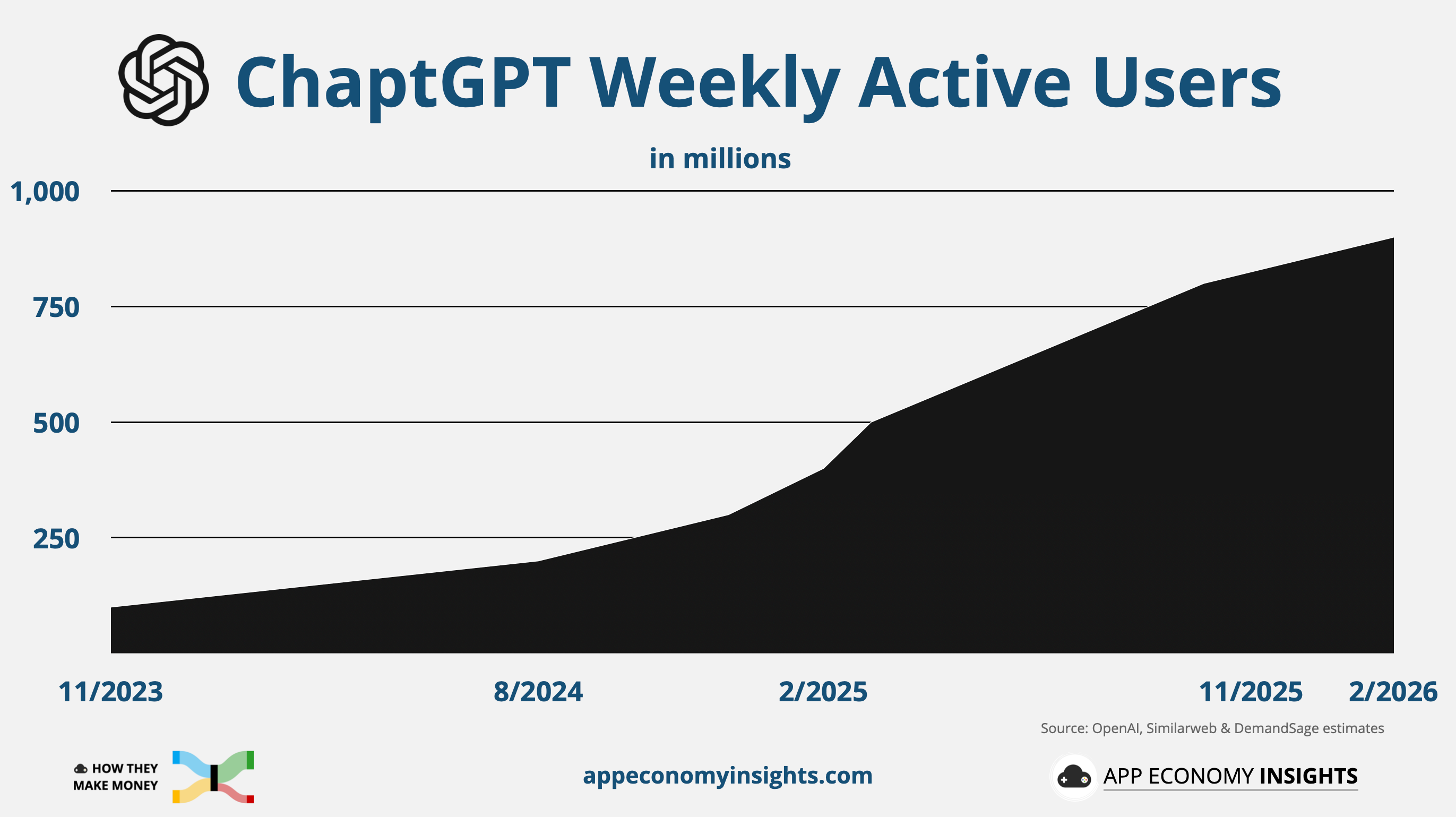
ChatGPT’s success has made OpenAI, as Ben Thompson put it, an accidental consumer tech company. Altman & Co. then tried to build ten startups under one roof. Now OpenAI is being forced to act less like a playground for new ideas and more like a business with a clearer center of gravity.
While apps like Sora were flashy and viral, video generation is expensive, difficult to moderate, and full of copyright landmines. When you are preparing for a possible IPO, these are the kinds of projects that get scrutinized fast. Viral clips of dogs driving cars don’t carry the same weight as high-margin enterprise seats.
That pressure is showing up most clearly in enterprise. Anthropic’s momentum with Claude Code and its $2.5 billion revenue run-rate has made the battle for workplace adoption much more urgent. OpenAI seems to have decided that the biggest prize is becoming the default software layer for work, and that changes how it thinks about resources. Every GPU spent on a side quest is one not being used to win the high-stakes battle for the developer’s desktop.
Instead of chasing every adjacent opportunity, the company now seems to be asking a simpler question: Does this help us win coding and enterprise? If the answer is no, it becomes much easier to cut, even if the project is flashy and has big-name partners attached.
For years, frontier AI companies were rewarded for launching whatever felt like a big idea. This next phase is less about proving how many cool things you can launch and more about proving you know which ones are actually worth building. OpenAI is starting to act less like an AI theme park and more like a company picking its battles. Sam Altman has already proven he is exceptional at fundraising and dealmaking. Now comes the hard part. OpenAI has to prove it can be exceptional at generating cash.
🏭 Terafab: The Silicon Bottleneck
Elon Musk’s newest big idea is not a rocket or a robotaxi. It’s a chip factory. This week, Musk unveiled Terafab, a chip-manufacturing joint venture between Tesla, SpaceX, and xAI that early reports peg at ~$25 billion.
The project aims to supply the specialized compute needed for self-driving cars, humanoid robots, and a newly revealed “Orbital Data Center” system. Musk’s vision is split into two distinct lines: the AI5/AI6 series for terrestrial robotics and the D3 series, which are high-power chips hardened for the hostile environment of space.
Terafab matters because it exposes a growing reality at the center of the AI boom. The Big Three foundries (TSMC, Samsung, and Intel) cannot expand quickly enough to meet Musk’s exponential projections. As Musk bluntly put it:
“We either build the Terafab or we don’t have the chips.”
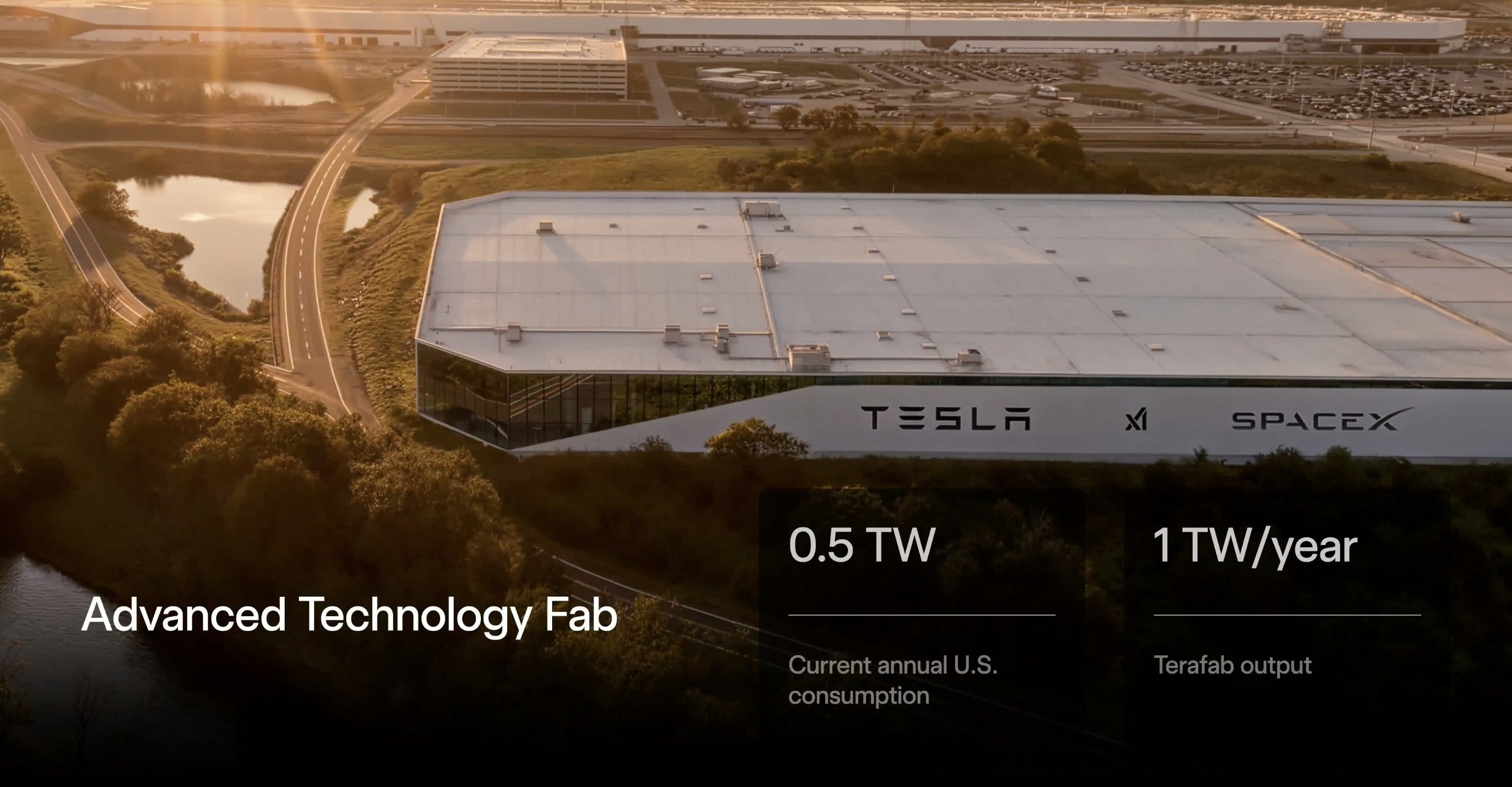
The scale is almost incomprehensible. Musk suggested Terafab will eventually span 100 million square feet—roughly 10x the size of Giga Texas—requiring over 10 gigawatts of power. Musk says bringing fabrication, memory, and packaging under one roof in Austin could create a ‘recursive design loop,’ allowing chips to be designed, printed, and tested in days rather than months. If successful, it would give Musk’s companies far more control over the chip-development cycle.
Here is what stands out from a business perspective:
The ambition is enormous: Terafab targets 1 Terawatt of annual compute. For context, analysts have argued that ambition is on the order of current relevant global semiconductor capacity.
Pivot to space-first compute: In a surprising twist, Musk says roughly 80% of Terafab’s output would eventually be dedicated to space-based AI satellites. He argues that solar irradiance is 5x stronger in orbit, potentially making space-based inference cheaper than terrestrial data centers within three years.
The xAI link-up: Terafab shows how closely xAI is becoming tied to Musk’s broader industrial ecosystem. That may strengthen the strategic logic, but it also raises fresh questions about how the spending is divided across Tesla, SpaceX, and xAI.
The cost question is unavoidable. Building a 2nm-capable fab from scratch is one of the most capital-intensive bets in industrial history. Even before reaching full scale, Terafab will pressure capital budgets that are already stretched thin.
Tesla is the most vulnerable link here. Its decline in vehicle sales and margin compression leave little room for error. While it generated $6.2 billion in Free Cash Flow in 2025, Goldman Sachs estimates that figure could turn negative in 2026.

SpaceX is currently the bank for this vision, with a potential $750 billion IPO on the horizon to fund these orbital ambitions. Skepticism remains high because chip manufacturing has moved toward specialization for a reason. NVIDIA designs, TSMC manufactures, and ASML provides the tools. By trying to pull the entire stack under one roof, Musk is betting that vertical integration can overcome decades of specialized industry expertise.
Still, Musk may be right about the broader bottleneck. If Tesla wants 10 billion Optimus robots by 2040 and SpaceX wants a million AI satellites, then chip supply stops being a procurement issue and starts becoming a fundamental constraint on the entire vision. Musk has made vertical integration look visionary before, but Terafab is a reminder that the ultimate bottleneck is the balance sheet.
📱 Apple: Maps Turn Into Ad Space
Apple just found a new place to sell ads.
This week, the company announced Apple Business, a free all-in-one platform that bundles device management, corporate mail, and brand tools. The company removed the monthly subscription fees previously required for these management tools.
In other words, Apple is lowering the barrier for millions of small businesses to formalize their digital presence. This free offering functions as a customer acquisition tool for Apple's newest high-margin revenue stream: Ads are coming to Maps.
Starting this summer in the US and Canada, businesses will be able to buy priority placement at the top of Maps search results and inside a new Suggested Places feed. It is a direct page from the Google Maps playbook, launched nearly 13 years later.
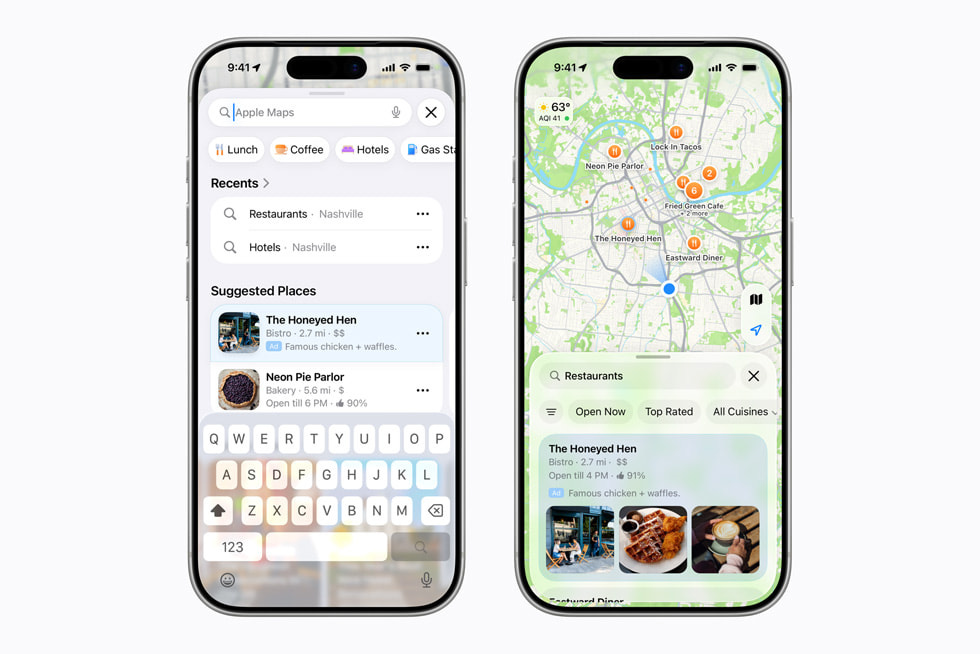
The shift toward advertising is a necessity for Apple’s valuation.
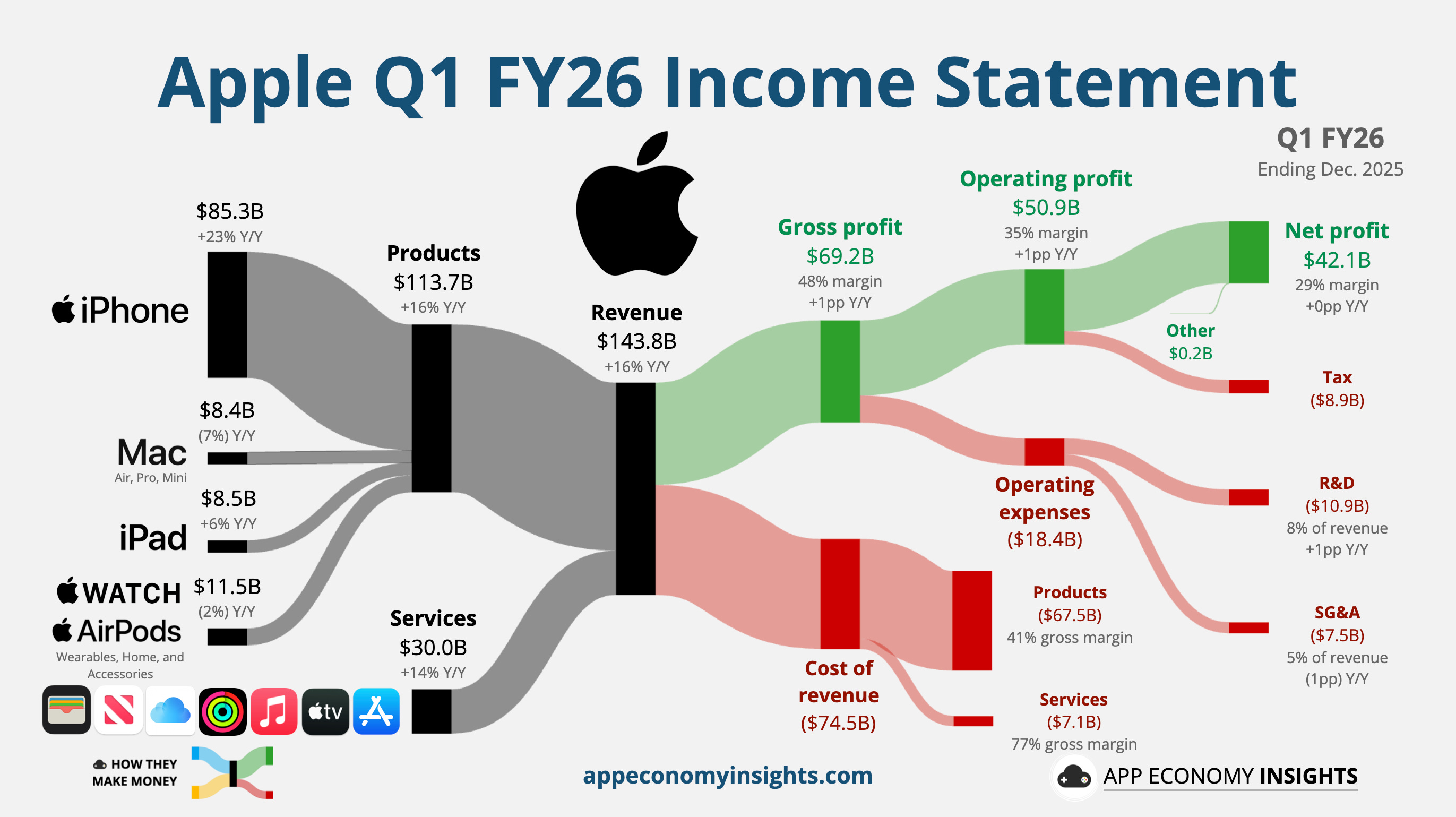
Apple still makes the bulk of its revenue from Products. But Services generated $86 billion in gross profit over the last 12 months (LTM). That’s good for 42% of Apple’s overall gross profit. The gap between Products and Services is narrowing rapidly. The two lines below will eventually cross. It’s a matter of when, not if.

Apple’s Services division now operates at a 77% gross margin—nearly double the margin of the Products segment. Every dollar of local ad revenue Apple generates from a coffee shop or retailer is almost pure profit, helping insulate the bottom line as hardware upgrade cycles lengthen.
This ad push also serves as a hedge against regulatory headwinds.
For years, a massive chunk of Apple’s Services profit came from a single source: the multi-billion dollar check Google pays to be the default search engine on Safari. Analysts now estimate this payment has ballooned to $28 billion annually.
The latest antitrust rulings in late 2025 and early 2026 did not ban these payments, but they did deliver a structural wake-up call. The courts stripped away Google’s ability to demand exclusivity, meaning Apple is now legally free to promote rivals alongside Google. More importantly, the ruling forces these contracts to be renegotiated every 12 months.
For Apple, the DOJ's message was clear: you can keep the money for now, but you can no longer outsource your search destiny to a single partner. By building its own search ad ecosystem inside Maps, Apple is essentially insourcing its revenue. They are moving from renting their search traffic to Google to owning the search intent themselves.
Apple is selling local intent. Unlike an App Store search, a Maps search happens at the very end of the purchase funnel. By turning Maps into a high-margin ad platform, Apple is showing that some of its most valuable economics come not from the glass and aluminum in your pocket, but from the data on where you’re going next.
That's it for today.
Happy investing!
Want to sponsor this newsletter? Get in touch here.
Thanks to Fiscal.ai for being our official data partner. Create your own charts and pull key metrics from 50,000+ companies directly on Fiscal.ai. Save 15% with this link.
Disclosure: I own AAPL, GOOG, META, NVDA, and TSLA in App Economy Portfolio. I share my ratings (BUY, SELL, or HOLD) with App Economy Portfolio members.
Author's Note (Bertrand here 👋🏼): The views and opinions expressed in this newsletter are solely my own and should not be considered financial advice or any other organization's views.