


Welcome to the Free edition of How They Make Money.
Over 300,000 subscribers turn to us for business and investment insights.
In case you missed it:
NVIDIA keeps outrunning the law of large numbers
The company just crossed $96 billion in quarterly revenue, with growth accelerating above 100%. Management now expects revenue to grow another 70% next year, adding more than $200 billion in annual revenue. At this scale, that should sound almost implausible. Yet even that outlook is supply-constrained.
But the story is also getting more complicated. NVIDIA is helping finance the infrastructure its customers need, while some of those same customers are developing competing chips of their own.
So the debate now comes down to two questions:
How long can the AI infrastructure boom keep compounding?
How much of it can NVIDIA continue to capture?
Today at a glance:
NVIDIA’s Q2 FY27
Business highlights
Key quotes from the call
What to watch moving forward

1. NVIDIA Q2 FY27
NVIDIA’s fiscal year ends in January, so the July quarter was Q2 FY27.
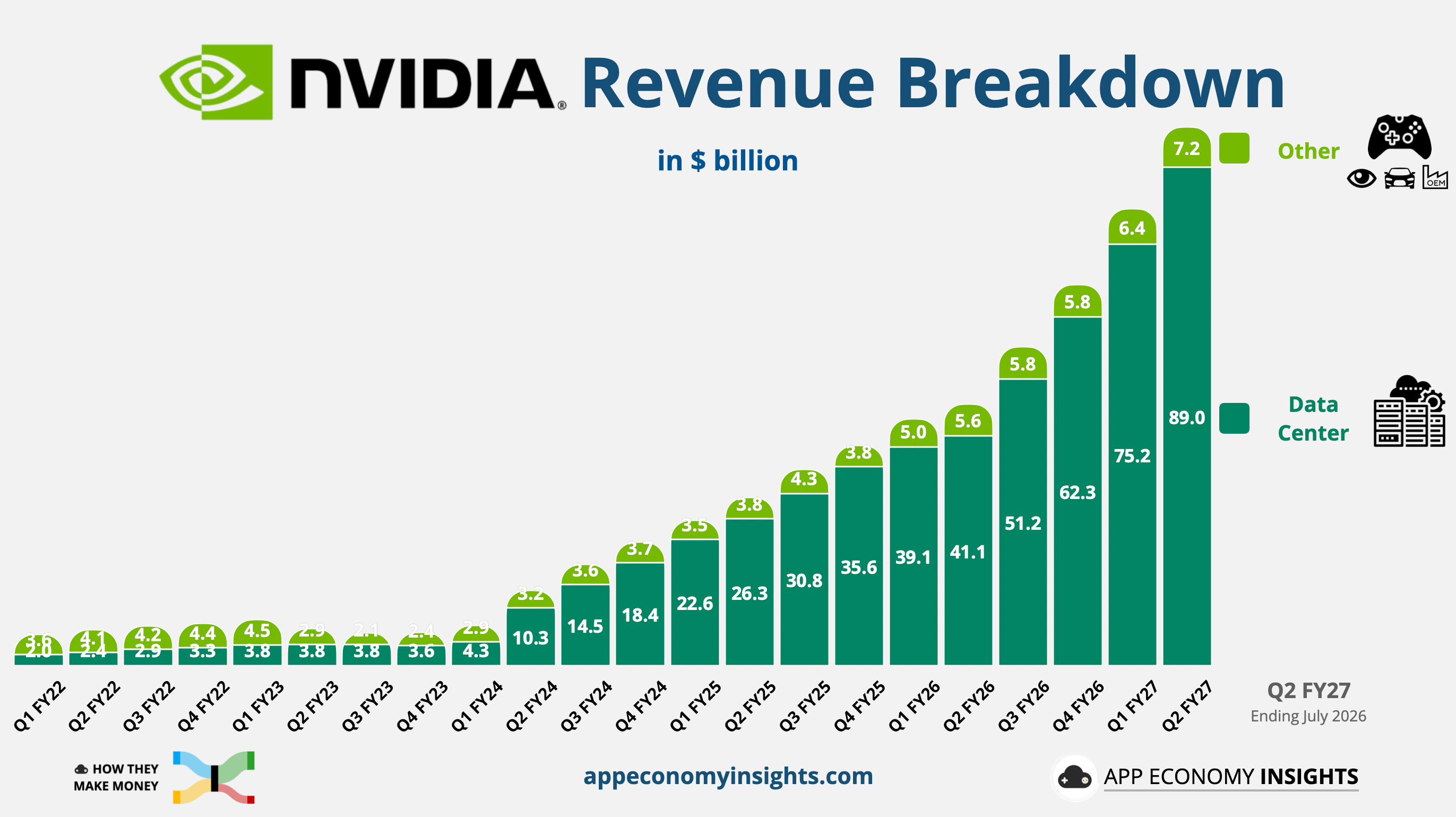
Data Center revenue remains off the charts, as illustrated below.
Income statement:
Revenue accelerated 106% Y/Y to $96.2 billion ($4.1 billion beat).
Data Center +117% Y/Y to $89.0 billion.
Edge Computing +27% Y/Y to $7.2 billion.
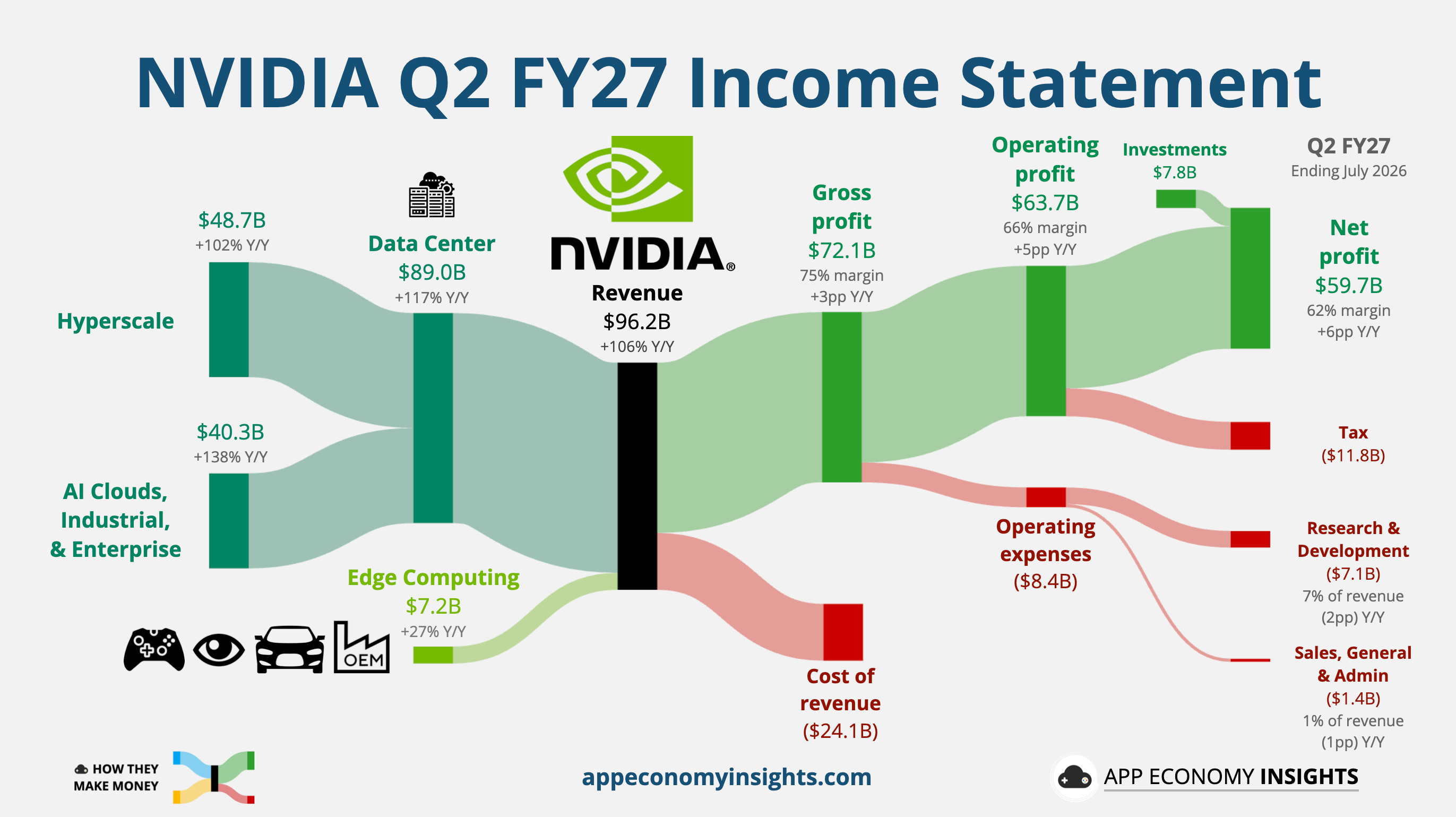
Gross margin was 75% (+3pp Y/Y).
Operating margin was 66% (+5pp Y/Y).
Non-GAAP EPS was $2.22 ($0.13 beat).
Cash flow:
Operating cash flow +57% Y/Y to $24.1 billion.
Free cash flow +59% Y/Y to $21.3 billion.
Balance sheet:
Cash and marketable securities: $99.4 billion.
Debt: $33.4 billion.
Q3 FY27 Guidance:
Revenue +12% Q/Q and +89% Y/Y to $108.0 billion ($3.4 billion beat).
Gross margin 74% (-1pp Q/Q).
Guidance assumes no Data Center compute revenue from China.
So, what to make of all this?
🚀 Growth accelerated again: Revenue growth jumped from 85% in Q1 to 106% in Q2, while Data Center accelerated from 92% to 117%. NVIDIA added nearly $15 billion of revenue sequentially, and Q3 guidance calls for another $12 billion.
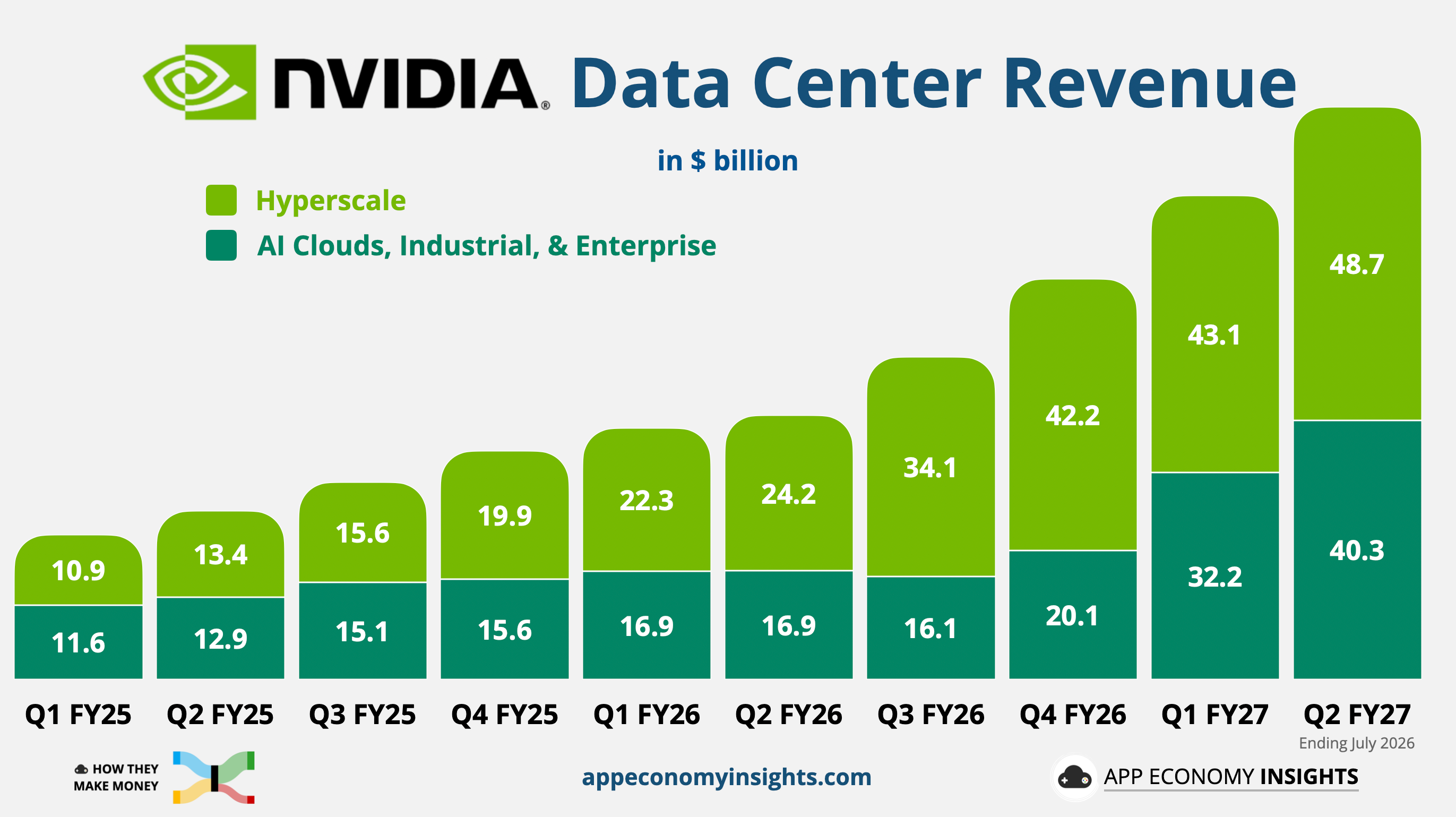
☁️ Demand is broadening: Hyperscale revenue reached $48.7 billion, while AI Clouds, Industrial, and Enterprise grew even faster to $40.3 billion. NVIDIA is increasingly benefiting from neoclouds, enterprises, and sovereign AI alongside Big Tech.
🔄 Rubin is arriving without a digestion pause: Blackwell Ultra is still ramping, yet Rubin shipments have already started. So far, each new architecture is layering onto the previous one rather than creating an air pocket.
📉 Margins are finally bending: Gross margin is expected to fall from 75% in Q2 to 74% in Q3 and roughly 71%-72% in Q4, largely because of higher memory costs. The pressure appears supply-driven rather than a sign of weaker demand or pricing.
🧱 NVIDIA is locking up supply: Supply and capacity commitments jumped from $119 billion to $279 billion in three months, largely to secure memory. That's a huge vote of confidence in future demand—and a much larger commitment if the cycle eventually slows.
🔮 The outlook remains extraordinary: NVIDIA expects roughly 70% revenue growth in FY28, far above prior Wall Street expectations. If that holds, the AI infrastructure cycle is still expanding rapidly despite NVIDIA already operating at enormous scale.
Big picture: Growth accelerated, demand broadened, and Rubin is arriving before Blackwell has slowed. The main new wrinkle is that sustaining this pace is becoming more expensive, with memory costs pressuring margins and supply commitments rising rapidly.
2. Business highlights
⚡ Rubin raises the value of a gigawatt
NVIDIA is capturing more revenue from every AI factory generation.
Management estimates its revenue opportunity per gigawatt keeps increasing:
~$18 billion per gigawatt with Hopper.
~$25 billion per gigawatt with Blackwell.
And now ~$40 billion per gigawatt with Vera Rubin.
Rubin combines GPUs, CPUs, networking, and software to deliver 30x higher throughput per megawatt and 35x lower token costs than Grace Blackwell Ultra.
Production shipments have already started, with purchase orders from every major hyperscaler, AI cloud, and system OEM.
🏦 NVIDIA becomes an AI financier
NVIDIA has invested nearly $50 billion in frontier AI labs and partnered with major financial institutions to help raise more than $500 billion of third-party capital for AI infrastructure.
It is also using credit support and take-or-pay commitments to help AI labs and neoclouds finance capacity. Critics call this circular financing. NVIDIA argues it is simply removing a capital bottleneck for customers whose demand is growing faster than their balance sheets.
Either way, NVIDIA is moving beyond selling infrastructure to helping make that infrastructure possible. There may also be a strategic benefit: financing infrastructure today can help lock in NVIDIA deployments before competing silicon reaches scale.
🤗 NVIDIA agrees to buy Hugging Face
According to The Information, NVIDIA has agreed to acquire Hugging Face for $12.9 billion, nearly triple its 2023 valuation.
Hugging Face is one of the main hubs for developers to discover, share, and deploy open AI models, often dubbed the “GitHub of AI.” With only about $150 million in annual revenue, NVIDIA is clearly buying strategic positioning rather than near-term profits.
The logic ties directly to Jensen’s argument on the call: NVIDIA benefits whenever AI models proliferate. Open models are particularly attractive because startups and enterprises generally don’t build custom chips and overwhelmingly rely on existing compute infrastructure.
Owning Hugging Face would move NVIDIA one layer closer to developers and tighten the link between open-model adoption and its broader computing platform. The risk is that NVIDIA ownership could weaken the neutrality that helped make Hugging Face so valuable in the first place.
3. Key quotes from the earnings call
Check out the earnings call transcript on Fiscal.ai here.
CEO Jensen Huang:
On custom chips:
“Whereas many of these XPUs are inference-specific chips for one cloud or one service, NVIDIA is a platform, an entire AI factory platform that spans the entire AI life cycle that you can use in any cloud. It’s in every cloud. You can run anywhere. [...] I have 100% confidence that our technology will continue to be extraordinary for them and that the economics of using our technology, whether it’s from data processing to training, to post-training, to agentic processing, our technology’s going to be extraordinary for them.”
This is Jensen’s answer to OpenAI’s Jalapeño and the broader custom-silicon threat. His argument isn’t that customers won’t build their own chips. It’s that those chips tend to optimize specific workloads, while NVIDIA’s advantage is a fungible platform spanning training, inference, networking, CPUs, and multiple clouds. The question is whether that breadth remains valuable enough to justify NVIDIA’s premium economics.
On what happens when AI becomes agentic:
“When the world goes to agentic, fully agentic systems, you are going to have agents running all the time, working with other agents running all the time. [...] I think the most important thing that matters for the industry is that, one, AI is now doing productive and useful work. Two, AI is generating profitable tokens. Three, if we had more compute, we could generate more profitable tokens, which results in more profit for all of the services. This is the exact phase where we are at, which is the reason why everybody is leaning in.”
Today’s AI is still largely triggered by humans. Jensen believes the next phase involves millions of agents operating continuously and interacting with other agents. If that happens, inference demand stops being directly tied to human usage, and the amount of compute required could increase dramatically.
4. What to watch next
NVDA is up roughly 20% YTD, still outperforming the S&P 500.
Even after the post-earnings jump, the stock trades at only about 20x forward earnings, well below the multiple it commanded earlier in the AI boom and below the rest of US Big Tech.

The latest 13F filings for Q2 2026 showed that hedge funds are not accumulating NVDA as much as they used to. The stock remains one of the most widely held names, although many funds are still underexposed relative to its 8% weight in the S&P 500.
At that valuation, the debate is less about whether NVIDIA looks cheap today and more about how durable these extraordinary earnings can be.
In semiconductors, a low P/E can sometimes signal peak earnings rather than a bargain. The multiple may be compressed precisely because the market is questioning whether today’s profitability is sustainable. So far, that skepticism has been repeatedly proven wrong.
Here’s what I’m watching:
Custom silicon: OpenAI just published the first results for Jalapeño, its custom inference chip. The company says it delivered 1.5x-1.9x more throughput per watt and materially lower latency than the NVIDIA systems tested across several models. OpenAI still plans to use NVIDIA broadly, but Jalapeño shows that NVIDIA’s largest customers have a growing incentive to move specialized inference workloads onto their own silicon.
Circular financing: NVIDIA says AI labs receiving some form of balance-sheet support could account for roughly one-quarter of its business next year. Financing customers does not make the underlying demand fake, but it increases NVIDIA’s exposure if AI labs eventually struggle to monetize the infrastructure they are building.
Margins and supply: Memory scarcity is expected to push gross margin down before price increases help it recover next year. The question is whether NVIDIA can continue securing sufficient supply to meet extraordinary demand without sacrificing too much of its economics.
📉 The bear case is that AI infrastructure spending eventually outruns the profits it can generate, while custom silicon takes a growing share of inference.
📈 The bull case is that agentic AI keeps expanding compute demand faster than efficiency gains and competition can reduce it.
So far, NVIDIA is still winning that race.

That’s it for today!
Happy investing!
Want to sponsor this newsletter? Get in touch here.
Thanks to Fiscal.ai for being our official data partner. Create your own charts and pull key metrics from 50,000+ companies directly on Fiscal.ai. Save 15% with this link.
Disclosure: I own AAPL, AMD, AMZN, GOOG, META, MSFT, and NVDA in App Economy Portfolio. I share my ratings (BUY, SELL, or HOLD) with App Economy Portfolio members.
Author's Note (Bertrand here 👋🏼): The views and opinions expressed in this newsletter are solely my own and should not be considered financial advice or any other organization's views.
The jump in supply commitments is where the bull and bear cases almost meet. If demand keeps compounding, locking scarce memory and capacity early is brilliant. If monetization lags the buildout, those commitments become a very different kind of operating leverage. At this scale I think the risk has shifted from “is AI demand real?” toward “how much future demand is already being financed and pulled into the present?”
The tape's reaction is the story to me. $NVDA grew 106% and gave back the entire post-earnings move in a day, and $MRVL beat with above-consensus guidance and fell 10.3%. When the two best reports in the group get sold, expectations are the constraint, and expectations reset on time, not on numbers. Watching 227 on NVDA as the line where that changes.