


Welcome to the Free edition of How They Make Money.
Over 300,000 subscribers turn to us for business and investment insights.
In case you missed it:
Alibaba’s AI bet is starting to show up in the numbers
Revenue rose 9% Y/Y to $39.6 billion, while Cloud accelerated to 45% growth, its fastest pace in more than five years. AI-related product revenue grew triple digits for the 12th consecutive quarter, and Cloud adjusted EBITA more than doubled as margins expanded.
The trade-off remains expensive (a familiar theme across Big Tech this earnings season). Alibaba spent almost $10 billion on CapEx during the quarter, up 75% Y/Y, while free cash flow was a $6.6 billion outflow. Adjusted EBITA also fell by 30% as the company continued to invest in AI infrastructure, models, and applications.
This quarter offered the clearest glimpse of the potential return on these AI investments, and management put a three-year payback timeline on its compute buildout.
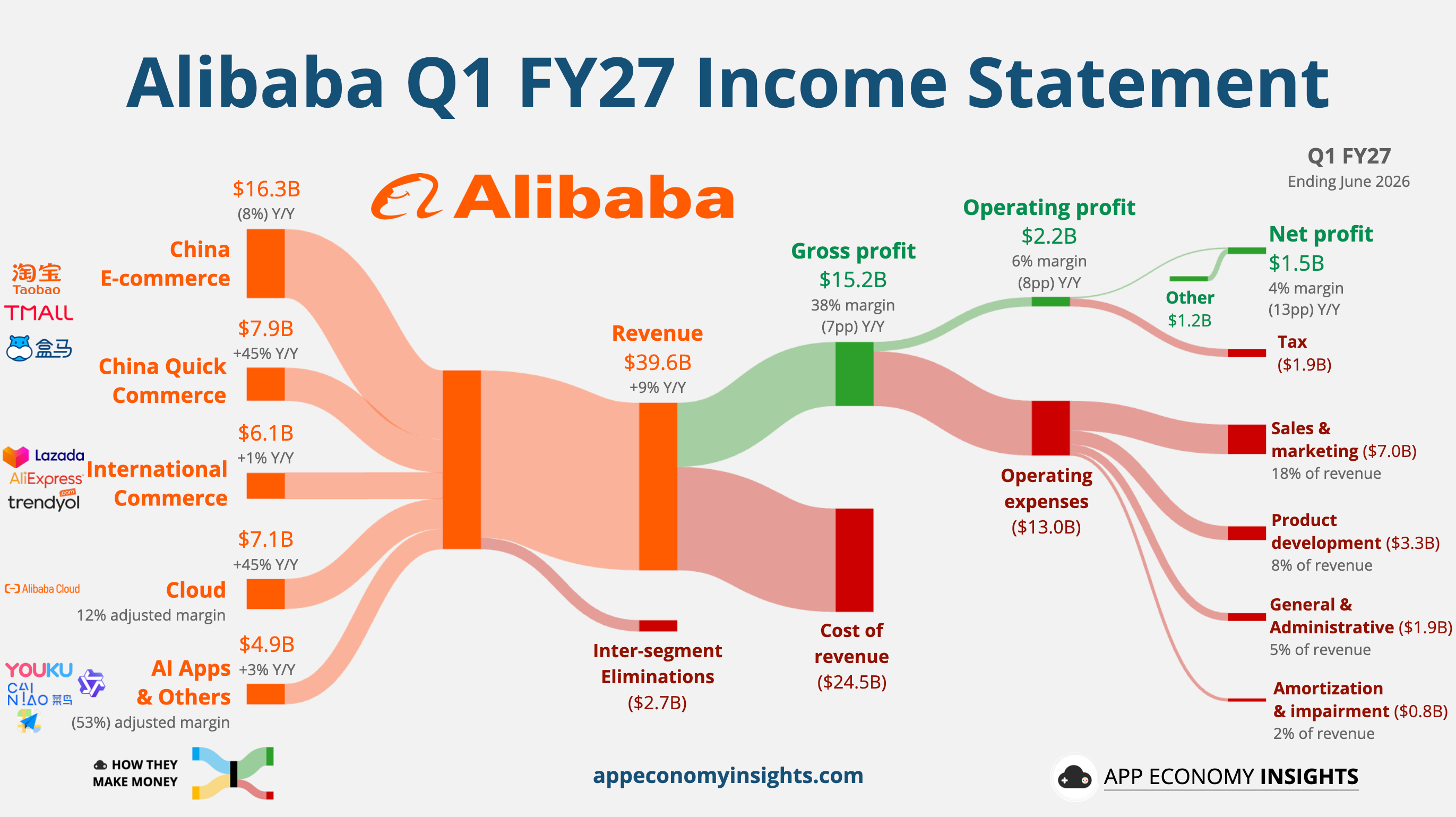
Revenue breakdown:
🛒 China E-commerce: $16.3 billion, down 8%.
🛵 Quick Commerce: $7.9 billion, up 45%.
🌍 International Commerce: $6.1 billion, up 1%.
☁️ AI Cloud & Compute: $7.1 billion, up 45%.
🤖 AI Apps & Others: $4.9 billion, up 3%.
Alibaba overhauled its reporting segments this quarter. Quick Commerce now stands apart from legacy China e-commerce, while Alibaba Cloud absorbed the T-Head chip division.
The 8% Y/Y decline in China E-commerce reflected weaker marketplace activity and Alibaba’s continued pullback from some direct-sales businesses.
Overall revenue rose 9% Y/Y, but it came with another step down in profitability. Operating margin fell to 6% from 14% a year ago, while adjusted EBITA declined 30% to $4.0 billion as Alibaba kept investing across AI and commerce.

Alibaba is getting faster growth from the businesses it is funding most aggressively, but the cost of building them remains visible across margins and cash flow. The company is maintaining its 380 billion yuan (~$56 billion) three-year AI investment plan.
☁️ The AI payback
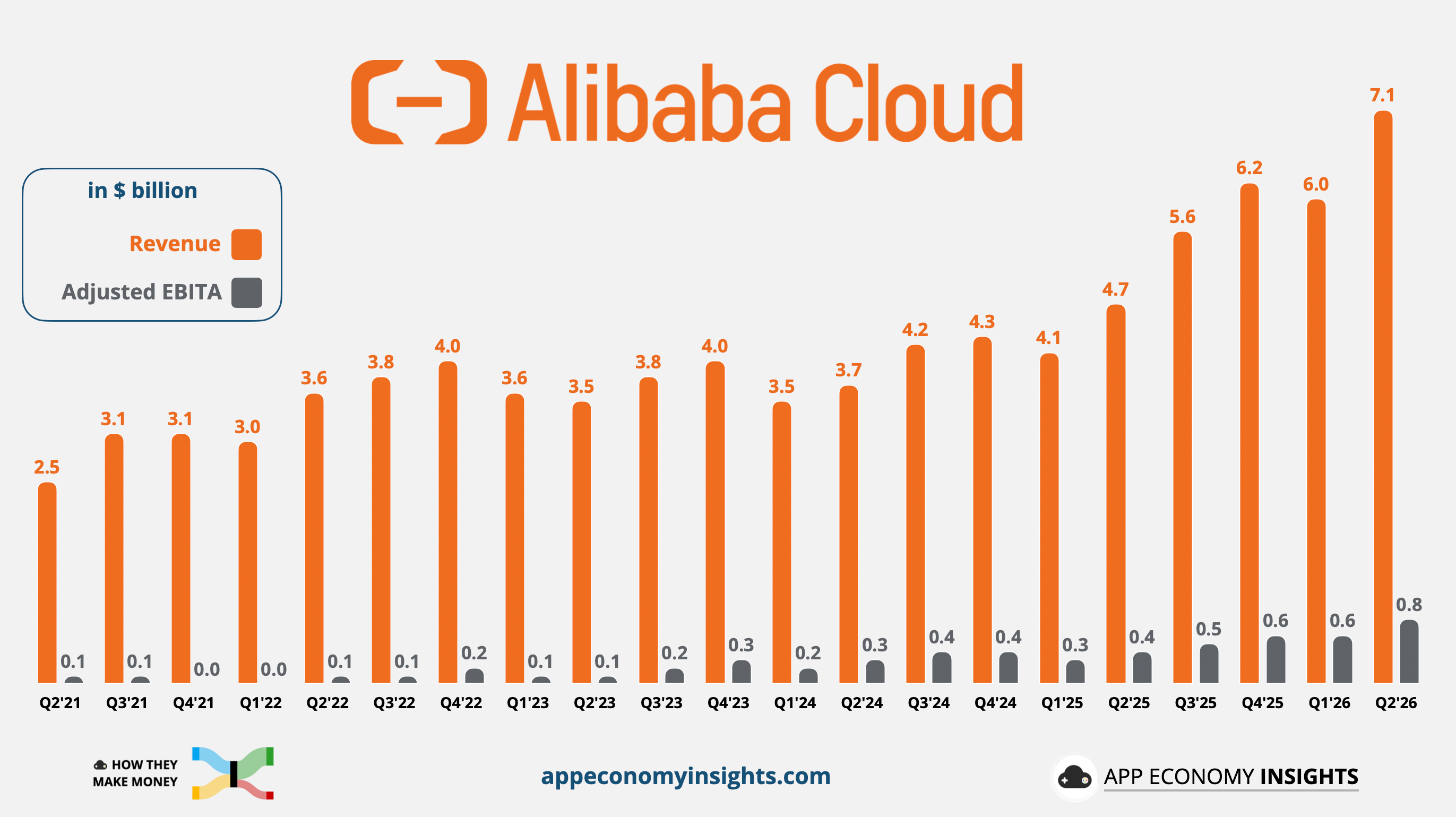
Alibaba Cloud delivered its strongest growth in more than five years, with revenue rising 45% Y/Y to $7.1 billion. AI-related products now account for roughly 35% of external Cloud revenue, up from 30% last quarter.
The acceleration is finally driving operating leverage. Cloud adjusted EBITA jumped 133% Y/Y to $830 million, expanding segment margins to roughly 12%, a notable milestone given how aggressively capacity is scaling.
Management says demand for AI compute still exceeds supply, which explains much of the current spending cycle. This quarter’s $10 billion in CapEx was primarily allocated to adding cloud infrastructure. AI-related revenue was already running at roughly $7.3 billion annually in the June quarter, with management expecting it to approach a $10 billion run rate this quarter.
The key question is how quickly those infrastructure investments can recoup their costs. Alibaba estimates that AI compute assets can currently reach breakeven in roughly three years, comfortably within their expected useful life. Management believes the payback period could eventually fall toward 2.5 years as utilization rises, Cloud margins improve, and more workloads shift toward Alibaba’s own chips.
That framework helps explain why Alibaba is comfortable sacrificing free cash flow today. If Cloud can sustain 40%+ growth while gradually improving margins, the current CapEx ramp can support a much larger recurring revenue base rather than becoming a permanent drag on returns.
🧠 Alibaba wants to own the stack
Alibaba’s advantage is that it does not have to monetize AI through one product.
It owns increasingly large pieces of the stack:
Silicon: T-Head (in-house Zhenwu chips).
Compute: Alibaba Cloud.
Foundation models: Qwen (open-weight ecosystem).
Applications: QwenWork, enterprise agents, and consumer assistants.
Owning more of that stack should help the economics over time. T-Head’s Zhenwu chips already serve more than 650 external customers across 20+ industries via Alibaba Cloud. As more workloads move onto Alibaba-designed silicon, the company can reduce its reliance on expensive third-party accelerators and potentially capture more of the margin generated by AI demand.
Qwen provides another distribution advantage. The model family has surpassed 3 billion downloads, with more than 300,000 derivative models built on top of it. Alibaba can make the models broadly available while monetizing the resulting usage through inference, storage, and other Cloud services. Its Model-as-a-Service business has already surpassed 16 billion yuan (~$2.4 billion) in ARR.
The play is much bigger than selling chatbot subscriptions. Alibaba distributes Qwen to capture developers, converts that open-source adoption into sticky Cloud compute, and deploys custom silicon to protect gross margins. That creates a flywheel across the stack.
🤖 But AI apps are expensive
Alibaba now breaks out AI Labs & Applications (part of AI Apps and Other in our visual above), giving investors a cleaner view of what model training and front-end apps cost while Cloud scales.
The segment includes Alibaba’s model labs, the consumer Qwen business, and products such as QwenWork.
AI Labs and Applications Revenue reached $0.5 billion, up 16% Y/Y.
Adjusted EBITA loss widened to roughly $2.0 billion, more than four times the year-ago level.
The losses reflect heavy spending on model training, product development, and user acquisition. Alibaba is still competing aggressively for consumer and enterprise adoption, even as much of the underlying technology remains free or inexpensive to access.
Management expects losses to narrow as training becomes more efficient and commercialization expands. For now, though, the economics are very different across the stack. Cloud is already showing operating leverage, while AI applications remain firmly in investment mode.
🛵 Quick Commerce becomes the second curve
Quick Commerce revenue surged 45% Y/Y to $7.9 billion, making it larger than Cloud this quarter. The business now includes Taobao Instant Commerce, Freshippo, and Tmall Supermarket’s on-demand operations.
On-demand delivery gives Alibaba a powerful frequency engine. Food delivery drives more frequent usage, while 30-minute delivery for groceries and everyday essentials expands order volume well beyond traditional multi-day marketplace shopping.
The economics are also improving:
Taobao Instant Commerce improved unit economics Q/Q while maintaining market share.
Higher average order values and a better mix of non-food orders helped margins.
Alibaba expects non-food volume to surpass food within the next fiscal year.
Quick Commerce is targeting overall profitability by FY29.
Management believes Quick Commerce could eventually represent around 30% of platform GMV. If that happens, the current spending would have done more than defend Alibaba against Meituan and JD.com. It would have added a much higher-frequency layer to an e-commerce business whose traditional China revenue is already mature.
Bottom Line
Alibaba’s AI spending is still crushing free cash flow, but this quarter offered tangible evidence that the investment is creating economic value. Management’s roughly three-year payback estimate on AI compute assets is the most revealing metric.
AI Labs remains deeply loss-making, and Quick Commerce still requires substantial investment. Still, if Cloud sustains 40%+ growth with expanding margins, today’s massive CapEx could look like smart capital allocation. It is broadly the same playbook we are seeing from the US hyperscalers.

Next up: Saturday’s PRO edition, with Walmart, Target, Klarna, and more.
That’s it for today!
Stay healthy and invest on!
Want to sponsor this newsletter? Get in touch here.
Disclosure: I own AMZN, BABA, GOOG, META, MSFT, and SHOP in App Economy Portfolio. I share my ratings (BUY, SELL, or HOLD) with App Economy Portfolio members.
Author's Note (Bertrand here 👋🏼): The views and opinions expressed in this newsletter are solely my own and should not be considered financial advice or any other organization's views.
The three-year compute payback estimate is the number I’d keep tracking. It converts “huge AI capex” into an ROIC question. If utilization rises and more workloads move onto Alibaba’s own silicon, the economics can improve quickly. But if inference pricing compresses faster than infrastructure costs, owning more of the stack concentrates the downside as well as the upside.
Really enjoyed this read!!!